In foreign countries, there are lots of ways to fail at finding and eating the food you have so carefully researched ahead of time.
Vietnam specializes in the unauthorized duplication of famous stalls, presenting you with the quandary, for example, of three seemingly identical banh xeo stands facing each other across an alley. Korea likes to write its menus in a loopy, highly stylized script on wooden planks deep inside the dining room, where it would be exceedingly awkward to stand for minutes with face buried in Google Translate. China likes to run out of whatever the restaurant specializes in right as you arrive, even if you arrive at 6am. Malaysia goes a simpler route and just makes it impossible to walk anywhere.
Hokkaido, however, has taken all my memories of frustrated, fruitless city-wandering and shoves them aside. All restaurants are where they say they are, and if they don’t have lacquered replicas of their dishes in display cases outside, they have colorful posters, and if they don’t have colorful posters, they have a waiter willing to parse my halting hiragana-reading.
Unagi Kamogawa is wallpapered around the outer door with shiny but simple images of eel. Eel in round bowls and eel in square bowls – that’s it. I step into a den thick with eelsmoke, take off my shoes, and practically trip down into the space beneath the squatting table. A customer with one protruding bottom tooth and slow but confident English tells me he only eats eel once a month because it’s so expensive. It is – my round bowl is ¥2200 – but the two thick fillets are more smoky and tender than sweet and cloying, have only tiny flexible little bones that yield easily to my swallowing, and come with pickled vegetables and a clear soup featuring a mystery spring-onion-looking thing that tastes a little like a fish cake.
Sapporo’s Nijo market solves my ever-present problem at seafood markets: seeing all this delicious seafood but being unable to do anything with a giant horsehair crab or tank of abalone in my hostel/Airbnb. Next to the tanks of waving tentacles and claws and bubbling shells, there are restaurants, and the restaurants will put any combination of the market’s wares in a rice bowl for you. Again, it’s pricey, but ¥3800 gets me a sea urchin/salmon/salmon roe kaisen-don accompanied by a bowl of miso soup with, no exaggeration, half a crab tilted out of the side as if to mount a too-late escape attempt. The urchin is so soft and indistinct that it looks like scrambled eggs, usually bad news for a creature that gets runnier the longer it’s out of its shell, but it’s so mild and sweet that perhaps even avowed uni-haters would reconsider. It stains the rice under it sun-yellow, a welcome leftover after disappearing so quickly.
Oddly, the urchin here is better than in Otaru, the port where they actually capture them. Otaru’s kaisen-donlets me sample two different species of urchin, the northern variety and the short-spined variety, and while both are firm-edged, their flavor is tinged with iodine, and one’s color is somewhat greenish. Both would be laudable in a US sushi bar, but compared to Sapporo’s scrambled-eggy urchin, they pale. The winner in the Otaru bowl is the giant mound of crab meat next to it, taking up fully half the bowl and remaining sweet and stringily flavorful to the last mouthful. I always feel weirdly decadent eating chopstickfuls of crab meat, knowing the work it takes to extract just one strand from a shell, and as if to underline my uneasiness, they place a crab claw across the bowl with half the shell cleanly removed to reveal a perfect, untouched, still-claw-shaped wall of meat, ripe for the taking.
But one can’t always spend $30 on unagi or kaisen-don, and this is where Japan’s unsung heroes step in: train station restaurants. They always have English-speaking workers, and JR Sapporo Station is so much more than a train station, so it may be unfair to call its food train station food, but still: it’s a mall – actually three malls – two subway stations, and an underground tunnel to ensure continued commerce even during Hokkaido’s long winters. And it provides me with:
– legitimately excellent soba (studded with melt-in-your-mouth shrimp tempura and a tidy pile of tamago)
– airily-breaded tonkatsu surrounded by stuffed eggplant and shrimp, accompanied by mustard greens and silky chawanmushi
– a bowl filled with big chunks of soft tuna, bright green avocado, and that slimy white mass known as mountain yam that I usually hate, but that somehow ends up blended with rice to make a sticky-rice-like concoction, accompanied by gorgeously silky black sesame ice cream splashed with matcha ice.
Asahikawa Station, for its part, though only attached to a mere one mall, has a version of takoyaki that is perfectly cooked, incorporates greens into its batter and comes with a sour, zingy yuzu sauce. I pair it with a sugar-dusted green tea custard-filled taiyaki from a few stalls down.
While Japan may be lacking in the thrill of the chase, and therefore in providing me with the satisfaction that comes after having successfully chased a food item down, it’s kind of nice sometimes to just be able to decide what I want to eat, set off on an organized, efficient public transit system, and eat it!
Showing posts with label soba. Show all posts
Showing posts with label soba. Show all posts
Saturday, August 5, 2017

Wednesday, July 17, 2013
The soba before the storm
About four days ago, I lost my sense of taste completely.*
I was in a kushikatsu bar in Osaka. I had just ordered a bunch of skewers: lotus root, tuna cheek, eggplant, quail egg. We'd made it through Shinsekai unmolested, found a bustling place without a ridiculous line, been irasshaimase-ed enthusiastically, and provided with a rough English menu. I was virtually wriggling with excitement as I watched the cook casually flip my food in the big fryer with a few long metal chopsticks.

When it got to my mouth, it tasted like fried paper.
All of it.
Hot, oily, crispy fried paper. Even when I added a coating of shichimi togarashi (Japanese seven-spice) that normally would have turned me red and set me a-coughing. Still hot, oily, crispy, now slightly gritty fried paper.
I tried some accompanying cabbage: wet paper. Drank water: cold, icy paper. With mounting desperation and dread, I unwrapped a red bean mochi ball I'd gotten earlier that day and shoved it in my mouth: lumpy, gummy paper.
Then I went home and cried.
I can say no more on this topic without becoming so despondent that I cease writing this entry.
But the day before all of that, there was this one bowl of hot soba.
When we asked the man who ran our Nara guesthouse for noodle recommendation, he prefaced his recommendations by saying he was from the 'udon prefecture' of Kagawa. The way he said this was matter-of-fact. It wasn't uppity or snobby. He didn't say it like I would have if someone asked me, a native Chicagoan, for hot dog recommendations in Los Angeles: with a toss off the head, a flip of the hand, and utter derision for Los Angeles' inferior attempts at meat in intestine casing.
No, he just mentioned it, letting his credentials hang in the air, then moved on. Looking carefully at our map, he pulled out a pen and started circling corners, appending them with his shaky English handwriting.
We went to the rough location of his first recommendation, but couldn't be sure whether we'd found it, since all signage was in Japanese. We stood outside the door and did that thing we've learned to do: Eugene haltingly sounds out the hiragana, and if it's a food word, I'll recognize it.
"Za-ru-so-ba," Eugene said, and I nodded. "Yeah, yeah, zaru soba, OK..."
"Sa-n-u-ki-u-don," he continued, and I nodded more vigorously. "I think we found..."
"Ka-ki-a-ge-no..."
"All right!"
We entered.
A ponytailed man with a completely open kitchen greeted us warmly and gestured for us to sit at the bar. From where we were seated, we could see his whole setup.

I ordered kakiage soba; Eugene ordered tanuki soba. I thought I was so smart because I knew kaki meant 'oyster' and age meant 'tofu' so I figured I was probably going to end up with some crazy oyster-tofu concoction.
No. That's not how Japanese works. Kakiage turned out to actually be a big hockey puck full of tempura-ed vegetables and shrimp.
Made of, and surrounded by, amazingness.

The udon-making man was not content to simply let his (beautiful, savory, steaming hot) bowls speak for themselves. He radiated food-enthusiasm. His total lack of English and our near-total lack of Japanese did not stop him.
He pointed to Eugene's tanuki udon and started talking. As he talked, he made his fingers into rings and covered his eyes. Then he made frantic digging motions with his hands. "Tanuki," he said, staring intently into each of our faces in turn. "OK?"
We nodded.
Then, he pointed his finger vaguely in the air, and, chatting, he put his palms behind his ears and turned them this way and that. "Kitsune," he said, catching our eyes.
"Tanuki soba. Kitsune udon."
I am so glad that I knew what those two words meant (raccoon, fox), and what they signified (the same style of soup for soba and udon, respectively) before this tirade, or likelihood is I'd have gone away thinking I'd been drinking woodland creature broth.
(Not that this would have stopped me.)
His soup came out too hot even to slurp, the noodles glistening like grass snakes. My tempura cake floated like a buoy on the broth, shining with oil and nearly audibly crackling, straight from the fryer. It tasted like both the ocean and a good solid greasy spoon breakfast. The shells on the shrimp got stuck in my teeth; I rinsed them out with swigs of strong roasted rice tea.
The whole time we were eating, the man talked. He disappeared into a little closet and came out with his hands full of tomatoes. For the first time, he spoke English. "I am farmer," he proclaimed.
Then he ran the tomatoes under cold water and placed them onto two side dish-sized plates, handing them over the bar. "Please," he said.
Shit, I thought.
See, I hate tomatoes.
People always ask me, before trips, what I will do if some foreign host offers me something really gross: a sheep's head, snake blood, fermented mare's milk, etc.
And I ask them, "...how is this a problem? I'd eat it!"
But I never considered that somebody might offer me a tomato.
There are three things I strongly dislike eating.
Celery.
Natto.
And raw tomatoes.
But here the tomatoes were, dribbling water from the faucet, fresh from the farmer's hands, fresh from the farmer's farm. He was smiling at me expectantly.
What could I do? I took a bite.
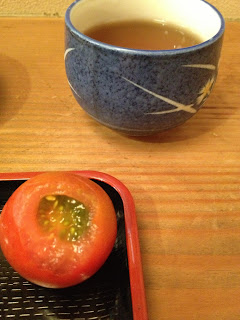
It was the first tomato I've ever wanted to finish.
It had none of the sponge-soaked-in-stale-water texture I've come to expect from tomato slices; none of the skin-pulling-creepily-away-from-the-flesh, zombie-like outside. Its seeds didn't hover in a solution of slime. It didn't taste like fertilizer and poison.
In short, it transcended tomato-hood.
---
I'd like to tell you where you can find this charming noodle shop, magically learn to like fruit you've previously hated, and be regaled with woodland creature tales of your own, but I honestly cannot remember its name. Instead, have a pin-festooned Google Map. That's better than an address in Japan anyway.
---
*It was last in a long line of indignities committed against me by my body, which, suddenly noting that it hadn't really been sick in a good three or four years, decided to get ALL the illnesses, ALL at once. First it hit me with a sore throat, the kind that feels like knives when you're swallowing something offensive, like warm broth. Then, it gave me a raging fever, caused me to pass out a couple times, stuffed up only one side of my face, and ended with the kind of hacking cough that goes on forever but doesn't do any good. Finally, it took my taste. (And my sense of smell. I stuck my nose right in a vat of Tiger Balm to check: nothing.)
I was in a kushikatsu bar in Osaka. I had just ordered a bunch of skewers: lotus root, tuna cheek, eggplant, quail egg. We'd made it through Shinsekai unmolested, found a bustling place without a ridiculous line, been irasshaimase-ed enthusiastically, and provided with a rough English menu. I was virtually wriggling with excitement as I watched the cook casually flip my food in the big fryer with a few long metal chopsticks.

When it got to my mouth, it tasted like fried paper.
All of it.
Hot, oily, crispy fried paper. Even when I added a coating of shichimi togarashi (Japanese seven-spice) that normally would have turned me red and set me a-coughing. Still hot, oily, crispy, now slightly gritty fried paper.
I tried some accompanying cabbage: wet paper. Drank water: cold, icy paper. With mounting desperation and dread, I unwrapped a red bean mochi ball I'd gotten earlier that day and shoved it in my mouth: lumpy, gummy paper.
Then I went home and cried.
I can say no more on this topic without becoming so despondent that I cease writing this entry.
But the day before all of that, there was this one bowl of hot soba.
When we asked the man who ran our Nara guesthouse for noodle recommendation, he prefaced his recommendations by saying he was from the 'udon prefecture' of Kagawa. The way he said this was matter-of-fact. It wasn't uppity or snobby. He didn't say it like I would have if someone asked me, a native Chicagoan, for hot dog recommendations in Los Angeles: with a toss off the head, a flip of the hand, and utter derision for Los Angeles' inferior attempts at meat in intestine casing.
No, he just mentioned it, letting his credentials hang in the air, then moved on. Looking carefully at our map, he pulled out a pen and started circling corners, appending them with his shaky English handwriting.
We went to the rough location of his first recommendation, but couldn't be sure whether we'd found it, since all signage was in Japanese. We stood outside the door and did that thing we've learned to do: Eugene haltingly sounds out the hiragana, and if it's a food word, I'll recognize it.
"Za-ru-so-ba," Eugene said, and I nodded. "Yeah, yeah, zaru soba, OK..."
"Sa-n-u-ki-u-don," he continued, and I nodded more vigorously. "I think we found..."
"Ka-ki-a-ge-no..."
"All right!"
We entered.
A ponytailed man with a completely open kitchen greeted us warmly and gestured for us to sit at the bar. From where we were seated, we could see his whole setup.

I ordered kakiage soba; Eugene ordered tanuki soba. I thought I was so smart because I knew kaki meant 'oyster' and age meant 'tofu' so I figured I was probably going to end up with some crazy oyster-tofu concoction.
No. That's not how Japanese works. Kakiage turned out to actually be a big hockey puck full of tempura-ed vegetables and shrimp.
Made of, and surrounded by, amazingness.

The udon-making man was not content to simply let his (beautiful, savory, steaming hot) bowls speak for themselves. He radiated food-enthusiasm. His total lack of English and our near-total lack of Japanese did not stop him.
He pointed to Eugene's tanuki udon and started talking. As he talked, he made his fingers into rings and covered his eyes. Then he made frantic digging motions with his hands. "Tanuki," he said, staring intently into each of our faces in turn. "OK?"
We nodded.
Then, he pointed his finger vaguely in the air, and, chatting, he put his palms behind his ears and turned them this way and that. "Kitsune," he said, catching our eyes.
"Tanuki soba. Kitsune udon."
I am so glad that I knew what those two words meant (raccoon, fox), and what they signified (the same style of soup for soba and udon, respectively) before this tirade, or likelihood is I'd have gone away thinking I'd been drinking woodland creature broth.
(Not that this would have stopped me.)
His soup came out too hot even to slurp, the noodles glistening like grass snakes. My tempura cake floated like a buoy on the broth, shining with oil and nearly audibly crackling, straight from the fryer. It tasted like both the ocean and a good solid greasy spoon breakfast. The shells on the shrimp got stuck in my teeth; I rinsed them out with swigs of strong roasted rice tea.
The whole time we were eating, the man talked. He disappeared into a little closet and came out with his hands full of tomatoes. For the first time, he spoke English. "I am farmer," he proclaimed.
Then he ran the tomatoes under cold water and placed them onto two side dish-sized plates, handing them over the bar. "Please," he said.
Shit, I thought.
See, I hate tomatoes.
People always ask me, before trips, what I will do if some foreign host offers me something really gross: a sheep's head, snake blood, fermented mare's milk, etc.
And I ask them, "...how is this a problem? I'd eat it!"
But I never considered that somebody might offer me a tomato.
There are three things I strongly dislike eating.
Celery.
Natto.
And raw tomatoes.
But here the tomatoes were, dribbling water from the faucet, fresh from the farmer's hands, fresh from the farmer's farm. He was smiling at me expectantly.
What could I do? I took a bite.

It was the first tomato I've ever wanted to finish.
It had none of the sponge-soaked-in-stale-water texture I've come to expect from tomato slices; none of the skin-pulling-creepily-away-from-the-flesh, zombie-like outside. Its seeds didn't hover in a solution of slime. It didn't taste like fertilizer and poison.
In short, it transcended tomato-hood.
---
I'd like to tell you where you can find this charming noodle shop, magically learn to like fruit you've previously hated, and be regaled with woodland creature tales of your own, but I honestly cannot remember its name. Instead, have a pin-festooned Google Map. That's better than an address in Japan anyway.
---
*It was last in a long line of indignities committed against me by my body, which, suddenly noting that it hadn't really been sick in a good three or four years, decided to get ALL the illnesses, ALL at once. First it hit me with a sore throat, the kind that feels like knives when you're swallowing something offensive, like warm broth. Then, it gave me a raging fever, caused me to pass out a couple times, stuffed up only one side of my face, and ended with the kind of hacking cough that goes on forever but doesn't do any good. Finally, it took my taste. (And my sense of smell. I stuck my nose right in a vat of Tiger Balm to check: nothing.)
Subscribe to:
Posts (Atom)