China and I have a long-standing love-hate relationship.
At the end of the summer in 2013, when I compiled my top ten favorite meals from a trip through Japan, China, Malaysia, Vietnam, and Cambodia, I was surprised to find that four of them were from China. I forget how good the food can be when I’m distracted by how difficult China is to exist in on a day-to-day basis.
I’ve spent so many afternoons getting honked at by buses, pushed on the shoulder by crossing guards, jostled in front of by pretty much anyone joining a ‘line’, cigarette smoke blown in my face, spat in front of, told that an establishment does not in fact have what is printed on their menu or that it is actually twice as much as it states in print, only to end up, at the end of the day, eating local cold-water river fish lovingly stuffed with herbs and spit-grilled to perfection, or dumplings made with rare fungus and young leaves collected from the mountainside, or a zillion razor clams steamed in foil, for something under the equivalent of $2-3.
And then I can’t even go home and write about it, because the Chinese government blocks access to Google, Facebook, Blogger, WordPress, Reddit, YouTube, and many more websites that I didn’t know I found indispensable until they weren’t available anymore. For good measure, sometimes the internet just plain stops working altogether, or the people next door start having an earsplitting karaoke party.
So despite spending 75% of my time in China thoroughly annoyed, I keep coming back. And there’s another reason for that. The friend I travel with and visit in China is fluent in Mandarin, which opens up a whole new world to me in terms of access to things tourists don’t generally access, understand, or even know exist. I’ve eaten a variety of snails out of a paper cup in the shantytown district of Shanghai, listened to a blind masseuse thunder about socialism and visas as he elbows my kidneys and cracks my neck alarmingly, visited the North Korean border at Tianchi Lake in Changbaishan Nature Reserve (which required a bewildering number of train, bus and taxi transfers that could never have been deciphered in English), and been able to interrogate-by-proxy every street vendor whose wares are hidden in steamers or behind the counter rather than having to rely on what I can see (a-la-Taiwanese night markets). And while people in public will bodily shove you out of the way to enter a reserved-seats train one second earlier, I admit that the attitude of most once you’re actually in their house or business is brusque but accommodating, and eventually, curious. So I would gather I know more about Chinese food and culture than any other country I’ve visited, even though I still speak very little Mandarin, can only recognize a few characters, and never feel the pull to return to China once I’ve left.
Again, though, I keep doing it. During this two-week trip I visited the northeast (Dongbei) region, visiting Changchun, Yanji, and Baihe (the gateway town for Changbaishan). Changchun, the provincial capital, was my home base. Yanji is a majority-ethnic-Korean city near the North Korean border (apparently a very porous border as that border goes) and Baihe is basically a resort town built up to serve the hordes of tourists visiting Changbaishan (though, confusingly, they centered it over 30km away from the park).
I expected Baihe to taste like, well, a boring overpriced resort town, but actually I had three of my most interesting meals there, which was fitting given that this was also where I felt the resulting ‘earthquake’ of North Korea’s most recent nuclear test. Downstairs from our hotel, there was a restaurant who served, on two separate nights, a dumpling feast consisting of rare fungus dumplings and young, dark green mountain leaf dumplings, and a plate of small whole cold water river fish in spicy garlic-cilantro sauce. We enjoyed these new flavors (the former tasted like a Chinese medicine shop smells – in a good way) while listening to a couple scream at each other outside a convenience store across the street. I knew that I had failed to adequately suck the fish heads clean of meat when the waitress asked me, “Are you used to Chinese food?” which I know really meant “You eat that fish wrong!”
Yanji was a stop we were looking forward to, hoping to get some unique Korean food, but what we ended up with was naengmyon (cold noodle) soup with a random watermelon slice in it for dinner, and kimbap (Korean rolled sushi) slathered in pink mayonnaise for lunch the next day. Happily, once I wiped the Pepto-Bismol covering off, the roll was very good, stuffed with fish eggs and radish.
I had plenty of time in Changchun to explore, as well as a kitchen at home to cook with, but I am ashamed to report I used the kitchen for only one purpose: to hardboil duck, goose, and wild chicken eggs that I bought from what they call the bazaar. The egg lady’s wares were the first thing I saw in the massive stadium-like indoor market, and she seemed to have every kind of egg from every kind of bird in the region. She didn’t have an ostrich egg, but I also didn’t have 40 people to share it with, so that worked out fine. I learned after cooking them that goose eggs > duck eggs > wild chicken eggs >>>>> regular chicken eggs, mostly because of the high yolk-white ratio, which is unfortunate for me given that I spent years in Long Beach searching for duck eggs and finding nothing.
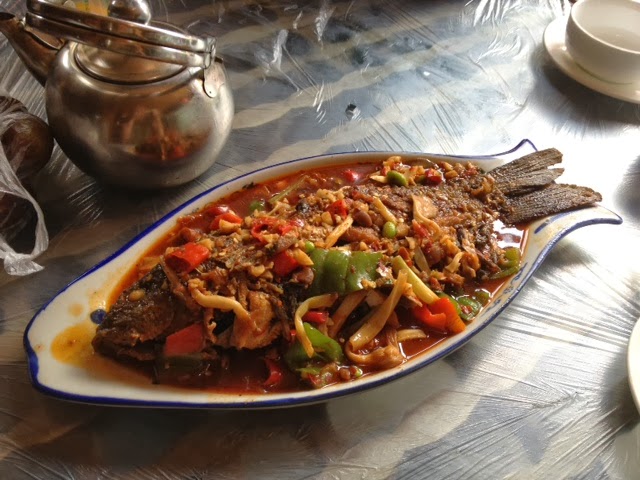
I heard that Changchun sources its seafood from North Korea, which is dubiously legal at best, but is a good explanation for why a very landlocked capital has so much shellfish on offer, from razor clams to cockroach-looking lobster hybrids to crayfish to tiny blue crabs to large red crabs to oysters. On two separate occasions, I bought heavy foil-wrapped packets bursting with razor clams and regular clams steamed in spicy red broth with accompanying glass noodles for between $2 and $3, and not one single clam was bad. They were all sweet and chewy with tender innards, and I ate so many at once that my mouth started to tingle (whether from a latent shellfish allergy that only emerges when I eat 50 clams or from the mala spice blend used, I’m not sure). I also tried a xiaokao place’s specialty roast fish, which came out on a scorching black platter and was an incredibly frustrating meal because the fish flesh was so sweet and flaky, and the skin so blackened and deep spiced, but the bones so numerous and tiny that they pricked me in the gums like little Novocaine needles while being too small for me to find and remove before they pricked me. I sucked that fish clean enough to avoid any passively judgmental comments by our waitress, though.
Another thing Changchun should not by rights have, but does anyway, is a wide array of fruit, including tropical fruit like mango, rambutan, durian, starfruit, and papaya. Every day for the last week I was here I would stop at the same mango juice stand and wonder why its room-temperature thick sweetness was so much better than mango juice in countries where mango-juice-vendors could literally reach up from their carts and pick mangoes from the trees.
Though my friend told me that Changchun normally has much more street food, and that many of the alleys and carts were closed for inspection, one alley did open on the last night and provide me with something I’d never seen before: a naan-adjacent blackened flatbread cooked stuck to the side of a kiln, lined before cooking with seaweed and pork. It crackled between the teeth more like papadam than like naan and was sweet for some reason, but not that sickly fake-buttery sweet many Asian bakeries slather on their bread and cakes. More like honey. And the lack of street food is less bothersome when many restaurants retain street-food-level pricing and cluster in open-doored rows along narrow streets, or create permanent stands in bazaars like the one featuring the egg lady. These close-enough-to-street-food establishments served me such interesting meals as bright orange carrot-infused wheat noodles with a thick mushroom dipping sauce, a hot, flaky fresh hamburger-sized pastry filled with ground pork and overflowing with very pickled sour vegetables, a miniature bright red numbing Sichuan-style hot pot with white fish and huge piles of potato, bamboo shoots, and leaves, garlic-topped grilled oysters, and durian pancake.
When we did go to fancier sit-down restaurants, it was usually to escape Chinese food and overpay for things like fig, goat cheese, and pine nut pizza, or bibimbap infused with cheese. I may pooh-pooh those things from the comfort and diversity of my home in the USA, but when my mouth burns from days of hot/numbing spice and endless oil, I will absolutely savor figs, pine nuts, and goat cheese, even if the pizza dough is lackluster by almost any standard. Also, what pizza place in the US would accompany their pizza with passionfruit-calamansi juice or a blueberry smoothie?
Today (well, yesterday: remember, Chinese firewall?), I board a plane to Ho Chi Minh City, Vietnam, suitcase stuffed with dried strawberries and blueberries and freeze-dried figs (China is awesome at dried fruits, especially when it refrains from adding sugar). Ho Chi Minh City is one of my favorite places, food-wise, in the world, and I think I’ve eaten much of what it has to offer during my previous two trips, but this time I’m going to try and go further afield to the Mekong Delta and the Vietnamese-Cambodian border at Ha Tien and Chau Doc, as well as to Mui Ne and Da Lat. No matter what happens, I’ll make sure to eat lots of snails.
Showing posts with label Chinese. Show all posts
Showing posts with label Chinese. Show all posts
Thursday, September 14, 2017

Sunday, June 19, 2016
Senses Smothered By Sheep
The first time China fed me some form of sheep was the very first day China ever saw me. I landed in Xi’an, Shaanxi, an odd city for a first-time tourist to cut her China-teeth on. It’s located in the center of the country and is noted mainly for its exhibition of terracotta warriors, which are showcased miles out of the city in their own warehouse and surrounding park.
The city itself was hot and grimy, and the air so bad I couldn’t see the ground from a tenth story window. We were at a hospital waiting for my boyfriend’s mom to get a couple root canals (PSA: China is not a good place for dental tourism), and I kept looking doubtfully out the window at how the air just slowly seemed to thicken until it became indistinct and yellowish-gray. It was like living in a cloud… a cloud of exhaust. A seasoned veteran of Los Angeles, I thought I’d seen pollution. I hadn’t.
When I got hungry, I thought we’d eat whatever the Chinese equivalent of hospital cafeteria food was; we were in sort of an industrial, restaurantless area. Instead, I was led outside onto the street, where the back of the parking lot of the hospital had been converted into what in the U.S. would totally count as a night market; sweating men and women, the lower halves of their faces covered in cloth, fanned at thick smoke billowing off a multitude of hot grills. Nearby, more vendors chopped fruit and scooped it into bags.
The grills, and whatever was on them, didn’t look immediately appetizing. The way the air was, thick and heavy, created an illusion that the smoke from the grills was what was creating the ambient haze. I didn’t feel like eating whatever caused me to feel like I was living in an exhaust-cloud city. Plus, it was hot, and the grills were hot. I wanted the cut fruit.
And I did get the cut fruit (watermelons mixed with carrots – weird), but my boyfriend insisted I also get what was on the grills, which turned out to be mutton skewers. This popular street food, ubiquitous in all parts of China but best-tasting, I think, in the western half, consists of mutton chunks skewered through and brushed with chili sauce, dried chilies, cumin, and salt. They’re handed to you scorching, so the experience has to begin with the smell, which is rich and spicy. Oil drips dangerously down the skewer towards your hand if you hold it too vertically, so you have to be careful with your angle. Once it’s cooled down enough to touch, you get the cumin first, a light coating all over your tongue, then the most explosive, fatty, gamey flavor. I don’t know why Chinese mutton and lamb tastes so much gamier than American mutton and lamb – whether it’s diet, the amount of fat left on, or the cooking method – but the difference is as big as if they were two different animals.
The second time China fed me sheep was in the prettier and much more touristy Muslim quarter, in a second floor cafe that looked like a converted shed draped in tapestry. I ordered yangrou paomo, a thick lamb broth filled with torn bits of bread and fat-streaked lamb chunks. It was delicious – rich and so gamey it felt like the used the essence of hundreds of sheep to make it – but regrettably so heavy I had to haul my stomach home and resume my Muslim Quarter culinary tour the next day.
I’ve never been able to find mutton skewers in Los Angeles exactly like they make them in China. I’ve tried. Most Angelenos will point you towards Feng Mao Mutton Kebab in Koreatown, but I find their version heavy on the gristle and light on the fat, and their staff way too trusting of patrons to cook their own skewers. You’re the experts, not me! If I could grill my own mutton skewers, I would – at home. Anyway, I think Omar’s Xinjiang Halal in San Gabriel comes much closer. In my own Yelp review I wrote that they got it ‘to the note’, but I was speaking comparatively. American restaurants are just too scared to embrace the fat. However, if you want to get as close as you’re going to get, go to Omar’s and make sure you order them with the garlicky cucumber salad.
I HAVE, however, been able to find gamey, lamby, pickled-garlicky replicas of Xi’an style lamb soup in the Los Angeles area, one with torn-up bread as the base and one with wide, hand-cut-and-stretched wheat noodles.
The torn-up bread version comes from Rainbow Bridge, a Ningxia province specialty restaurant in Irvine. The bread chunks here are perfect little tiny crouton-like squares. (I have no idea how they get them so uniform. Mechanical bread separator?) They cause the soup, at first glance, to resemble a bowl of white Legos. But they rapidly slurp up the thick cloudy broth and turn into puffy Legos with indistinct edges that, upon contact with your tongue, become lamb bombs. The experience of placing a spoonful of those in your mouth is not unlike placing a xiao long bao in your mouth, in terms of the shocking spurt of meat essence it releases. And if the lambiness of the bread isn’t enough, there are also hunks of lamb, almost appropriately fat-streaked, sitting in little wood-ear mushroom beds and wearing leek hats. The overall effect is added to by a pervasive taste/smell of pickled garlic; I’m not sure if this is because it was actually used for cooking or because the little plate of it next to my bowl was sending aromas wafting up to mix up my senses.
The noodly version comes from Xi’an Tasty in Monterey Park. Speaking of noodles, I think the noodles in this broth are secretly just one 20 foot long noodle. While attempting to serve ourselves, we kept unspooling and unspooling these monster noodles, splattering broth all over the table and the floor and our shirts in the process, trying to reach the end. Eventually, we ended up meeting in the middle. Usually, in situations like this, Chinese restaurants will offer scissors, but I think in this case they judged that the value of getting to laugh at us was greater than the value of satisfied customers with scissors. (Just kidding, our waitress was above-and-beyond sweet.)
The broth here is less aggressively gamey and garlicky than Rainbow Bridge’s, but mostly because it tastes like it may get a slight moderation from chicken broth. The lamb here is more tender, and falls apart at the first feather touch from a fork. The real fun of it, though, is the Mobius strip monster noodle. It’s so substantial it may as well be a rope of bread.
If getting your senses smothered in the essence of sheep sounds like a good time to you, northwestern China is the place for you, but in the meantime, Los Angeles, as always, at least approximates.
The city itself was hot and grimy, and the air so bad I couldn’t see the ground from a tenth story window. We were at a hospital waiting for my boyfriend’s mom to get a couple root canals (PSA: China is not a good place for dental tourism), and I kept looking doubtfully out the window at how the air just slowly seemed to thicken until it became indistinct and yellowish-gray. It was like living in a cloud… a cloud of exhaust. A seasoned veteran of Los Angeles, I thought I’d seen pollution. I hadn’t.
When I got hungry, I thought we’d eat whatever the Chinese equivalent of hospital cafeteria food was; we were in sort of an industrial, restaurantless area. Instead, I was led outside onto the street, where the back of the parking lot of the hospital had been converted into what in the U.S. would totally count as a night market; sweating men and women, the lower halves of their faces covered in cloth, fanned at thick smoke billowing off a multitude of hot grills. Nearby, more vendors chopped fruit and scooped it into bags.
The grills, and whatever was on them, didn’t look immediately appetizing. The way the air was, thick and heavy, created an illusion that the smoke from the grills was what was creating the ambient haze. I didn’t feel like eating whatever caused me to feel like I was living in an exhaust-cloud city. Plus, it was hot, and the grills were hot. I wanted the cut fruit.
And I did get the cut fruit (watermelons mixed with carrots – weird), but my boyfriend insisted I also get what was on the grills, which turned out to be mutton skewers. This popular street food, ubiquitous in all parts of China but best-tasting, I think, in the western half, consists of mutton chunks skewered through and brushed with chili sauce, dried chilies, cumin, and salt. They’re handed to you scorching, so the experience has to begin with the smell, which is rich and spicy. Oil drips dangerously down the skewer towards your hand if you hold it too vertically, so you have to be careful with your angle. Once it’s cooled down enough to touch, you get the cumin first, a light coating all over your tongue, then the most explosive, fatty, gamey flavor. I don’t know why Chinese mutton and lamb tastes so much gamier than American mutton and lamb – whether it’s diet, the amount of fat left on, or the cooking method – but the difference is as big as if they were two different animals.
The second time China fed me sheep was in the prettier and much more touristy Muslim quarter, in a second floor cafe that looked like a converted shed draped in tapestry. I ordered yangrou paomo, a thick lamb broth filled with torn bits of bread and fat-streaked lamb chunks. It was delicious – rich and so gamey it felt like the used the essence of hundreds of sheep to make it – but regrettably so heavy I had to haul my stomach home and resume my Muslim Quarter culinary tour the next day.
I’ve never been able to find mutton skewers in Los Angeles exactly like they make them in China. I’ve tried. Most Angelenos will point you towards Feng Mao Mutton Kebab in Koreatown, but I find their version heavy on the gristle and light on the fat, and their staff way too trusting of patrons to cook their own skewers. You’re the experts, not me! If I could grill my own mutton skewers, I would – at home. Anyway, I think Omar’s Xinjiang Halal in San Gabriel comes much closer. In my own Yelp review I wrote that they got it ‘to the note’, but I was speaking comparatively. American restaurants are just too scared to embrace the fat. However, if you want to get as close as you’re going to get, go to Omar’s and make sure you order them with the garlicky cucumber salad.
I HAVE, however, been able to find gamey, lamby, pickled-garlicky replicas of Xi’an style lamb soup in the Los Angeles area, one with torn-up bread as the base and one with wide, hand-cut-and-stretched wheat noodles.
The torn-up bread version comes from Rainbow Bridge, a Ningxia province specialty restaurant in Irvine. The bread chunks here are perfect little tiny crouton-like squares. (I have no idea how they get them so uniform. Mechanical bread separator?) They cause the soup, at first glance, to resemble a bowl of white Legos. But they rapidly slurp up the thick cloudy broth and turn into puffy Legos with indistinct edges that, upon contact with your tongue, become lamb bombs. The experience of placing a spoonful of those in your mouth is not unlike placing a xiao long bao in your mouth, in terms of the shocking spurt of meat essence it releases. And if the lambiness of the bread isn’t enough, there are also hunks of lamb, almost appropriately fat-streaked, sitting in little wood-ear mushroom beds and wearing leek hats. The overall effect is added to by a pervasive taste/smell of pickled garlic; I’m not sure if this is because it was actually used for cooking or because the little plate of it next to my bowl was sending aromas wafting up to mix up my senses.
The noodly version comes from Xi’an Tasty in Monterey Park. Speaking of noodles, I think the noodles in this broth are secretly just one 20 foot long noodle. While attempting to serve ourselves, we kept unspooling and unspooling these monster noodles, splattering broth all over the table and the floor and our shirts in the process, trying to reach the end. Eventually, we ended up meeting in the middle. Usually, in situations like this, Chinese restaurants will offer scissors, but I think in this case they judged that the value of getting to laugh at us was greater than the value of satisfied customers with scissors. (Just kidding, our waitress was above-and-beyond sweet.)
The broth here is less aggressively gamey and garlicky than Rainbow Bridge’s, but mostly because it tastes like it may get a slight moderation from chicken broth. The lamb here is more tender, and falls apart at the first feather touch from a fork. The real fun of it, though, is the Mobius strip monster noodle. It’s so substantial it may as well be a rope of bread.
If getting your senses smothered in the essence of sheep sounds like a good time to you, northwestern China is the place for you, but in the meantime, Los Angeles, as always, at least approximates.
Monday, October 21, 2013
Snacking across Asia, part II: China
(...continued from Part I.)
1. Fenghuang, Hunan: Candied ginger
Fenghuang is known for its ginger crafting. That much is clear with a simple Google. However, further information about what type of ginger is hard to come by. Pickled? Candied? Sugared?
The shops along the obviously-tweaked-to-look-ancient-but-still-striking streets of Fenghuang sold white sticks that looked like bleached bark. This might have been ginger. We walked past a man in practically medical garb working a taffy machine like a jumprope, twirling it and lassoing the air gracefully.

This may have been ginger, too. Who knows?
What I eventually bought was a baggie of crystallized ginger from shop tucked way off the main road, just because that was the image in my head of how ginger ought to be consumed. It looked just like the kind you get at Trader Joe's: soft, chewy, and sugared - except that instead of big crystals of sugar, it was powdered sugar. And also, there was the small matter of it tasting so fresh and dewy and spicy that I may have gathered a handful straight from a passing fluffy ginger cloud.
My fatal error was buying only one bag, thinking it would last me the rest of my trip (about 6 weeks at that point). It lasted me three days: just long enough that I was on the train to Kunming by then, regretting my decision strongly.
Ruili had something similar, imported from Malaysia, and so did Vietnam, in gigantic plastic bulk containers at the market, but nothing ever quite reached the magic of Fenghuang's.
2. Weishan, Yunnan: Sweet cornbread with fig filling
The dominant sweet in Weishan, The Friendliest City in China, was a jiggly white Jello-like cake lump that inexplicably, when cut into, formed a jagged, baklava-like square, as though phyllo dough were hidden in the midst.
It tasted like paper and soy. I wished it were interesting. It was offered as a sample by a pair of friendly (of course) sisters under a cardboard awning.
The rarer sweet carts only came out in the morning, disappearing entirely by about 10am. From one of these epheremal vendors came something wholly un-Chinese, so utterly random as to almost seem unreal.
This square of cornbread, stuffed with a sweet brown fig filling, would have seemed more at home somewhere in the Mediterranean. We were soon to see figs in Dali, in the same province, but they were plump, green, and looked almost like apples. This filling looked like it came straight from a Black Mission.
It was a welcome respite from the bracingly sweet red bean cakes that popped up in every Yunnan bakery we would pass for the next 3 weeks. Too bad respites work better when they come after the routine, not before.
3. Ruili, Yunnan: Shandong squid skewers
Yeah, that's a lot of place names.
I specify that this squid skewers originate from Shandong because the man who grilled them never stopped talking about his hometown. He insisted that his skewers were the best in Ruili because he grilled them the way he had learned to grill them all the way across the country - really all the way across, over 1850 miles away.
Here he is, grilling squid the Shandong way, arm-muffs and all:

I don't purport to be able to distinguish squid skewers by grilling style, but I do know that these were more than worth the wait in the tropical rain. He had the squid divided up into legs and bodies. I had chosen to try one leg skewer and one body skewer, but he insisted that I choose both legs, since they were 'better'.
He soaked his grill with oil, scraped it flat, placed the squid on, coated it with oil, pressed it hard with his metal press, then let all the juices that pressed out soak up the oil and spices left over from previous orders. Then, he scooped up the now-fried juices and poured them back over the squid, pressing them out again and repeating the process four or five times, adding garlic and powdered spices towards the end.
Again, I regretted only ordering two after I had returned to the dryness and coziness of my hotel room, and was disinclined to venture out and get more. We looked for him the next night, but as it goes in China, he'd moved on to a different corner and was never to be seen again.
4. Dali, Yunnan: Fried goat cheese
What we initially thought were tortillas on a stick were thinly-sliced sheets of goat cheese, stuck in the fire until they blistered and crisped! (And they weren't on a stick, they were shoved ingeniously in the center of one split chopstick.)
Now, my thoughts on Dali cuisine are well-documented, but occasionally these tangy, pungent snacks would be well-made and when they were, they were otherworldly. They'd crunch and then melt, leaving a bite on your tongue not unlike Swiss cheese, but with a brown sugar aftertaste.
Next time: Vietnam and Cambodia!
1. Fenghuang, Hunan: Candied ginger
Fenghuang is known for its ginger crafting. That much is clear with a simple Google. However, further information about what type of ginger is hard to come by. Pickled? Candied? Sugared?
The shops along the obviously-tweaked-to-look-ancient-but-still-striking streets of Fenghuang sold white sticks that looked like bleached bark. This might have been ginger. We walked past a man in practically medical garb working a taffy machine like a jumprope, twirling it and lassoing the air gracefully.

This may have been ginger, too. Who knows?
What I eventually bought was a baggie of crystallized ginger from shop tucked way off the main road, just because that was the image in my head of how ginger ought to be consumed. It looked just like the kind you get at Trader Joe's: soft, chewy, and sugared - except that instead of big crystals of sugar, it was powdered sugar. And also, there was the small matter of it tasting so fresh and dewy and spicy that I may have gathered a handful straight from a passing fluffy ginger cloud.
My fatal error was buying only one bag, thinking it would last me the rest of my trip (about 6 weeks at that point). It lasted me three days: just long enough that I was on the train to Kunming by then, regretting my decision strongly.
Ruili had something similar, imported from Malaysia, and so did Vietnam, in gigantic plastic bulk containers at the market, but nothing ever quite reached the magic of Fenghuang's.
2. Weishan, Yunnan: Sweet cornbread with fig filling
The dominant sweet in Weishan, The Friendliest City in China, was a jiggly white Jello-like cake lump that inexplicably, when cut into, formed a jagged, baklava-like square, as though phyllo dough were hidden in the midst.
It tasted like paper and soy. I wished it were interesting. It was offered as a sample by a pair of friendly (of course) sisters under a cardboard awning.
The rarer sweet carts only came out in the morning, disappearing entirely by about 10am. From one of these epheremal vendors came something wholly un-Chinese, so utterly random as to almost seem unreal.
This square of cornbread, stuffed with a sweet brown fig filling, would have seemed more at home somewhere in the Mediterranean. We were soon to see figs in Dali, in the same province, but they were plump, green, and looked almost like apples. This filling looked like it came straight from a Black Mission.
It was a welcome respite from the bracingly sweet red bean cakes that popped up in every Yunnan bakery we would pass for the next 3 weeks. Too bad respites work better when they come after the routine, not before.
3. Ruili, Yunnan: Shandong squid skewers
Yeah, that's a lot of place names.
I specify that this squid skewers originate from Shandong because the man who grilled them never stopped talking about his hometown. He insisted that his skewers were the best in Ruili because he grilled them the way he had learned to grill them all the way across the country - really all the way across, over 1850 miles away.
Here he is, grilling squid the Shandong way, arm-muffs and all:

I don't purport to be able to distinguish squid skewers by grilling style, but I do know that these were more than worth the wait in the tropical rain. He had the squid divided up into legs and bodies. I had chosen to try one leg skewer and one body skewer, but he insisted that I choose both legs, since they were 'better'.
He soaked his grill with oil, scraped it flat, placed the squid on, coated it with oil, pressed it hard with his metal press, then let all the juices that pressed out soak up the oil and spices left over from previous orders. Then, he scooped up the now-fried juices and poured them back over the squid, pressing them out again and repeating the process four or five times, adding garlic and powdered spices towards the end.
Again, I regretted only ordering two after I had returned to the dryness and coziness of my hotel room, and was disinclined to venture out and get more. We looked for him the next night, but as it goes in China, he'd moved on to a different corner and was never to be seen again.
4. Dali, Yunnan: Fried goat cheese
What we initially thought were tortillas on a stick were thinly-sliced sheets of goat cheese, stuck in the fire until they blistered and crisped! (And they weren't on a stick, they were shoved ingeniously in the center of one split chopstick.)
 |
| That makes more sense than there being tortillas in China. Duh. |
Next time: Vietnam and Cambodia!
Tuesday, October 15, 2013
Too special for me: A mystery Yunnanese mountain vegetable
We trundled out of a city bus from Xiaguan to Weishan in the middle of what looked like nowhere. With our suitcases rolling and clattering on the cobblestone streets, making a big racket, we promptly (and naively) wandered right into a construction site.
A woman, shoveling debris, put her hand out and yelled for us to stop. We did, and right as we did, a wheelbarrow descended clunkily from the second floor of a building, hanging from the claw of a crane, coming to a crashing halt right where we'd have been standing if it hadn't been for her.
Weishan was the friendliest city I encountered in China. Someone saving our lives was just the beginning.
The very first hotel we wandered into came complete with an effusive owner, who showed us his guest log to definitively prove he had given us the best deal of the week, narrated the local news channel's offerings in the evenings, got down on his hands and knees to try and fix our internet (despite being of the generation to which internet connectivity makes no sense), and whose wife offered to do all our laundry while we were at lunch. (Contrast this to a more typical first hotel, whose front desk clerk brusquely informs us that they don't accept foreigners.)
Old ladies in juice shops were thrilled to see us and to share small talk over mango smoothies. Nobody 'hello-ed' us like we were clowns in the circus, but rather waved as though we all shared a common humanity.
And, miracle of miracles, the waitress in the small country-style lunch place we went to was the helpful sort. She didn't merely stand behind us, tapping her pen against her pad impatiently. She hovered over Julian's shoulder, eagerly explaining what each dish was (in a country where dish names often bear no relation to their contents, this is invaluable). She even dashed over to the cooler a few times to grab a sample of whatever it was she was talking about, so we could see it. With her guidance, we ordered a stewed eggplant dish, tofu egg flower soup, cassava (not really cassava, but close) chips, and the omnipresent 'empty heart' stirfry.
She couldn't help herself, though:
"This dish is a mountain vegetable we grow here in this part of Yunnan. I don't know if you would like it. The flavor is maybe too... special for you."
Was this supposed to be a challenge? (Or just a subtly well-played marketing ploy?)
I fear not its specialness - bring me the special mountain vegetable!!
This was one of those meals that was so complete, so filling from all directions, so obviously well-rounded, that I didn't notice it was vegetarian until hours later - until I looked at the picture, in fact.
The eggplant melted into its garlicky red sauce, its texture more like lentils than like vegetable stew. (After we had finished, a fly dove into the liquid and slowly drowned as though it were sinking in quicksand. It made no attempt to escape until the very last minute, when it was too late. I was buoyed by the thought that it was probably experiencing the best taste sensation of its life, and so didn't think to save itself.)
The cassava-ish chips were clearly fried just that instant, and more hefty-tasting than potato. They crunched briefly, then melted on our tongues.
And the 'maybe too special' mountain vegetables? You know what that tasted like?
Pumpkin seeds.
Pumpkin seeds with the texture of a good oven-fried basil leaf, with a woody, gnawing sort of stem, but otherwise: 100% pumpkin seed flavor. It was uncanny. Why would a leaf growing in Yunnan taste exactly like pumpkin seeds?
---
Actually, this happened again later, in Ruili, when we ordered a dish of mysterious green leaves with okra.

The green leaves tasted exactly like ripe mango. Julian dutifully asked the waiter if they were mango leaves, but the waiter said that they were not. He did not, however, say what they were, and it's tickled at the back of my mind ever since.
Does anyone know what either of these leaves are?
A woman, shoveling debris, put her hand out and yelled for us to stop. We did, and right as we did, a wheelbarrow descended clunkily from the second floor of a building, hanging from the claw of a crane, coming to a crashing halt right where we'd have been standing if it hadn't been for her.
Weishan was the friendliest city I encountered in China. Someone saving our lives was just the beginning.
The very first hotel we wandered into came complete with an effusive owner, who showed us his guest log to definitively prove he had given us the best deal of the week, narrated the local news channel's offerings in the evenings, got down on his hands and knees to try and fix our internet (despite being of the generation to which internet connectivity makes no sense), and whose wife offered to do all our laundry while we were at lunch. (Contrast this to a more typical first hotel, whose front desk clerk brusquely informs us that they don't accept foreigners.)
Old ladies in juice shops were thrilled to see us and to share small talk over mango smoothies. Nobody 'hello-ed' us like we were clowns in the circus, but rather waved as though we all shared a common humanity.
And, miracle of miracles, the waitress in the small country-style lunch place we went to was the helpful sort. She didn't merely stand behind us, tapping her pen against her pad impatiently. She hovered over Julian's shoulder, eagerly explaining what each dish was (in a country where dish names often bear no relation to their contents, this is invaluable). She even dashed over to the cooler a few times to grab a sample of whatever it was she was talking about, so we could see it. With her guidance, we ordered a stewed eggplant dish, tofu egg flower soup, cassava (not really cassava, but close) chips, and the omnipresent 'empty heart' stirfry.
She couldn't help herself, though:
"This dish is a mountain vegetable we grow here in this part of Yunnan. I don't know if you would like it. The flavor is maybe too... special for you."
Was this supposed to be a challenge? (Or just a subtly well-played marketing ploy?)
I fear not its specialness - bring me the special mountain vegetable!!
 |
| Clockwise from top left: super strong Yunnanese tea, chips, soup, eggplant, pickles, empty heart, special mountain vegetable |
The eggplant melted into its garlicky red sauce, its texture more like lentils than like vegetable stew. (After we had finished, a fly dove into the liquid and slowly drowned as though it were sinking in quicksand. It made no attempt to escape until the very last minute, when it was too late. I was buoyed by the thought that it was probably experiencing the best taste sensation of its life, and so didn't think to save itself.)
The cassava-ish chips were clearly fried just that instant, and more hefty-tasting than potato. They crunched briefly, then melted on our tongues.
And the 'maybe too special' mountain vegetables? You know what that tasted like?
Pumpkin seeds.
Pumpkin seeds with the texture of a good oven-fried basil leaf, with a woody, gnawing sort of stem, but otherwise: 100% pumpkin seed flavor. It was uncanny. Why would a leaf growing in Yunnan taste exactly like pumpkin seeds?
---
Actually, this happened again later, in Ruili, when we ordered a dish of mysterious green leaves with okra.

The green leaves tasted exactly like ripe mango. Julian dutifully asked the waiter if they were mango leaves, but the waiter said that they were not. He did not, however, say what they were, and it's tickled at the back of my mind ever since.
Does anyone know what either of these leaves are?
Sunday, September 22, 2013
Lox and cream cheese saves Dali
The 'Old City' of Dali, Yunnan, China was tourist heaven and therefore (as far as I was concerned) food hell.
Throngs of Western and Chinese travelers pushed shoulder to shoulder down the narrow cobblestone streets. Shoe-menders roamed the same streets pointing in mock horror at the travelers' feet. Their faces were theatrically twisted into expressions like the tourists' shoes had murdered their parents by virtue of their shoddiness, and the only way to right the wrong was to stitch up the offending parts.
Tourists caused traffic jams watching street performers strum guitars, throat-sing, and do stand-up comedy. They crouched at the sides of paths to finger the edges of fine silks and the soles of hand-stitched shoes. They gathered in cafés to sip hippie-friendly vegan mushroom soup and, at best, eat strange fusion dishes like yak lasagna or or fried spiced goat cheese burgers. At worst, they shrank away from any foreign influence whatsoever and had spaghetti with thin, watery marinara, or spammy ham and eggs on toast.
There were 'authentic' Chinese restaurants, but these, too, were catered to the tourist throngs. With high hopes, I tried a few of the row of Bai restaurants that stood sandwiched in between puzzle shops, jewelry counters, and travel agencies.
The first one served me a 'Bai Special Grilled Fish' on a metal platter that was burning hot in the chest, freezing cold in the tail, and soggy in the skin, lying in a pool of oniony, peppery soy sauce. Its head was bitter, and some meat was too tough to chew while the rest mushed off the bone all water-laden like turkey stuffing. When we inquired after this travesty, the waitress snapped that this was how they made it.

The second one had snails bubbling away in a tank on the sidewalk, so I took the opportunity to order large and small snails in bean sauce. They came out so bitter that my tongue physically ejected them from my mouth as my lips shrank away. Upon a second try, I noted that the snails were gritty with sand and the overall impression the sauce left my mouth was: totally numb. Not Sichuan peppercorn numb - Novocaine numb. Dead numb. This waitress, too, claimed that this was how it was meant to be made.

Street vendors sold me rubbery, room-temperature quail egg skewers and burned, asphalt-textured fried cheese. A smiling guy at a table outside a bookstore sold homemade custard that flopped around on my tongue like a dying guppy and tasted like glue. Mango juice was made from syrup instead of fruit.
Of course, this all occurred at prices a good 2-3 times higher than the rest of China.
I was fed up and I was hungry, so I threw my policy of only eating local when traveling right out the window.
I'd heard tell of a German bakery that made delectable European-style rolls, loaves, and bagels, and better yet: I'd heard it had the elusive lox-and-cream-cheese topping!
When I'm traveling in Asia, a bagel with lox and cream cheese is always at the top of my homesick cravings list. I can't explain why. It has something to do, certainly, with much of Asia's reticence about cheese, but at this particular time I was in Yunnan, home of fried goat cheese. Also, China doesn't shy away from yogurt. So I'm not sure why I craved this so intensely, but I did.
"It's going to cost 100 kuai," I joked with Julian, not actually entirely sure I was joking.
At the bakery, timid, limited-English-speaking staff watched us as we perused the menu. Sure enough, "bagel with cream cheese spread and smoked salmon" was written at the very bottom, nearly edged out by splashy chocolate mousse cakes and resplendent blueberry pies, next to the high but not totally insane price of 48 kuai.
"Bagel... ah... méiyǒu..." a staff member stammered. He was right to be nervous. I was on the edge of leaping across the counter and shaking the bagels right out of him.
A crisis was averted by ordering the lox and cream cheese on potato walnut bread. While we waited for it to come out, we chatted with a couple of Californians snacking on blue cheese and bratwursts about the weather. It was surreal.
I failed to take a picture of my quarry, because the second it was in my hands, it was between my teeth. Here is a picture of it, three-quarters-eaten, next to the vegetable bāozi Julian insisted on having instead.

It may not have been the best idea to bite into the sandwich without looking, because it is apparently German-expat-in-China tradition to line one side of bread with whole lime slices, peel, seeds and all. The first taste was therefore a combination of heavenly sighs and utter confusion, my tongue savoring the creamy spread at the same time as my teeth were crunching lime seeds.
Once the limes were removed (and retained for palate-cleansing between bites), the sandwich, while not quite akin enough to, say, delicatessen bagel creations to be in the same family, was certainly familiar enough to be utterly comforting.
Soft, pillowy potato walnut bread, with its mild flavor punctuated by pockets of nuttiness, was almost a better base for the smoky fish than bagels. The traditionalist in me (note: not a large part) hates to say it, but it's true. They even used red onions and capers, the latter so alien in China that I have no idea where they possibly could have sourced them.
This fist-sized sandwich alone saved Dali from being a purely resentful slot in my culinary memory.
I suppose that's worth the shame of admitting I succumbed to my American-food cravings and paid $6 for Western breakfast in China.
Throngs of Western and Chinese travelers pushed shoulder to shoulder down the narrow cobblestone streets. Shoe-menders roamed the same streets pointing in mock horror at the travelers' feet. Their faces were theatrically twisted into expressions like the tourists' shoes had murdered their parents by virtue of their shoddiness, and the only way to right the wrong was to stitch up the offending parts.
Tourists caused traffic jams watching street performers strum guitars, throat-sing, and do stand-up comedy. They crouched at the sides of paths to finger the edges of fine silks and the soles of hand-stitched shoes. They gathered in cafés to sip hippie-friendly vegan mushroom soup and, at best, eat strange fusion dishes like yak lasagna or or fried spiced goat cheese burgers. At worst, they shrank away from any foreign influence whatsoever and had spaghetti with thin, watery marinara, or spammy ham and eggs on toast.
There were 'authentic' Chinese restaurants, but these, too, were catered to the tourist throngs. With high hopes, I tried a few of the row of Bai restaurants that stood sandwiched in between puzzle shops, jewelry counters, and travel agencies.
The first one served me a 'Bai Special Grilled Fish' on a metal platter that was burning hot in the chest, freezing cold in the tail, and soggy in the skin, lying in a pool of oniony, peppery soy sauce. Its head was bitter, and some meat was too tough to chew while the rest mushed off the bone all water-laden like turkey stuffing. When we inquired after this travesty, the waitress snapped that this was how they made it.

Of course, this all occurred at prices a good 2-3 times higher than the rest of China.
I was fed up and I was hungry, so I threw my policy of only eating local when traveling right out the window.
I'd heard tell of a German bakery that made delectable European-style rolls, loaves, and bagels, and better yet: I'd heard it had the elusive lox-and-cream-cheese topping!
When I'm traveling in Asia, a bagel with lox and cream cheese is always at the top of my homesick cravings list. I can't explain why. It has something to do, certainly, with much of Asia's reticence about cheese, but at this particular time I was in Yunnan, home of fried goat cheese. Also, China doesn't shy away from yogurt. So I'm not sure why I craved this so intensely, but I did.
"It's going to cost 100 kuai," I joked with Julian, not actually entirely sure I was joking.
At the bakery, timid, limited-English-speaking staff watched us as we perused the menu. Sure enough, "bagel with cream cheese spread and smoked salmon" was written at the very bottom, nearly edged out by splashy chocolate mousse cakes and resplendent blueberry pies, next to the high but not totally insane price of 48 kuai.
"Bagel... ah... méiyǒu..." a staff member stammered. He was right to be nervous. I was on the edge of leaping across the counter and shaking the bagels right out of him.
A crisis was averted by ordering the lox and cream cheese on potato walnut bread. While we waited for it to come out, we chatted with a couple of Californians snacking on blue cheese and bratwursts about the weather. It was surreal.
I failed to take a picture of my quarry, because the second it was in my hands, it was between my teeth. Here is a picture of it, three-quarters-eaten, next to the vegetable bāozi Julian insisted on having instead.

It may not have been the best idea to bite into the sandwich without looking, because it is apparently German-expat-in-China tradition to line one side of bread with whole lime slices, peel, seeds and all. The first taste was therefore a combination of heavenly sighs and utter confusion, my tongue savoring the creamy spread at the same time as my teeth were crunching lime seeds.
Once the limes were removed (and retained for palate-cleansing between bites), the sandwich, while not quite akin enough to, say, delicatessen bagel creations to be in the same family, was certainly familiar enough to be utterly comforting.
Soft, pillowy potato walnut bread, with its mild flavor punctuated by pockets of nuttiness, was almost a better base for the smoky fish than bagels. The traditionalist in me (note: not a large part) hates to say it, but it's true. They even used red onions and capers, the latter so alien in China that I have no idea where they possibly could have sourced them.
This fist-sized sandwich alone saved Dali from being a purely resentful slot in my culinary memory.
I suppose that's worth the shame of admitting I succumbed to my American-food cravings and paid $6 for Western breakfast in China.
Saturday, September 7, 2013
Crabs in China, crabs in Cambodia
I. Crabs in China (Ruili, Yunnan)
Our first view of Ruili's night market came through waves of rain, crashing down from the sky like we were walking under the world's biggest waterfall. The streets quickly flooded and became streams. We crossed several in water up to mid-calf.
When we got to the market, it was ghostly. Tarps rattled in the wind, covering deserted stalls. The stalls were filled with coolers, which were empty and draped in cloth and cardboard. Only a few places were open. In one, one drenched diner sat, bedraggledly sipping a papaya smoothie.
We tried again a week later after a scorching day spent on the Burmese border, watching villagers traverse the tiny border river using unofficial makeshift bamboo bridges or merely wading with their pant legs rolled up. I wanted to find crab to eat; we'd seen rows and rows of workers packing their little silvery blue bodies up into crates bound for the rest of Yunnan.
The night was clear and the market was hopping. Vendors jostled for space at the edges of a massive inner dining area, their carts all identically piled with skewered meat, snails, crabs, crickets, worms, and baby bees.
I wasn't that hungry, because, as I recall, I had had about 40 pork and green onion dumplings for lunch, but the night market vendors only sold their merchandise in one size: gigantic-Chinese-family-sharing-size, for 50 kuai (~$8.25).
Julian, of course, refused to eat any of the creatures on offer, so he was tasked with trying to convince the vendors to give me a smaller portion at a smaller price. Some were mildly amused by the question (in a why-would-I-even-entertain-that sort of way), and some were offended by it (in a you-want-less-of-my-delicious-food?!?! kind of way).
One, though, didn't understand the question, or else didn't care. "40 kuai," she said with a shrug and a take-it-or-leave it flip of her wok-stirring spatula. As a normally utterly ineffective bargainer, I was shocked but pleased by this turn of events: an unintentional bargain!
As the dish was set in front of me and I smelled the garlic and chilies wafting up into the air, all my hunger came rushing back somehow. The dumplings, though still digesting, became a distant memory, as though I had eaten them in a dream. It was a good thing I hadn't gotten a half-order. I ate every last claw.
The crabs' sauce was so dark and thick it was tough to distinguish the basil leaves from the undercurrent of pounded chilies. At first I tried to dig the meat out with chopsticks, but quickly came to realize it was a futile endeavor. I pulled a rubber band from my pocket, tied my hair back, pushed wayward strands behind my ear, and dug into the bowl with both bare hands like the sauced-up and hot-oiled crab bodies and claws were nothing more than a bowl of jelly beans.
Before long, I couldn't pick up my drink without it slipping right out of my absolutely sauce-coated hands. I dug my fingers under carapaces and wormed my way into tiny claw crevices. I scraped claw adductors with my teeth and smeared my cheeks trying to get my tongue all the way into some of the spaces between organs.
The garlic had been stir-fried so thoroughly that it could be eaten in chunks right along with the crabmeat, which was good since they were indistinguishable in color. The chilies' flavor had seeped into everything so thoroughly that eating them directly had no spicy effect beyond the effect of the rest of the dish, which was very hot. At first, my tongue delightedly bounced from garlic to ocean to spicy to herby and back, but before long it started tingling and burning them all together.
On the way out, we told the crabs' cook that her work had been amazing. She barely nodded as she kept stirring someone else's eventual dinner in her wok; she knew.
---
II. Crabs in Cambodia (Phnom Penh)
Khmer cuisine is one of those cuisines that hasn't been widely exported to the U.S. Last year, I was persistent enough to ferret out a few places in Long Beach, but apart from those tastes, I had no idea what to expect when I found myself on a bus to Phnom Penh earlier this week.
Luckily, Cambodia and Vietnam share the custom of, at nightfall, dragging out hundreds of plastic chairs and tables along with countless tanks of fresh shellfish. They do this in front of places that remained shuttered and gated all day. A place that was fixing motorbikes at noon might be tossing sea snails with lemongrass at nine. And language barriers can't stop me from recognizing those telltale shells.
There was one such place right down the street from our hostel. It was called the Oyster House. They had a simple one page menu largely consisting of English translations that left a lot to the imagination. This wasn't unusual in Phnom Penh, a capital with a much higher general English level than Ho Chi Minh City - enough English to have translations, not enough English to have detailed translations. One restaurant, for example, listed a particular soup as 'Khmer spice soup' and what came out was full of pumpkins, wintermelon, green beans, eggplant, and cucumbers.
My crab dish was an exception, though - it was called "Shake Sea Crab with Salt and Chili".

Which is exactly what it was.
It came out unadorned with any sort of silverware altogether, which confused me for a good minute. My stomach was rumblings and I couldn't get any meat out! Was I supposed to scrape the brain meat with my fingers and then stare at the legs wistfully?
No: I watched the locals. They were cracking the legs with their teeth.
Despite knowing my dentist would wince if she saw me, and despite the fact that some of the legs were spiky, I did the same. The crabs were small, about the same size as my palm. Their open heads were full of potent pepper seeds and sea salt; the legs were grilled until they could almost be crunched like BBQ flavored potato chips. To get the tiny wedges of meat out of their skinny limbs was like performing hand surgery, but ultimately worth it. The seasoning was simple, but the crabs were effortlessly, lightly fresh, the kind of fresh you only get in the States by paying over $30 per head or by going out in a boat yourself. Getting them for $1.50 was an experience I knew I shouldn't take for granted.
But they were tiny... so I couldn't help ordering some of the restaurant's namesake afterwards.
Our first view of Ruili's night market came through waves of rain, crashing down from the sky like we were walking under the world's biggest waterfall. The streets quickly flooded and became streams. We crossed several in water up to mid-calf.
When we got to the market, it was ghostly. Tarps rattled in the wind, covering deserted stalls. The stalls were filled with coolers, which were empty and draped in cloth and cardboard. Only a few places were open. In one, one drenched diner sat, bedraggledly sipping a papaya smoothie.
We tried again a week later after a scorching day spent on the Burmese border, watching villagers traverse the tiny border river using unofficial makeshift bamboo bridges or merely wading with their pant legs rolled up. I wanted to find crab to eat; we'd seen rows and rows of workers packing their little silvery blue bodies up into crates bound for the rest of Yunnan.
The night was clear and the market was hopping. Vendors jostled for space at the edges of a massive inner dining area, their carts all identically piled with skewered meat, snails, crabs, crickets, worms, and baby bees.
 |
| View from inside the covered area, with a solid border of stalls |
Julian, of course, refused to eat any of the creatures on offer, so he was tasked with trying to convince the vendors to give me a smaller portion at a smaller price. Some were mildly amused by the question (in a why-would-I-even-entertain-that sort of way), and some were offended by it (in a you-want-less-of-my-delicious-food?!?! kind of way).
One, though, didn't understand the question, or else didn't care. "40 kuai," she said with a shrug and a take-it-or-leave it flip of her wok-stirring spatula. As a normally utterly ineffective bargainer, I was shocked but pleased by this turn of events: an unintentional bargain!
 |
| Chopped crabs, passion fruit juice, mango shake |
The crabs' sauce was so dark and thick it was tough to distinguish the basil leaves from the undercurrent of pounded chilies. At first I tried to dig the meat out with chopsticks, but quickly came to realize it was a futile endeavor. I pulled a rubber band from my pocket, tied my hair back, pushed wayward strands behind my ear, and dug into the bowl with both bare hands like the sauced-up and hot-oiled crab bodies and claws were nothing more than a bowl of jelly beans.
Before long, I couldn't pick up my drink without it slipping right out of my absolutely sauce-coated hands. I dug my fingers under carapaces and wormed my way into tiny claw crevices. I scraped claw adductors with my teeth and smeared my cheeks trying to get my tongue all the way into some of the spaces between organs.
The garlic had been stir-fried so thoroughly that it could be eaten in chunks right along with the crabmeat, which was good since they were indistinguishable in color. The chilies' flavor had seeped into everything so thoroughly that eating them directly had no spicy effect beyond the effect of the rest of the dish, which was very hot. At first, my tongue delightedly bounced from garlic to ocean to spicy to herby and back, but before long it started tingling and burning them all together.
On the way out, we told the crabs' cook that her work had been amazing. She barely nodded as she kept stirring someone else's eventual dinner in her wok; she knew.
---
II. Crabs in Cambodia (Phnom Penh)
Khmer cuisine is one of those cuisines that hasn't been widely exported to the U.S. Last year, I was persistent enough to ferret out a few places in Long Beach, but apart from those tastes, I had no idea what to expect when I found myself on a bus to Phnom Penh earlier this week.
Luckily, Cambodia and Vietnam share the custom of, at nightfall, dragging out hundreds of plastic chairs and tables along with countless tanks of fresh shellfish. They do this in front of places that remained shuttered and gated all day. A place that was fixing motorbikes at noon might be tossing sea snails with lemongrass at nine. And language barriers can't stop me from recognizing those telltale shells.
There was one such place right down the street from our hostel. It was called the Oyster House. They had a simple one page menu largely consisting of English translations that left a lot to the imagination. This wasn't unusual in Phnom Penh, a capital with a much higher general English level than Ho Chi Minh City - enough English to have translations, not enough English to have detailed translations. One restaurant, for example, listed a particular soup as 'Khmer spice soup' and what came out was full of pumpkins, wintermelon, green beans, eggplant, and cucumbers.
My crab dish was an exception, though - it was called "Shake Sea Crab with Salt and Chili".

Which is exactly what it was.
It came out unadorned with any sort of silverware altogether, which confused me for a good minute. My stomach was rumblings and I couldn't get any meat out! Was I supposed to scrape the brain meat with my fingers and then stare at the legs wistfully?
No: I watched the locals. They were cracking the legs with their teeth.
Despite knowing my dentist would wince if she saw me, and despite the fact that some of the legs were spiky, I did the same. The crabs were small, about the same size as my palm. Their open heads were full of potent pepper seeds and sea salt; the legs were grilled until they could almost be crunched like BBQ flavored potato chips. To get the tiny wedges of meat out of their skinny limbs was like performing hand surgery, but ultimately worth it. The seasoning was simple, but the crabs were effortlessly, lightly fresh, the kind of fresh you only get in the States by paying over $30 per head or by going out in a boat yourself. Getting them for $1.50 was an experience I knew I shouldn't take for granted.
But they were tiny... so I couldn't help ordering some of the restaurant's namesake afterwards.
.JPG) |
| Grilled oysters! |
Monday, August 26, 2013
Shanghai pooh-poohs my well-laid plans
I approached my Shanghai meal itinerary with all the precision of a Swiss watch-maker. Shanghai's a huge city, I reasoned, and I couldn't just go wandering off into a random corner of the city and expect it to impress me (as my usual strategy goes). I only had four days, and only the best would do!
I scoured food blogs and newspaper features, noting the dishes and restaurants that made me drool. I wrote down their addresses and their hours. I drew circles around sections of my printed out subway map and plotted out walking directions. I showed the characters for each dish to my Mandarin speaking partner and had him confirm he could pronounce each one.
Visions of myself flitting freely from place to place, one hand filled with hairy crab dumplings, the other filled with pork mooncakes, with a baggie of tofu soup swinging from my arm and the city's best egg custard in my mouth filled my brain as I had the breath squished out of me on the subway.
China had other plans.
China had other plans.
I skipped up to the hairy crab dumpling place, whose sign faithfully listed the characters I'd written down. There was even a picture of the dumplings - orange roe brightly decorating the swirled noodly baskets. But no: "We don't have any," barked the man behind the counter.
You don't have any of your flagship dish? Well, OK. No need to apologize or explain why, I guess!
Only slightly daunted, we set off for the egg custard place. Yum yum, giant Portuguese style egg tarts, the likes of which Shanghainese bloggers can't stop raving about! Brilliant yellow-orange custard with spots of brown where the sugar has caramelized!
Except the address was a clothes store.
Moving slightly more warily now, we approached the pork mooncake window, which wasn't too far. In fact, we could see the line spiraling out into the street from a few blocks away. Happy customers darted off holding baggies full of steaming, fresh pork mooncakes as the people who'd been in line right behind them...
...just kidding, there aren't any lines in China. But the people who'd been elbowing and squirming and shouting and pressing their way up to the window managed to laboriously obtain their own baggies of gold.
I joined the thrum. My height gave me an advantage; I watched the buns, hot and fresh on a silver try, get stuffed into bags and handed off. I threw elbows with the best of them. I slowly inched closer to the front. And when I got there...
They had just sold the last bun of the day. "No, no, no more," the lady behind the counter said brusquely, waving both her hands in front of her face like she was shooing away flies. "Tomorrow," she added when pressed, like this was a viable solution, like we hadn't taken three subway lines and a two hour meandering walk to get there already.
It was a long, long way to the place that was meant to sell tofu flower soup, and it was something of a torturous walk. Not having eaten anything all day, we were slogging along at a glacial pace - even more glacial than everyone else's normal 100 degree walking speed. (I stubbornly insisted on eating only what was on my list, which turned out to be very stupid.)
The tofu flower place, however, existed! And it was open! And it had tofu flower soup on the menu! Finally - delicate dried shrimp sprinkled over curls of curdled soy, pickled radishes forming the flowers on the top!
Nope. A nightmare of glass noodles, MSG, and sweet soy.
It's a good thing I learned these paired lessons on only my second day in China:
Never expect to find what you're looking for. If you see something good in front of your face, seize it.
Monday, May 13, 2013
The Theory of the Dive
So, I eat almost exclusively at what most people might charitably call dives.
Why do I do this?
It's not because I'm a masochist. If I were I'd exclusively patronize eardrum-shattering bars or Pizza Hut or the deli food bar at health food stores. Or any place that uses lab-made capsaicin crystal hot sauce for the shock value.
It's not because I am a Guy Fieri disciple - I only know the guy's name because when I see it emblazoned on a formerly cheap, casual dive's wall, it's usually accompanied by jacked-up menu prices and hordes of camera-toting tourists.
And it's especially not, as one recent accusation implied, that I'm a huge foodie-hipster who only thinks restaurants are cool before they're 'discovered' (though I realize my last paragraph implies that there might be a grain of truth here).
Nope.
What follows is my Theory of the Dive. The Theory of the Dive is simple and (I think) intuitive:
If a restaurant is dirty, if it's small and the chairs grate, squeak, and wobble; if customers are crowded onto benches with strangers or forced to endure terrible music; if the waitstaff is rude, disinterested, or nonexistent; if there are cockroaches scurrying along the margins or the owner's baby runs around unsupervised; if the decor is neon green or 70's wood-paneled or otherwise garish; if some or all of these things are true, and the restaurant is still in business...
...there must be a damn good reason.
And that reason is usually that the food is phenomenal.
Think about it!
I don't expect everyone to be just like me and eat out solely for the food - I understand that people go out to eat for different reasons.
Some people like to feel taken care of. They cook for their family all the time and want to relax and have an experience where they are the ones waited on for a change.
Some people want to immerse themselves in some sort of crafted scene, an artistically constructed environment, and derive their pleasure from the aesthetics of their surroundings as they eat.
Some people treat dining as a social gathering and don't even notice what's going into their mouths as long as their friends are with them.
And some treat it as a stage. A see-and-be-seen catwalk of sorts.
The fact that I have different priorities than these people doesn't bother me.* I think it's obvious by the strained way I wrote those last four paragraphs that their preferences are hard for me to relate to, but their existence makes it easier for me to pinpoint a great restaurant just by looking at it.
All of the aforementioned eaters-for-other-reasons are eliminated.
All that's left is replicas of me. My food-obsessed, blinders-wearing brethren.
And if we're enough to keep the place open, it's almost guaranteed: there is something amazing hiding in there!
----
My favorite dives in the country (and though it should be clear by now, I emphasize that I say 'dives' with the utmost respect and affection):
Sahara Restaurant, Minneapolis. Hidden behind a fabric store, occasionally closed at prayer time, kids filing through with backpacks after school... all worth it for how well they cook their goat.
Ghareeb Nawaz, Chicago. Surly service, chaotic layout, excellent green chile chicken, 50 cent naan.
Good Mong Kok Bakery, San Francisco. Zero English from the cooks, zero lining-up prowess from the customers, best char siu bao in SF from a storefront the size of a closet.
Banh Mi My Tho, Alhambra. Half convenience store, half sandwich wizardry.
Sachi Sushi, Niwot. Shockingly good chirashi bowls in the back of a grocery store next to the dairy section.
Poke-Poke, Venice. Fresh raw fish sprinkled with all sorts of Hawaiian goodness surrounded by urine-soaked sidewalks, medical marijuana hawkers, and all-around kookiness.
----
*One exception to that rule is people who think it's appropriate to judge a place on the personalities of employees or fellow diners. This (perhaps irrationally) enrages me. The following are 100% real Yelp complaints posted for insanely delicious restaurants where I have had both amazing food and friendly service.
"...the restaurant is basically where fobby old asian guys who don't work go to talk shit and drink beer..." - a one-star review of Binh Dan Restaurant, home of excellent seven course goat.
(I'm sorry, how are these men eating food from their home country impacting your enjoyment of your own meal?)
"the lady could barely speak english...i hate when i go to restaurants where they can barely speak english, that's just not how you run a restaurant here." - a three-star review of Gae Sung, home of wondrous gamjatang.
(Come on, how hard is it to just point at a number on the menu?)
"food is ok, but be ready to learn about the owners political views and opinions about the world ..and they are not afraid to share it ha ha ha" - a one-star review of Zait&Zaatar, who makes the best chicken sandwich I've ever tasted.
(Oh no! Human contact!)
"I don't care that you can speak marathi, hindi, gujarati, and english. I mean congratulations that you know some many languages..but what does that have to do with my Sabudana vadas? So yeah, this place would get my 5 stars if the owner guy brought his yakkity yak down a notch." - a three-star review of Mumbai Ki Galliyon Se, whose owners constantly go out of their way to recommend the best combinations of their food.
(I have no words for this, other than I hope the guy never reads this review lest he erroneously think he needs to change his personality for this person.)
Why do I do this?
It's not because I'm a masochist. If I were I'd exclusively patronize eardrum-shattering bars or Pizza Hut or the deli food bar at health food stores. Or any place that uses lab-made capsaicin crystal hot sauce for the shock value.
It's not because I am a Guy Fieri disciple - I only know the guy's name because when I see it emblazoned on a formerly cheap, casual dive's wall, it's usually accompanied by jacked-up menu prices and hordes of camera-toting tourists.
And it's especially not, as one recent accusation implied, that I'm a huge foodie-hipster who only thinks restaurants are cool before they're 'discovered' (though I realize my last paragraph implies that there might be a grain of truth here).
Nope.
What follows is my Theory of the Dive. The Theory of the Dive is simple and (I think) intuitive:
If a restaurant is dirty, if it's small and the chairs grate, squeak, and wobble; if customers are crowded onto benches with strangers or forced to endure terrible music; if the waitstaff is rude, disinterested, or nonexistent; if there are cockroaches scurrying along the margins or the owner's baby runs around unsupervised; if the decor is neon green or 70's wood-paneled or otherwise garish; if some or all of these things are true, and the restaurant is still in business...
...there must be a damn good reason.
And that reason is usually that the food is phenomenal.
Think about it!
I don't expect everyone to be just like me and eat out solely for the food - I understand that people go out to eat for different reasons.
Some people like to feel taken care of. They cook for their family all the time and want to relax and have an experience where they are the ones waited on for a change.
Some people want to immerse themselves in some sort of crafted scene, an artistically constructed environment, and derive their pleasure from the aesthetics of their surroundings as they eat.
Some people treat dining as a social gathering and don't even notice what's going into their mouths as long as their friends are with them.
And some treat it as a stage. A see-and-be-seen catwalk of sorts.
The fact that I have different priorities than these people doesn't bother me.* I think it's obvious by the strained way I wrote those last four paragraphs that their preferences are hard for me to relate to, but their existence makes it easier for me to pinpoint a great restaurant just by looking at it.
All of the aforementioned eaters-for-other-reasons are eliminated.
All that's left is replicas of me. My food-obsessed, blinders-wearing brethren.
And if we're enough to keep the place open, it's almost guaranteed: there is something amazing hiding in there!
----
My favorite dives in the country (and though it should be clear by now, I emphasize that I say 'dives' with the utmost respect and affection):
Sahara Restaurant, Minneapolis. Hidden behind a fabric store, occasionally closed at prayer time, kids filing through with backpacks after school... all worth it for how well they cook their goat.
Ghareeb Nawaz, Chicago. Surly service, chaotic layout, excellent green chile chicken, 50 cent naan.
Good Mong Kok Bakery, San Francisco. Zero English from the cooks, zero lining-up prowess from the customers, best char siu bao in SF from a storefront the size of a closet.
Banh Mi My Tho, Alhambra. Half convenience store, half sandwich wizardry.
Sachi Sushi, Niwot. Shockingly good chirashi bowls in the back of a grocery store next to the dairy section.
Poke-Poke, Venice. Fresh raw fish sprinkled with all sorts of Hawaiian goodness surrounded by urine-soaked sidewalks, medical marijuana hawkers, and all-around kookiness.
----
*One exception to that rule is people who think it's appropriate to judge a place on the personalities of employees or fellow diners. This (perhaps irrationally) enrages me. The following are 100% real Yelp complaints posted for insanely delicious restaurants where I have had both amazing food and friendly service.
"...the restaurant is basically where fobby old asian guys who don't work go to talk shit and drink beer..." - a one-star review of Binh Dan Restaurant, home of excellent seven course goat.
(I'm sorry, how are these men eating food from their home country impacting your enjoyment of your own meal?)
"the lady could barely speak english...i hate when i go to restaurants where they can barely speak english, that's just not how you run a restaurant here." - a three-star review of Gae Sung, home of wondrous gamjatang.
(Come on, how hard is it to just point at a number on the menu?)
"food is ok, but be ready to learn about the owners political views and opinions about the world ..and they are not afraid to share it ha ha ha" - a one-star review of Zait&Zaatar, who makes the best chicken sandwich I've ever tasted.
(Oh no! Human contact!)
"I don't care that you can speak marathi, hindi, gujarati, and english. I mean congratulations that you know some many languages..but what does that have to do with my Sabudana vadas? So yeah, this place would get my 5 stars if the owner guy brought his yakkity yak down a notch." - a three-star review of Mumbai Ki Galliyon Se, whose owners constantly go out of their way to recommend the best combinations of their food.
(I have no words for this, other than I hope the guy never reads this review lest he erroneously think he needs to change his personality for this person.)
Friday, April 26, 2013
Finding the real Sichuan pepper
The Sichuan pepper was banned from entering the United States from 1968-2005. Not because it numbs one's face just as surely as a few good shots of novocaine. Not even because it's terrifyingly spicy (it isn't: the fire in Sichuanese cuisine comes from elsewhere).
No. (Anticlimax alert.) We were just worried it would infect citrus trees with canker.
The end result for me is that for my whole life in the States I thought I was already eating Sichuan peppers. For example, I'd had twice-cooked fish absolutely slathered with dry peppers, such that it appeared as though the cook had accidentally knocked a shelf full of them into my take-out container.
These were not Sichuan peppers, however. I learned this only when I tasted the real thing for the first time in Chengdu, the capital of Sichuan province.
My boyfriend's ex-host-brother, who was showing us around, had been briefed on the reason I was traveling around China, and tested me out almost within the first half hour of meeting me.
"You say you want to try everything?"
"Everything."
"I can buy you pig stomach sandwich?"
"You try rabbit dry pot?"
Having passed the pig stomach and rabbit dry pot midterms, I went on to take the final: real Sichuan hotpot.
It was almost 100 degrees outside and heat shimmers rolled off the sidewalk in bursts. We ambled, sweating and rolling ice cubes around in our mouths, over to what our host assured us was the best hotpot restaurant in town Like any hotpot restaurant worth its capsaicin, they informed us the wait would be an hour, then retrieved us from the teahouse next door within 15 minutes.
I surveyed the scene. Guys were hunched over their steaming pots, shirts rolled up in the back all the way to their necks, sweat pouring down their backs and pooling in the notches of their belts. Some of them just gave up decorum entirely and removed their shirts altogether, creating a strange and surreal atmosphere where ladies in cute summer dresses primly perched in their seats next to shirtless, butt-crack-revealing men in what was really a pretty fancy-looking establishment, especially for China: wood-paneling, stone detail, fake plants and all.
Our host ordered practically the entire kitchen to be brought and cooked in our double-sided pot (broth for my boyfriend the spice-o-phobic, full red hot fire for himself and me).
I was pretty much expecting my tastebuds to burn to death upon mere contact with anything that had been dunked, let alone cooked, in that fire pit. I took a breath, filled my bowl, mashed an ungodly amount of garlic and cilantro to it, as I observed my host do, and took a bite.
For one brief seething second I felt the spice start to rise, bubble, swell, arm itself, and drive its tiny needles into my lips and tongue. Then, as I braced myself, it slowly began to transform.
My whole mouth started to feel like someone was holding a lightly charged battery to it, or a buzzing massager. My lips started to tingle. I felt like I was at the dentist's office and the first shot of Novocaine was just starting to kick in.
I looked at my bowl.
I took another bite.
By then, I could feel hardly any burning at all. I tasted flowers, and wood, and something almost medicinal. I felt sweat start beading around my hairline. I was drooling like it was spicy, sweating like it was spicy, and my nose was running like it was spicy, but the spice had been dulled. Somehow, the pepper had managed to block the pain, but leave in the part of capsaicin that enhances other flavors.
An hour later, I was absolutely drenched, exhausted, full to brimming, and understood fully why one would want to eat a scorching dish served in a scorching climate in a room full of sweaty, loud people drinking beer. I can't explain it, but I understood it.
(I should mention that the pepper's properties were not always as blissful in other dishes. When infused too strongly into oil, for example, the effect became so pervasive that it was unsettling. Eating what looked like an innocuous plate of something translated only as 'empty-heart-vegetable', my throat slowly became so thoroughly numb that I no longer retained control over my swallowing muscles at all and had to wait, dousing my senseless throat with water, for half an hour before I could eat again.)
But when it gets truly hot now, when my skin starts prickling and sweat beads start forming on my forehead, half of me still craves a passion fruit smoothie (sinh tố chanh dây, if I properly credit the little Vietnamese stands that instilled that craving in me).
But the other half longs for a clamoring, bubbling, burning, numbing, buzzing, woodsy, flowery hotpot full of Sichuan peppers.
-----
Where to find dishes made with Sichuan pepper in Orange County:
I have no idea. If you find out, I'd love to hear about it. Even exclusively Sichuan restaurants like Chong Qing Mei Wei in Irvine don't seem to use it in the same way (though I highly recommend eating there anyway). Their Chongqing hotpot burns like lava without the relief of numbing.
The end result for me is that for my whole life in the States I thought I was already eating Sichuan peppers. For example, I'd had twice-cooked fish absolutely slathered with dry peppers, such that it appeared as though the cook had accidentally knocked a shelf full of them into my take-out container.
 |
| Dude... be more careful about swinging things around in the kitchen. (Thanks, Yelper Chris Y) |
My boyfriend's ex-host-brother, who was showing us around, had been briefed on the reason I was traveling around China, and tested me out almost within the first half hour of meeting me.
"You say you want to try everything?"
"Everything."
"I can buy you pig stomach sandwich?"
 |
| Delicious! |
 |
| Gladly! |
It was almost 100 degrees outside and heat shimmers rolled off the sidewalk in bursts. We ambled, sweating and rolling ice cubes around in our mouths, over to what our host assured us was the best hotpot restaurant in town Like any hotpot restaurant worth its capsaicin, they informed us the wait would be an hour, then retrieved us from the teahouse next door within 15 minutes.
I surveyed the scene. Guys were hunched over their steaming pots, shirts rolled up in the back all the way to their necks, sweat pouring down their backs and pooling in the notches of their belts. Some of them just gave up decorum entirely and removed their shirts altogether, creating a strange and surreal atmosphere where ladies in cute summer dresses primly perched in their seats next to shirtless, butt-crack-revealing men in what was really a pretty fancy-looking establishment, especially for China: wood-paneling, stone detail, fake plants and all.
 |
| Not the greatest picture, but you get the idea. |
 |
| I wonder how many pepper species went extinct to feed us that night? |
I was pretty much expecting my tastebuds to burn to death upon mere contact with anything that had been dunked, let alone cooked, in that fire pit. I took a breath, filled my bowl, mashed an ungodly amount of garlic and cilantro to it, as I observed my host do, and took a bite.
For one brief seething second I felt the spice start to rise, bubble, swell, arm itself, and drive its tiny needles into my lips and tongue. Then, as I braced myself, it slowly began to transform.
My whole mouth started to feel like someone was holding a lightly charged battery to it, or a buzzing massager. My lips started to tingle. I felt like I was at the dentist's office and the first shot of Novocaine was just starting to kick in.
I looked at my bowl.
 |
| Squid, lotus, intestine, shortrib, sweet potato. |
By then, I could feel hardly any burning at all. I tasted flowers, and wood, and something almost medicinal. I felt sweat start beading around my hairline. I was drooling like it was spicy, sweating like it was spicy, and my nose was running like it was spicy, but the spice had been dulled. Somehow, the pepper had managed to block the pain, but leave in the part of capsaicin that enhances other flavors.
An hour later, I was absolutely drenched, exhausted, full to brimming, and understood fully why one would want to eat a scorching dish served in a scorching climate in a room full of sweaty, loud people drinking beer. I can't explain it, but I understood it.
(I should mention that the pepper's properties were not always as blissful in other dishes. When infused too strongly into oil, for example, the effect became so pervasive that it was unsettling. Eating what looked like an innocuous plate of something translated only as 'empty-heart-vegetable', my throat slowly became so thoroughly numb that I no longer retained control over my swallowing muscles at all and had to wait, dousing my senseless throat with water, for half an hour before I could eat again.)
 |
| Sneaky death-greens! |
But when it gets truly hot now, when my skin starts prickling and sweat beads start forming on my forehead, half of me still craves a passion fruit smoothie (sinh tố chanh dây, if I properly credit the little Vietnamese stands that instilled that craving in me).
But the other half longs for a clamoring, bubbling, burning, numbing, buzzing, woodsy, flowery hotpot full of Sichuan peppers.
-----
Where to find dishes made with Sichuan pepper in Orange County:
I have no idea. If you find out, I'd love to hear about it. Even exclusively Sichuan restaurants like Chong Qing Mei Wei in Irvine don't seem to use it in the same way (though I highly recommend eating there anyway). Their Chongqing hotpot burns like lava without the relief of numbing.
Subscribe to:
Posts (Atom)