Every possible kind of vehicle except a taxi is speeding around one of Muar, Malaysia’s frenetic roundabouts, especially vehicles that sort of look like they might be taxis from afar – just to mess with us. The weather might best be described as ‘steamy’. I have a destination address which is four miles away. In a less equatorial climate, four miles is walkable. Here, it’s a marathon.
But getting to this address is non-negotiable, because it’s the only place for miles around that serves patin tempoyak.
There is foreign food that you can’t get in the States, and then there’s foreign food you really can’t get in the States. Patin tempoyak is the latter. It’s Malaysian silver catfish somehow prepared with (rubbed in, soaked in a broth made largely from, etc) fermented durian.
For a typical American reaction to this prospect, I quote a friend’s comment on my Facebook post featuring this dish: “Why/how anyone would DARE to ferment a durian and then turn it into paste is utterly beyond me.”
For MY reaction to this prospect, see, well, the predicament I find myself in: fruitlessly circling a Muarian roundabout, surrounded on all sides by other restaurants (good ones! Novel ones!) and panicking because the fermented durian restaurant will be closing in a hour, along with my window to try it. This dish hails from Temerloh, and Muar is as closely as I’m likely to get to Temerloh in my lifetime.
Finally, I duck into a hotel (not my hotel) and ask for help in calling a taxi. The Chinese hotel owner looks doubtfully at the restaurant’s name, smacking his lips over the syllables, and says ‘Must be new.’ He also says he has never tried the dish, and from the way he says it, I know that he does not wish to try the dish. His kindness in helping a stranger find a taxi to a fermented durian restaurant he is obviously pretty sure she won’t like, however, does not go unnoticed.
Out in the ‘suburbs’ of Muar, on the green jungly edge of the nation-spanning Route 5, is a restaurant that looks like it could just as easily be a auto service/parts store. Not just because of the garage doors that haul up and down, which are featured on nearly every urban business in Malaysia, but because of the double-car sized dining area. Grills line the back, and vats, filled with orangish oily liquid. Surprisingly, the place doesn’t smell like much. I was expecting the air-thickening scent of my memories of the durian-heavy sidewalk market in Jayapura, Indonesia. I have never thought, like many, that durian smells like armpits or sweaty socks or onions. I think it smells like an unusually cheesy jackfruit. But a very aromatic cheesy jackfruit, one that can eclipse most other scents, even motorcycle exhaust or the smoke of a hundred satay stands.
My nose isn’t the only thing that’s surprised; so are the chefs and waiters, who later post on Facebook that we are the first Americans to ever come to their restaurant, adding pictures of us posing, sweating, and smiling with our banana-leaf-wrapped, durian-paste rubbed fish, and our big bowl of spicy durian-soaked fish soup.
For those two dishes, plus a line-up of starfruit and calamansi juices that we ask to keep coming as we sweat the previous ones right out, it costs something like US$7. For both of us. I’d pay severalfold that to be able to eat these dishes again less than 9000 miles from my home. (I’d be thrilled if I could even get starfruit or calamansi juice alone in my home, which is a reasonably warm, extremely ethnically diverse major city that imports all sorts of tropical fruit, so why not these?)
Flaunting all known culinary laws, fermented durian tastes LESS pungent than non-fermented durian. In the paste on the banana leaf-grilled fish, it tastes like the fermentation process simply concentrated the fruity note of the durian, turning it almost pineapply, if this pineapple had also been pickled in the manner of those pickles you find in South Indian thali. In the case of the soup, the spice is so instant and searing it’s hard to tell what’s going on until your tongue calms down a little. Then, the durian’s oniony notes come out and blend seamlessly with the rest of the herbs and vegetables floating in there. The fish itself – and when else is the fish’s quality an afterthought? – is pure white, naturally sweet, and covered in iridescent, soft, and fatty skin. The main accompanying vegetable is something right at the intersection of carrot, radish, and potato.
The chefs are amused that we’re loving this, some of our friends are shocked that we’re loving this, and it’s overall treated as a weird, adventurous experience by everyone involved, but zest for adventure aside, quest for novelty aside – this is legitimately one of the best meals I’ve ever eaten.
There are no taxis out in the untamed wilderness of State Route 5, still, and a relative of the chef’s who looks to be about 13 drives us back to the city. As goes a normal day in Malaysia.
Showing posts with label fish. Show all posts
Showing posts with label fish. Show all posts
Thursday, April 20, 2017

Friday, August 23, 2013
Assault by pepper: My first day on the Chinese-Burmese border
Rarely do I manage to escape a cluster of street stalls without fistfuls of mystery to-go bags, but Ruili’s local farmers’ market so overwhelmed me that I managed it.
(I should reiterate here that I am the person who regularly gets into near-altercations with Thai and Chinese restaurants in the U.S. who are reluctant to make my food spicy enough.)
However, with the lemongrass dipping sauce, the fish made an extremely satisfying dinner. Dragon-backed and with almost no bones to speak of except for a robust rib cage, its flesh was easy to dig out, place in the lettuce leaf, and sprinkle with trimmings. The flesh alone was white and mild, but smeared in dry spice, soaked in wet spice, wrapped in leaves, and sprinkled with beans and garlic, it came alive in the kind of way that only really overwhelmingly flavorful meals can.
When what should by all rights be way too many axe-wielding ingredients somehow settles down, smooths out, and hits your throat as a unified whole, you know the chef really knows his stuff.
People fanned spits of rotating ducks and chickens, the air heavy with dry spiced smoke. The woman at the first duck stall waved her cleaver menacingly as she told us how she’d cut and price the duck, but she good-naturedly offered me one of a bucket of tiny chili-soaked crabs as a taste when I expressed interest. The crab was a thumb-sized bomb of pure red spice, its meager flesh holding the oil of so many peppers that my nose, shocked, immediately started running so aggressively I had to use up my entire day’s supply of toilet paper.
Women sat surrounded by bowls of green salad-looking dishes, and after much deliberation, I chose two to sample as I wandered. Despite the vendor’s assurances that these were dishes and not spices, even though they came in plastic bags with no chopsticks, the first was a dense mass of cilantro and pepper seeds that would have been fiery even as a teaspoon in a pot of something much bigger, and the second was not much milder. Wishing I could magic the bags home to my mom, who would quickly figure out how to blend them into something, we kept walking. A beggar asked for my dishes/spices, and I gladly acquiesced, hoping he knew what he was getting into, and it started raining.
The covered section of the market was a muddy, sloshing gymnasium-sized gathering of butchers, vegetable vendors, breakfast stalls, and oddities (the most notable of which was a large, uneven-looking rock that its vendor explained was actually an anthill. One apparently hacks off a piece of anthill, boils it, and eats it. Next door to the anthills were mushrooms so large they appeared to have morphed into wooden tree trunks.
Unfortunately lacking in places or pots in which to boil an oversized anthill for lunch, we left the market (via boards laid across the flooding ground) and found a place that advertised Thai-style chicken on its sign, but actually drew us in with bowlfuls of fresh fruit on the counter, plus an extensive fruit juice menu. Buoyed by the sudden realization of my proximity to Burma - less than 6km away - I ordered tea leaf salad. It came out thick and a pastelike dark green, its leaves weighed down as though painted onto the plate. The dish was dotted with bright red circles of pepper, though the owner claimed they were merely decorative and the spice came from the green. Based on the care which I had to take to keep my lips from catching fire and falling to the ground, the green paste was likely distilled from ghost peppers. The only thing that saved me was the tall glass of passion fruit juice, which I saved from the inevitable Chinese Sugar Spoon of Overkill by claiming I wanted it ‘sour’.
I would not be granted a respite from spiciness for dinner.
The covered section of the market was a muddy, sloshing gymnasium-sized gathering of butchers, vegetable vendors, breakfast stalls, and oddities (the most notable of which was a large, uneven-looking rock that its vendor explained was actually an anthill. One apparently hacks off a piece of anthill, boils it, and eats it. Next door to the anthills were mushrooms so large they appeared to have morphed into wooden tree trunks.
 |
| Indoor market |
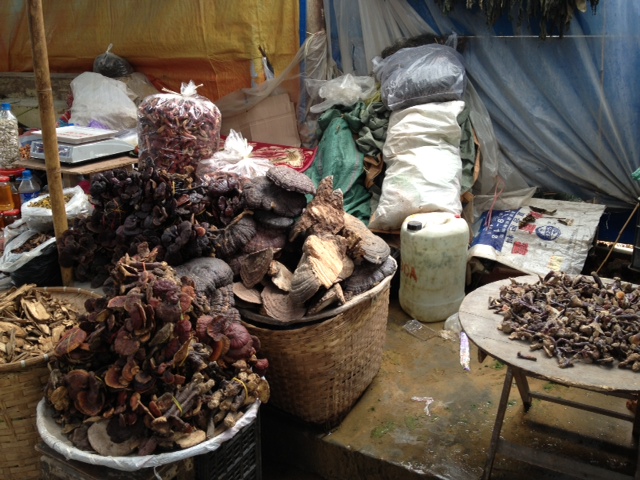 |
| Tree trunk mushrooms |
 |
| Tea leaf salad in front, vegetarian rice embarrassment in back, smoothies standing guard. |
Dai Dai Xiao Diao, a lushly decorated Dai minority restaurant next to a blind massage parlor (where I received my first gua sha of the trip), advertised Lao-style roast fish and though I knew what that would entail - dry red spice rubbed on the outside, gut cavity stuffed with wet green spice - I went for it.
As though the dry and wet spice weren’t enough, the fish came (along with lettuce leaves, fried garlic and mung beans, a mystery fish-mint cousin, and cilantro) with a mildly foamy orange sauce for dipping, a mere drop of which sent my nose into evacuation mode yet again.

Spying on my distress from a corner, our waiter very kindly dropped off a different dipping sauce which he claimed was not spicy. Though totally untrue objectively, when compared with the habanero lava lake, it indeed gave mostly the impression of lemongrass and garlic.
As though the dry and wet spice weren’t enough, the fish came (along with lettuce leaves, fried garlic and mung beans, a mystery fish-mint cousin, and cilantro) with a mildly foamy orange sauce for dipping, a mere drop of which sent my nose into evacuation mode yet again.

(I should reiterate here that I am the person who regularly gets into near-altercations with Thai and Chinese restaurants in the U.S. who are reluctant to make my food spicy enough.)
However, with the lemongrass dipping sauce, the fish made an extremely satisfying dinner. Dragon-backed and with almost no bones to speak of except for a robust rib cage, its flesh was easy to dig out, place in the lettuce leaf, and sprinkle with trimmings. The flesh alone was white and mild, but smeared in dry spice, soaked in wet spice, wrapped in leaves, and sprinkled with beans and garlic, it came alive in the kind of way that only really overwhelmingly flavorful meals can.
When what should by all rights be way too many axe-wielding ingredients somehow settles down, smooths out, and hits your throat as a unified whole, you know the chef really knows his stuff.
Thursday, August 22, 2013
Betraying Japanese river fish
In slippers, we padded eagerly down the stairs and into the dining room of our minshuku. Each table was set with what looked from far away like dozens of hot plates, platters, stone pots, and side dishes. I found it difficult to maintain Japanese composure, and would rather have leapt into the dining room yelling with excitement than what I did do, which was glide in as Japanese and refined a way as I could manage.
We seated ourselves, poker-faced. A man came by to light the flames beneath our hot plate and our bowl of soup. The candles burned steadily, setting the soup to bubbling and the hot plate to spattering.

And as I dodged hot oil from my exploding fatty beef slices and Shimeji mushrooms, I noticed something.
Those fish... the ones near the right, the whole ones with sea salt so artfully crusted on their fins and tails...
Younger versions of them had just been hanging out with me in the river that morning.
Kawayu Onsen, in Wakayama province, is a town built along a bend in a mountain river where boiling water comes bubbling up in tiny spurts through cracks in the riverbed. The water is generally cold, but when the pebbly bottom is disturbed, either by a too-aggressive wiggling toe or by a hired hotel bulldozer come to forcibly create baths, boiling water comes shooting forth, either mixing with the cold to form a comfortable bath, or scalding whatever unfortunate skin unveiled it.
I had found a comfortably shallow, smooth-stoned lounging place with hot bubbles surrounding me and heating the water to body temperature. I was leaning back against a rock, enjoying the tingling feeling of what I thought were bubbles bursting against my skin, only to find out that hundreds of little silvery fish were darting around my limbs, trying to eat up my freckles.
It was a guilty realization for sure that night when I realized my tiny massaging friends' parents were on my plate. It was even worse when I realized the fish heads were bitter and inedible. I sucked the salt off their fins and crunched their tails, hoping that savoring at least that much of them would make my betrayal worth it.
As for the rest?
Being a devotee of the wonderful, country-style Domo Restaurant in Denver, as well as an unabashed fan of most Japanese dishes, I was shocked to find that the country-style food in the actual Japanese countryside was not, generally, my cup of tea. Not dinner that night, not breakfast the next morning, and not even the beautifully presented bento-style lunch pack they tucked into our hands as we left to take another dip in the river before our bus back to town.
While everything we ate looked like a whimsically wrapped present, it boiled down to two basic flavors: vinegar (pickles) and soy. When food was not pickled or marinated in soy, it was left to fend for itself. This, of course, works when ingredients are very fresh, but there was no evidence that these were. (Though I will allow that the eggs were, as I didn't die after eating a big bowl of rice with a raw egg cracked in.)
I had found a comfortably shallow, smooth-stoned lounging place with hot bubbles surrounding me and heating the water to body temperature. I was leaning back against a rock, enjoying the tingling feeling of what I thought were bubbles bursting against my skin, only to find out that hundreds of little silvery fish were darting around my limbs, trying to eat up my freckles.
It was a guilty realization for sure that night when I realized my tiny massaging friends' parents were on my plate. It was even worse when I realized the fish heads were bitter and inedible. I sucked the salt off their fins and crunched their tails, hoping that savoring at least that much of them would make my betrayal worth it.
As for the rest?
Being a devotee of the wonderful, country-style Domo Restaurant in Denver, as well as an unabashed fan of most Japanese dishes, I was shocked to find that the country-style food in the actual Japanese countryside was not, generally, my cup of tea. Not dinner that night, not breakfast the next morning, and not even the beautifully presented bento-style lunch pack they tucked into our hands as we left to take another dip in the river before our bus back to town.
While everything we ate looked like a whimsically wrapped present, it boiled down to two basic flavors: vinegar (pickles) and soy. When food was not pickled or marinated in soy, it was left to fend for itself. This, of course, works when ingredients are very fresh, but there was no evidence that these were. (Though I will allow that the eggs were, as I didn't die after eating a big bowl of rice with a raw egg cracked in.)
 |
| That's what you do when your bowl has a raw egg in it! |
 |
| Lunch bento, layer 1. |
Subscribe to:
Posts (Atom)