Showing posts with label Japanese. Show all posts

Wednesday, August 9, 2017

Review: Destination 1 (Hokkaido)

In transit to my next destination, Taiwan, I reflect upon my 16 days in Hokkaido.

New dishes/ingredients tried that I’d never tried before:

Haskap berries: I couldn’t find them fresh, only partially frozen and ice-encrusted in the too-cold refrigerator section of the souvenir shop at the Otaru JR station. They were tongue-buzzingly sour and only palatable spread on a croissant.
Hairy crab: This is the food I kicked myself for nearly a year for failing to try in Hong Kong. I would have failed here in Hokkaido as well – you seem to need a deep-pocketed entourage for a hairy crab feast, and all I have is a staunch vegetarian – except that on my last day in Hakodate, I was thrilled to randomly find a giant pre-cracked hairy crab leg and half-body submerged in my miso soup, which was itself an accompaniment to:
Fresh squid sashimi: While I have had squid sashimi before, I’ve always dismissed it as flavorless rubber bands. Cut directly from a squid that was swimming around seconds before, it’s more like flavorless tacky jello strands. Oh well. I tried.
Squid ink ice cream: Sinisterly pitch black ice cream that tastes like… cream. Perhaps squid just doesn’t have any taste at all? But lest you think maybe I’m just biased against squid…
Squid liver: As you may gather from this entry, squid liver is a winner, along with every other type of liver I’ve ever eaten.
Squid crackers and sea urchin crackers: These are a mainstay on shelves in souvenir shops, and are actually delicious, and yes, do actually contain squid and sea urchin as a significant portion of the ingredients. No, I don’t know how they don’t go bad. They have the texture of slightly thicker versions of those baked potato chips that cornered the ‘healthy chip’ market back when people were still scared of fried food.
Iwashi (sardine sashimi): Sardines are amazing as sushi. So soft and silky and yielding. Why they’re pooh-poohed as lower-class fish is utterly beyond me.
Yubari melon: Furano is famous for these melons, and I ate one with the aromas of melon and lavender mingling in the air, drifting over from the farms in which they were grown.
Wasabi sorbet: This was pressed upon me by the sweetest pair of Japanese (but English-speaking) tourists from Yokohama who happened to sit next to me at a fancy traditional sushi bar and keep me from making a fool out of myself. They were shocked to find that Americans use the terms ‘wasabi’ and ‘horseradish’ more or less interchangably, and wanted me to have this sorbet to prove once and for all that they’re different. I mean, who would eat horseradish sorbet? It was mild, vegetably, and more tangy than spicy.
Japanese-style cheesecake: More of a suggestion of a cake than an actual physical cake, these airy half-palm-sized cakes evaporate into a light cream the instant they come in contact with your tongue.

Favorite meal: Ha ha, this is not a remotely answerable question. Let’s try these:

Best uni (sea urchin): Let me preface this by saying that I will probably refrain from eating uni in the U.S. from now on. After having better uni than fancy-U.S.-restaurant uni as a) a flavoring on a gift shop cracker, and b) from a grocery store deli case, I am now irreversibly spoiled and choose to wait until my next Japan trip. Anyway, I picture the taste of uni on a spectrum from iodine-y or bitter (bad) to briny and oysteresque or sweet (good). The best briny uni was either at Uni Murakami, the formerly Michelin-starred eatery at Hakodate’s Morning Market, or at Sushi Dokoro Kihara in Yunokawa, and the best sweet uni was either at the Jiyuichi Market in Hakodate or at Sakanaya no Daidokoro in Sapporo. So yes, basically I’m saying that almost every uni I tried was awesome – just awesome in different ways.

Also, my dad requested that I title a blog post “Searchin’ for the Urchin”. Since I don’t plan to do an entire post on uni, please consider that the title of my last paragraph.

Best ramen: Full disclosure: I’m not a ramen girl. But each Hokkaido city I’ve visited lays claim to mastering one of the three major types of ramen, so it’d be silly not to pit them against each other. Asahikawa owns shoyu (soy), Sapporo owns miso, and Hakodate owns shio (salt).

Keeping in mind I only sampled one restaurant in each city, the winner is pretty easy: Sapporo. Ramen Shingen’srich, salty, murky red broth, snappy noodles, and thin-sliced, fully-half-fat pork was thoroughly enjoyable all the way to the last sip, and could only have been improved with an egg, which was my fault for not adding on. I cheated a little at Mizuno in Asahikawa by ordering ginger shoyu ramen instead of plain shoyu ramen, but I really don’t like shoyu ramen and wanted to give it at least a chance to be palatable. And it was: spicy with ginger shreds and full of tender bamboo and skinny noodles. Hakodate’s Ramen Ajisai comes in a distant third with ramen that tastes like chicken broth and is topped with still-cold deli-turkey-esque ‘chashu’. Better stick to squid, Hakodate. (No doubt they serve squid ramen somewhere.)

Most Unexpectedly Amazing Meal: Toyako Onsen may have overlooked a breathtakingly beautiful misty volcanic lake, but it barely had any food options (I ate dinner at 7-11 the second night, after some nightmarish takoyaki the first one). However, when we biked around Lake Toya’s perimeter, a surprisingly difficult (but of course picturesque and worth it) 22 mile slog, we discovered that the town on the opposite end of the lake featured a visitor centre with outstanding bukkake udon made with thickly marinated mushrooms, tempura crumbles, green onions, nori, and a fresh raw egg cracked over it all. Let me repeat: a visitor centre. In a touristy town. With no obligation or impetus to have good food. This simple noodle dish was so carefully portioned and divided and every ingredient tasted like it had just been picked, laid, sliced, or fried.

Meal At Which I Was Most Out Of My Element: I accidentally chose a really fancy traditional sushi bar for lunch in Yunokawa where only about 9 patrons were let in at once to sit in a semicircle around three sushi chefs who dedicated themselves exclusively – up close and personal – to 3 patrons each. Since everything was omakase, it didn’t matter that I couldn’t order, but there was a certain amount of risk in not being able to fit nigiri into my mouth whole, dipping the nigiri wrong and the rice falling apart, getting full before the courses were finished, being served octopus, etc. Luckily, the English-speaking couple from Yokohama was there, and I copied everything they did, sighing with relief whenever they did something imperfect to mask my own imperfections. I was rewarded with excellent uni (of course – de rigeur by now), a long skinny shell-less crab leg topped by organy tasting roe, two different cuts of tuna, scallop, and crunchy herring roe with the texture of baby corn. And the wasabi sorbet, of course.

Most Un-Japanese Meal: Surprisingly, NOT the Indian thali I had after overdosing on seafood bowls. The winner of this category goes to a woodsy cabin in Furano serving curry rice that had rude, confrontational signs all along its outer walls with unfollowable rules about how to behave. They were very firm about customers finishing their plates, admonishing foreigners (and only foreigners; the signs all began ‘Dear foreigners’) to only order what they could finish. I ordered the smallest possible menu item, and it was gigantic. While this totally un-Japanese frustation annoyed me, I have to admit that their homemade sausage curry rice was the best curry I’ve ever tasted. Spicy and complex, it bore no resemblance to any chain or boxed variety.

And I got full before the plate was empty, and I left, and there was nothing they could do about it.

The Breath of Fresh Air: I love seafood, of course, and I estimate I ate it every single day on this trip. But sometimes I longer for a vegetarian interlude, and Rojiura Curry Samurai in Sapporo provided the best of these rare interludes with a curry claiming to be made with 20 seasonal vegetables. When it arrived, every single one of these 20 vegetables was outlined in relief, from lotus root to cassava to carrot to chestnut. I ordered my curry cut with soy milk to balance the spicy tomato base, and accompanied by a yuzu lassi. Japanese-Indian fusion can be a little watered down, but this was anything but.


When my plane touches down in Taipei, Taiwan, I’ll take my vacuum-packed ika-meshi (rice-stuffed squid) that I bought at the airport, save it for a special occasion when I feel like remembering Japan, and otherwise shift gears. My culinary wish list in Taiwan includes: guancai ban, yam leaves with pork, shimu yu (milkfish soup), fried milkfish, luffa with clam, shachang fish (raw barracuda), mua gui, eel noodle soup, danzaimian, seafood congee, starfruit, durian, pomelo, custard apple, and Taitung sticky rice. Onward!

Sunday, August 6, 2017

The Squid City

I’m at a street festival in a city known as the Squid City, and within the hour the citizenry will be enthusiastically performing the Ika Odori (translation: Squid Dance), a lively dance dedicated entirely to squid, at nearly every street corner in the city.

But none of the food stands at this street festival are serving squid.

They’re serving fried chicken. They’re serving okonomiyaki. They’re serving a staggering array of greyish-looking meats on sticks. And of course, they’re serving bananas coated in chocolate and decorated with candy to look like cute cartoon characters. But not squid. No squid anywhere.

This has been my experience all day. Okay, there’s squid at the Asaichi Morning Market, but much of it is served as a ‘dancing’ dish (confoundingly ALSO named Ika Odori) where the squid’s head is chopped off and its muscles contract in a morbid ‘dance’ as soy sauce is poured over it, usually accompanied by wide-eyed, madly Instagramming tourists, and I’m super not into that.

And, okay, there’s squid in most seafood restaurants, but as sashimi it’s too chewy for me. I certainly don’t want a repeat of that sashimi restaurant in Asahikawa where I lost all the face in the world by unsuccessfully covering up my unchewable octopus with an insufficient pile of daikon radish.

I just want some casual, cooked squid. Straight-up grilled. As tempura. Legs akimbo in a pile of soba noodles. Even on a stick, spiced so aggressively I choke on it (this happened in Hunan, China).

It takes me all day to finally find it, after many false starts, including being refused seating at an outdoor restaurant for not wanting to order alcohol. It’s in an alley paralleling the festival called Daimon Yokocho, and has no recognizable name, but on its window is taped a picture of a grilled, sauced squid sliced into perfect strips like a big fat squid-shaped piano.

I order the version with liver and organs intact, and wait. It comes out bigger than expected, perhaps three-quarters the length of a forearm. Its triangle-shaped head’s angles are curled and crispy from the grill, and it lies in a pool of liver-tinged sauce. It’s cut into rings, as in the picture, but since I ordered it with organs, it looks like it’s stuffed with paté. Ankimo (monkfish liver) is one of my favorite dishes to order in sushi restaurants, and this is like ordering two plates of it served inside a squid.

Some of its other organs taste and feel to-the-note like miniature mussels. Maybe they are. Maybe Hakodate stuffs their grilled squid with mini mussels. Maybe they FEED their squid de-shelled mussels. I don’t know how Japan works, or how squid works, or how any of this works, but I know I like this squid and I like its organs. I wish some of my paté-loving relatives could try this, in the same way I wish they would try balut, which also tastes a bit like paté. A liver is a liver is a liver, even if it’s a squid liver, a monkfish liver, or a fetal duck liver.

Full, pondering squids and livers, I wander back to the street festival, where a crowd has gathered around a Hakodate-Singapore Friendship Float, all ready to dance the Ika Odori. We’re all dancing the Squid Dance, but I might be the only one dancing the Squid Dance literally full of squid.

Saturday, August 5, 2017

Easily Found Food

In foreign countries, there are lots of ways to fail at finding and eating the food you have so carefully researched ahead of time.

Vietnam specializes in the unauthorized duplication of famous stalls, presenting you with the quandary, for example, of three seemingly identical banh xeo stands facing each other across an alley. Korea likes to write its menus in a loopy, highly stylized script on wooden planks deep inside the dining room, where it would be exceedingly awkward to stand for minutes with face buried in Google Translate. China likes to run out of whatever the restaurant specializes in right as you arrive, even if you arrive at 6am. Malaysia goes a simpler route and just makes it impossible to walk anywhere.

Hokkaido, however, has taken all my memories of frustrated, fruitless city-wandering and shoves them aside. All restaurants are where they say they are, and if they don’t have lacquered replicas of their dishes in display cases outside, they have colorful posters, and if they don’t have colorful posters, they have a waiter willing to parse my halting hiragana-reading.

Unagi Kamogawa is wallpapered around the outer door with shiny but simple images of eel. Eel in round bowls and eel in square bowls – that’s it. I step into a den thick with eelsmoke, take off my shoes, and practically trip down into the space beneath the squatting table. A customer with one protruding bottom tooth and slow but confident English tells me he only eats eel once a month because it’s so expensive. It is – my round bowl is ¥2200 – but the two thick fillets are more smoky and tender than sweet and cloying, have only tiny flexible little bones that yield easily to my swallowing, and come with pickled vegetables and a clear soup featuring a mystery spring-onion-looking thing that tastes a little like a fish cake.

Sapporo’s Nijo market solves my ever-present problem at seafood markets: seeing all this delicious seafood but being unable to do anything with a giant horsehair crab or tank of abalone in my hostel/Airbnb. Next to the tanks of waving tentacles and claws and bubbling shells, there are restaurants, and the restaurants will put any combination of the market’s wares in a rice bowl for you. Again, it’s pricey, but ¥3800 gets me a sea urchin/salmon/salmon roe kaisen-don accompanied by a bowl of miso soup with, no exaggeration, half a crab tilted out of the side as if to mount a too-late escape attempt. The urchin is so soft and indistinct that it looks like scrambled eggs, usually bad news for a creature that gets runnier the longer it’s out of its shell, but it’s so mild and sweet that perhaps even avowed uni-haters would reconsider. It stains the rice under it sun-yellow, a welcome leftover after disappearing so quickly.

Oddly, the urchin here is better than in Otaru, the port where they actually capture them. Otaru’s kaisen-donlets me sample two different species of urchin, the northern variety and the short-spined variety, and while both are firm-edged, their flavor is tinged with iodine, and one’s color is somewhat greenish. Both would be laudable in a US sushi bar, but compared to Sapporo’s scrambled-eggy urchin, they pale. The winner in the Otaru bowl is the giant mound of crab meat next to it, taking up fully half the bowl and remaining sweet and stringily flavorful to the last mouthful. I always feel weirdly decadent eating chopstickfuls of crab meat, knowing the work it takes to extract just one strand from a shell, and as if to underline my uneasiness, they place a crab claw across the bowl with half the shell cleanly removed to reveal a perfect, untouched, still-claw-shaped wall of meat, ripe for the taking.

But one can’t always spend $30 on unagi or kaisen-don, and this is where Japan’s unsung heroes step in: train station restaurants. They always have English-speaking workers, and JR Sapporo Station is so much more than a train station, so it may be unfair to call its food train station food, but still: it’s a mall – actually three malls – two subway stations, and an underground tunnel to ensure continued commerce even during Hokkaido’s long winters. And it provides me with:

legitimately excellent soba (studded with melt-in-your-mouth shrimp tempura and a tidy pile of tamago)

airily-breaded tonkatsu surrounded by stuffed eggplant and shrimp, accompanied by mustard greens and silky chawanmushi

– a bowl filled with big chunks of soft tuna, bright green avocado, and that slimy white mass known as mountain yam that I usually hate, but that somehow ends up blended with rice to make a sticky-rice-like concoction, accompanied by gorgeously silky black sesame ice cream splashed with matcha ice.

Asahikawa Station, for its part, though only attached to a mere one mall, has a version of takoyaki that is perfectly cooked, incorporates greens into its batter and comes with a sour, zingy yuzu sauce. I pair it with a sugar-dusted green tea custard-filled taiyaki from a few stalls down.

While Japan may be lacking in the thrill of the chase, and therefore in providing me with the satisfaction that comes after having successfully chased a food item down, it’s kind of nice sometimes to just be able to decide what I want to eat, set off on an organized, efficient public transit system, and eat it!

Thursday, August 3, 2017

The Octopus Dilemma

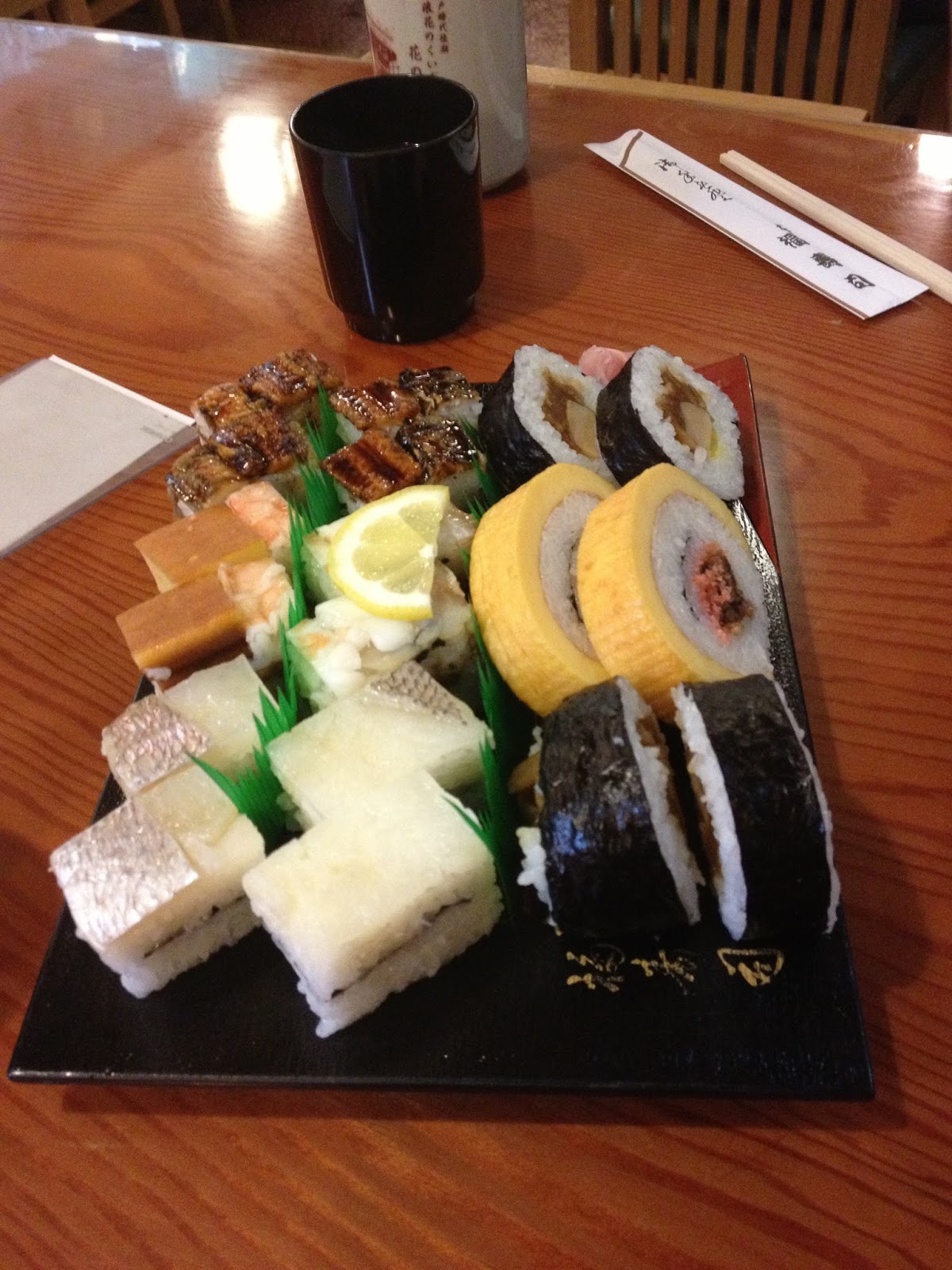
She comes out carrying a long, square, boat-shaped platter piled high with six different types of sashimi. This is exactly what I meant to order, which is a miracle considering I had to try to explain in Japanese that I wanted sashimi from Hokkaido only.

With the aid of a bilingual fish info sheet she procured from some hidden closet, we confirm that what is in front of me is, from left to right: hirame (flatfish), tako (octopus), hokkigai (surf clam), hotate (scallop), amaebi (raw shrimp), and iwashi (sardine). With a bow, she withdraws, though I can see her hovering in the corner in an area she might think is just out of my sightline. She is extremely anxious to please, which I find heartwarming considering I entered her establishment alone with terrible Japanese skills in a tank top and wide-leg pajama-esque pants to take up the only non-tatami four-top in the restaurant.

At first, there’s no problem with being attentively spied upon, since the iwashi are tiny maroon-striped fatty oily wonders coupled with ginger and green onions that make me wonder why we ever bother to cook, pickle, or jar them, and the amaebi, tiny tender little pink fingers, make me forget every negative word I’ve ever said about raw shrimp having the texture of dried glue.

I get nervous as I get closer to the octopus, though. Octopus served as sashimi is almost always inedible for me, and not because I don’t like it the taste. In fact, the soft white rubber banded fat around the tentacles of this version is plump, oceany, and delicious. What I mean is that I literally cannot eat it, because my front teeth are incapable of tearing off a piece, and my molars are incapable of crushing it.

Sadly, this turns out to be the case here. The only way I’m going to be able to eat this octopus, I know, is if I tear at it with my paws like a bear at salmon, suck the fatty tentacled area off with a big slurp and leave the rest, or choke to death trying to fit a whole piece in my mouth at once. So I know I’ve got to find some other way of getting rid of it.

I’ve been faced with this dilemma at sushi bars before. I have a vivid memory, for example, of sliding a piece of slimy, rank uni (sea urchin) nigiri slowly off the bar and into a napkin-lined jacket pocket, permanently imbuing the pocket with the smell of iodine, just so the chef wouldn’t know I didn’t eat it.

But there are no pockets in my pajama-like pants to slide the octopus into, and even if there were, I’m being watched closely enough that this isn’t an option. So I eat the rest of the platter with obvious appreciative gestures, which isn’t difficult given that everything else is excellent, and as I chopstick up various pieces of fish flesh, I nudge the pile of shredded daikon and onions ever closer to the pile of octopus. With each bite that travels to my mouth, the pile of vegetables overtakes the pile of octopus, until, at last, my tastebuds are vibrating with the last rich sardine (please make it a point to try sardine sashimi, everyone, really), and the octopus is very superficially covered.

I linger for awhile with my green tea, but realize that I’d better get up and pay at the counter so she doesn’t come over and look at my platter while asking how everything is, so I do that, and after I pay (a bit of a shock at ¥3200), she delivers a mouthful, a couple sentences maybe, of utterly incomprehensible Japanese, looks at me expectantly, and when it becomes clear I have no idea what she’s talking about, abruptly leans around me to gaze directly and at length upon the contents of my vacated table.

No ‘oiishi-des’s in the world can hide my abandoned tako now.

Is this a grave expression I see coming over her face as she places her hands on her thighs, bows more deeply than she yet has, and sends me on my way? Or is it just me projecting my shame?

Saturday, May 10, 2014

California Chirashi Wars


I’m a chirashi fiend, but not for the normal reasons (and there are plenty of normal reasons to love chirashi, like, oh, I don’t know, that it’s fucking delicious*).  No, I’m a chirashi fiend because – this is embarrassing – but because my mouth is too small for nigiri.

It’s ridiculously awkward to be seated all primly and silently in front of some perfect-postured, kindly-eyed fish-slicing wizard who’s spent his whole career polishing his arrangement technique, to be handed an aquatic work of art, and then to spill the whole thing in a waterfall of shame down my chin and onto the front of my shirt when I try to either bite it or force the whole thing in.

I touched on this briefly here and I won’t comment further except to say that I’m being overdramatic for effect (although the description of the waterfall of shame is not an exaggeration): of course I still eat and greatly enjoy sushi.  But I am less inherently stressed by chirashi, where I can bite my fish in half in peace.  To me, a good chirashi place is like a neighborhood diner.  I go there to relax and enjoy the closest thing to a Cheers-style diner, only with the kind of food that refreshes and invigorates me.
I have an unequivocal favorite chirashi place in the Los Angeles area, and that’s the implausibly located and discouragingly named Toro’s Japanese Fusion Seafood.

It sounds like it could be a wacky-roll emporium, but despite the giant-screen TV set up behind the chefs that constantly plays deep sea or aquarium slideshows, it’s not.  It’s the purveyor of what are almost certainly the thickest, pillowiest, most flavorful and oceanic slices of tuna in Los Angeles. 

The restaurant is called ‘Toro’s’ for a reason – it’s owned, and likely kept afloat by, tuna.
It’s sliced thick, fatty, and looks absolutely nothing like the archetypal dark maroon maguro.  You know the kind: you see it, darkened and cloudy, stuffed next to cucumbers and browning avocado in supermarket sushi, and more often than not, it’s mixed with and camouflaged by ‘spicy sauce’.  Old, it’s smelly, but even fresh, in my opinion, it’s usually flavorless.

Not at Toro’s – the tuna here is a bright salmon pink, striped with fat, and snuggles into the rice’s nooks and crannies like a blanket.  They cut it huge and thick, at least the width of my finger.  It’s not only the tuna they cut thick – the hamachi is thick enough to see its shiny, cream tinged white sheen, and the salmon to count up to ten striations in its rich orange flesh.

Those three fish may be the predictable three ‘chirashi fish’, but they sure don’t taste the same here.
Toro’s will also put in, depending on the season, scallops, ikura, spicy albacore, squid, lotus roots, hirame, or masago… but there’s always ample seaweed, a beautiful triangle of sweet tamago, and perfectly vinegared sticky rice.

For dinner, the restaurant is outrageously expensive – although probably still worth it.  I wouldn’t know, because I would never pay $60 to fill myself up on even the best quality sushi when I can roll in at noon and pay $16.
Toro’s takes the top spot in my heart, so it will take up the majority of the text space, but I have some honorable mentions to award, too, in case you don’t want to drive all the way out to Alhambra (but, just saying, you should drive out to Alhambra).

Murakami Sushi in West Hollywood has the casual ambiance that I crave – its breezy outdoor seating is paired with compact, ideally proportioned, and customizable bowls of fish that are impressively fresh for the price (though nothing compared to Toro’s and the fish is certainly not sliced as generously). Murakami specializes in build-your-own chirashi – you choose 4, 5, 6, or 7 types of fish and the price goes up in increments, starting at $12 for the 4 ingredient bowl. My favorite combination is mackerel, hamachi, scallops, and salmon. The scallops, tender and marinating in a masago-flecked white sauce, really are outstanding.

Tamon Sushi, in the Miyako Hotel downtown, is way too fancy for my taste, but if you’re a presentation junkie, you’ll love the ornate, double-layered chirashi (top dish, sorry for the blurriness). It also boasts the best ikura in town, with pops so dramatic you’ll swear you’re eating pop-rocks (or those weird fruit-burst things they’ve got in Yogurtland now).

The fish itself, in my opinion, is unexciting – fresh, clearly, but unexciting. The joy lies in the variety – taking turns surprising your tongue with the pops of ikura, the gum-like tako, the crunch of lotus, the tacky slips of sea bream, and the accompanying pickled salads and sticky mochi. If you bring a friend, force them (I mean, cajole them nicely) to order the Tamon Bento, whose shiso dust-topped rice, giant juicy mushroom, and greasy, charred, and flaky black cod make an excellent accompaniment. The shrimp hiding within the tempura is springy, but the time I went, the oil was a bit stale.

Though Tamon sounds like the weakest of the the three options I listed – and it is – there are a couple reasons to choose it. The first is if you are on a date and you want something darkened and formal. The second is that Fugetso-Do is across the street, and you can you stop by for some 101-year old mochi. I mean, the mochi isn’t 101 years old. The shop is. And the instant your teeth sink into one of their creations – silky, soft, fluffy clouds that envelope your tongue in joy and happiness – you’ll know why.


*I have noticed that the only way I can be positive that Anthony Bourdain REALLY likes something is if he calls it ‘fucking delicious’. He might have written 4000 words on its preparation or the bumpy third world train ride he took to reach it or the artistry of the chef that dreamt it up, but if the words ‘fucking delicious’ are not present, all bets are off. So please take this phrase in the manner in which it’s intended: to convey that chirashi is something I love, crave, and aggressively seek out on a regular basis.

Tuesday, February 11, 2014

Tasting without tastebuds: Eating during flu season


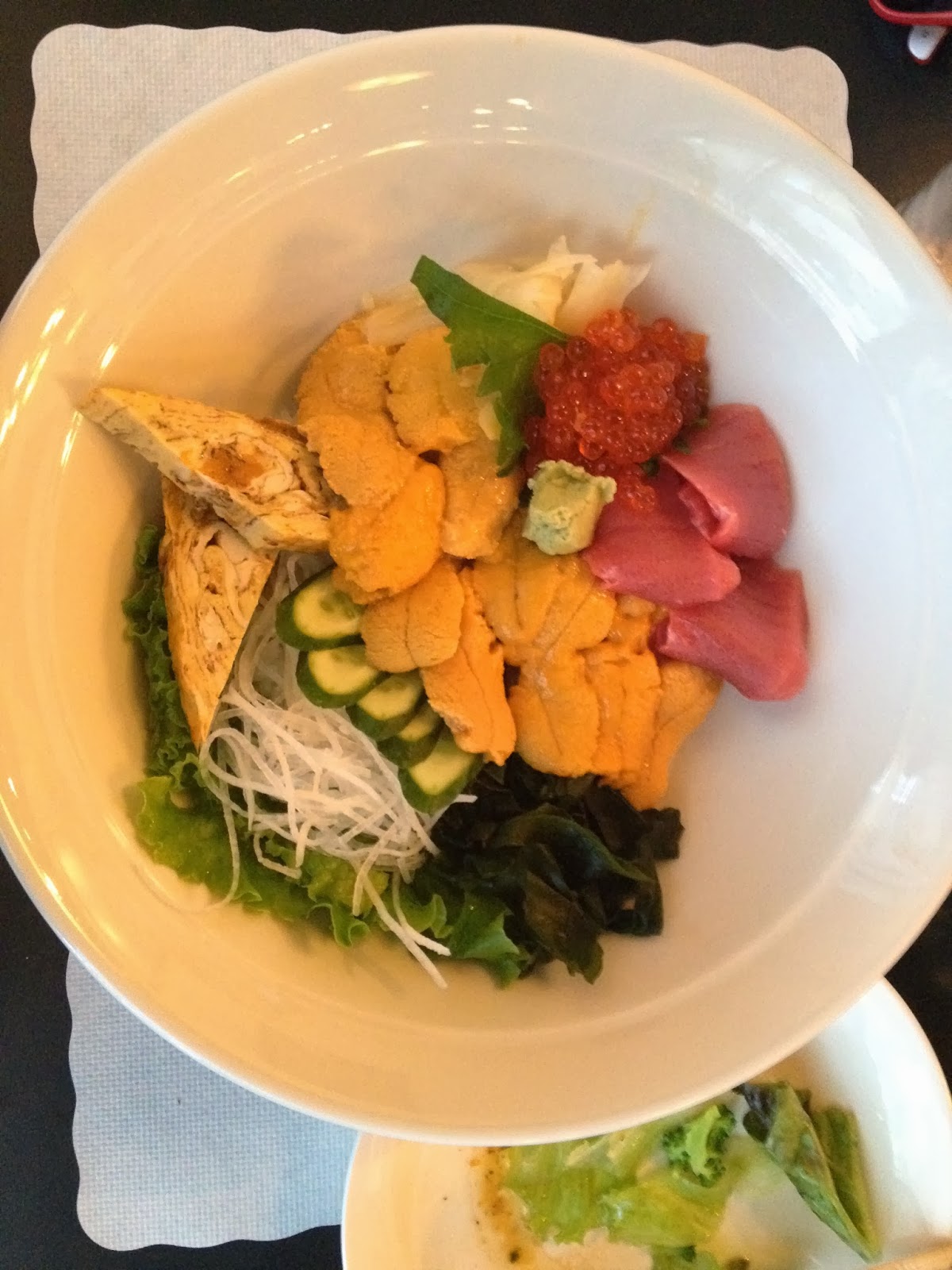
There's a bowl the size of my face on the table in front of me.  It's heavily layered in seafood, its peaks and valleys striped and shining.  Sprigs of seaweed spring like ribbons, and play-doh-like puddles of uni overlap one another.  The musky aroma of charred uni-stuffed tamago curls into my nostrils

Or it would, had I any sense of taste or smell.  I only know that it is, objectively, because I have had this exact bowl before.


You may recall that I lost my sense of taste in Japan last July for a few days.  This completely blindsided me, reducing me to a crying, paranoid ball of uselessness.  It had never happened before.  It had no precedent.  What if it never went away?


Well, it did go away - luckily, because I had two more months in Asia, and a tasteless trip in Asia is a depressing trip in Asia - and when it happened to me again a few weeks ago, I remained dry-eyed, knowing that it would pass.


Also, my dad was in town for four days and he required a food guide.  Basically, I was going to eat, I was going to eat constantly, and I was going to have to find a way to like it.  There was no wallow-in-self-pity option this time.


-----


To hold back my intermittent waves of regret as I consider the prospect of eating this bowl without tasting it, I start thinking about what else I can do to help me enjoy it.  Might this help me get better at noticing texture?  Is it possible for me to enjoy the tiny snaps of fish egg membrane on my tongue as much as I normally enjoy the little individual waves of saltiness?


Viewed through a textural lens, the bowl takes on an utterly new quality.  It's a little bit like trying to taste in a dream.  In dreams what one experiences is based entirely on inference and expectations, since there are no external stimuli.


Or maybe it's like trying to appreciate one of those thickly layered, practically 3-D oil paintings by licking the surface and feeling the points and swirls of the dried paint on my tongue.


I have to ignore the tendency to infer and focus only on what I can actually feel.


What I can feel is those tiny snaps, how far my teeth can go before their pressure breaks the roe's surface tension.  It reminds me of watching videos of water gliders walking on ponds.  I try to hold my teeth at that exact point where my teeth are skating across the surface.


What else I can feel is the pillowiness of the salmon enclosed in the sharp, close sheets of seaweed.  If I get a piece of fish between two pieces of seaweed, the salmon abruptly shoots out the sides into my cheek like a Nerf ball, and I have to reconfigure the food in my mouth in order to chew it all at once.


The tuna is more striated than the salmon, and this allows it to fall into neat, even blocks after one clean chew.  I like it best with with strips of daikon, like onions around ceviche.


And the uni - oh, the uni.  Ten tongues of glistening marigold, and I know that they taste like sweet oysters and ocean, but I have to not know that for the time being.  They fall apart mashed between my tongue and the roof of my mouth, but for the first time, I notice that the seemingly slimy blob is actually thousands and thousands of miniscule lobes and globes.  Not eggs, but protrusions like the currently nonfunctional bumps on my own tongue.


Something my teeth think is a sort of mushroom turns out, upon discussion, to be sea cucumber, and the squid in uni marinade is oddly identical to certain kinds of Vietnamese c.


The tamago is the only thing that sort of makes it through my heretofore impenetrable wall; even though I can't experience it directly, after I eat it, the inside of my nose feels a little bit like I'm at a barbecue.


-----

Postscript: Spicy BBQ Thai Restaurant


My tastelessness lasts three days, and like last time, it evaporates so suddenly that the ensuing rush of flavors feels like being on powerful hallucinogens!


I recommend, should you find yourself coming off a nasty cold, or even should you not, and just want a delicious, basil-y punch to the tastebuds, you order the Northern special pork patties at Spicy BBQ in Hollywood.

Monday, January 13, 2014

Al Bap Addendum II: Twists of Korea and Japan

Since my love affair with al bap began in the summer of 2012, I have mostly been resigned to making it myself.  After all, if the shortest route to al bap involves 40 minutes on the freeway, why shouldn't I raid the fish roe section of H-Mart and make my entire house smell like chopped kimchi and sesame oil a few times a month?

It took me a few months after I moved to Los Angeles to realize that the shortest route to al bap was no longer 40 minutes on the freeway.  It was 10 minutes in a car (followed by circling insane parking lots full of jostling valets, but I digress) to Koreatown.

Desiring to start my descent into al bap madness in a controlled fashion, I carefully chose two restaurants who boasted wildly divergent approaches to the dish.  (You have no idea how happy it makes me that my potential al bap selection is now so enormous that I can type the previous sentence.)

The first, Chunju Han-Il Kwan, was a bustling stew-ladling madhouse at lunch, the whole place smelling like Seoul distilled and echoing with enthusiastic Korean vowels.  Four waitresses served the whole restaurant; there were no assigned 'areas' or 'sections'.  They came by the tables in shifts while the others filled banchan dishes, refilled and shook the barley-water machine, and visited the kitchen.  Each took care to warn us, in studied tones, to be careful of our hot stone bowls!

The second, A-Won Japanese restaurant, though Japanese in title, murmured quietly with the sounds of Korean just the same.  I was politely shown to the sushi bar with all the other single diners.  Everyone else except me was a Korean businessman silently and methodically scooping up chopstickfuls of rice, fish, and fish eggs.  The sushi bar was staffed by a tall, thin chef who made al bap and hwe dup bap in rows like a single-man assembly line.  He took a break to gaze at me with an unreadable expression as I started mixing the beautiful rainbow of fish eggs, seaweed, uni, and tamago he'd just carefully arranged.  I couldn't read his gaze.  Perhaps I should have taken more than five seconds to admire the swirl of color and its deliberate asymmetry.

Chunju Han-Il Kwan's version came with the normal dizzying array of banchan - some standouts like spicy zucchini and marinated fishcakes were terrific and gone in no time - but the main attraction itself was surprisingly low key on flavor.  Of course, it came out angrily splattering hot oil everwhere, and when I nudged it with chopsticks it sizzled menacingly.  Leaning my whole upper body away, I stirred the rice, dodging the explosive snaps, knowing that my reward would be a perfectly crunchy, yet not unrecognizably blackened, rice layer.

And so it was, and it was the best part of the dish, once I got to it.  Until then, the little piles of tiny roe dissolved so thoroughly into the rice that they left little in their wake but a slight oceany tinge on the tongue.  I ate it enthusiastically nonetheless - the upbeat atmosphere was contagious and the promise of the crispy rice on the bottom propelled me through.

If this al bap was understated, I expected the al bap at A-Won to be overstated.  I'd cheated and looked at pictures of it online, and it was an absurd carnival of colors.  Fully four different shades of roe provided a pointillist background to a big old yellow slash of uni, two different types of seaweed salad (the light green wakame and the earthy green hijiki), and the giant orange marbles of ikura (salmon roe).  Even the rice was speckled under the roe with tiny chopped pieces of tamago.  A few strands of surimi poked their stupid meddling heads up around the bowl.  I scowled at them, but mixed them in with everything else.  My chef was watching.

A-Won's al bap, though, was a whole lot of showmanship masking a similarly muted flavor.  The presence of yellow pickled daikon helped, but the only major difference here was the ikura, which burst showily between my teeth, and the lucky few times I was able to get some uni goo in a bite with all the rest of it.

What have I learned?  I've learned that al bap may only be transcendent when taken as a welcome break from a constant overdose of gochujang, but it's always going to be a comfort food, and whether it's due to bursting ikura or crackling rice, my teeth are going to enjoy the ride.

Tuesday, December 10, 2013

Cold day, hot udon: Marugame Monzo

There is a stark divide among the patrons at Marugame Monzo.

Half of them are fighting their instincts.  Their instincts tell them to be restless.  They tell them to feel irritated at the long wait, the shoulder-to-shoulder closeness, the space for exactly two people to wait inside and no more, this coupled with the freezing (for L.A.) temperatures and threat of rain.  Even once they're seated, the overwhelming smell of dashi, butter, and seaweed coupling with their own empty plates, their instincts tell them to be urgently, impatiently hungry.

Their bodies want to fidget, their fingers to seek their phones, their voices to rise, but their brains won't let them, because their brains are firmly directing their eyes to stare at the Udon-Making-Man.

The Udon-Making-Man is a wonder.  He is perpetually on display - behind a large glass pane at the bar - and perpetually moving.  He isn't a blur, for he moves at a steady, careful pace, but his limbs never stop rolling, patting, flour-sprinkling, stretching, chopping, and rinsing.  Not once does his hand derail to wipe his brow (a kerchief takes care of that) or do his eyes leave his station (despite the pairs of eyes all directed at him).  He displays no evidence of being unsettled by the attention.

The disc of dough grows, it stretches, it's floured.  It's floured A LOT.  "Floury," murmurs my mom from her spot at our hard-won table.  I detect a hint of judgment in her voice that may just be me, projecting my own.  It looks like the noodles are going to taste like a used rolling pin.  90% flour, 10% dough.

They do not.

For the other half of the patrons, those who have received their half-bowl, half-platters of noodles, have a different air entirely.

Their bodies and brains are in harmony: both dedicated wholly to eating udon.  They're wearing constant grins, grins visible even through rapid chopstickfuls of noodles and the motion of conversation.

Mirroring the Udon-Making-Man's, the customers' hands don't stop moving until the job is done.  The job, in this case, is to get every last snake of udon into their mouths.  Every last spoonful of roe-speckled, lightly spicy butter, every last textured tiny tongue of urchin, every last strip of pork fat or duck breast or green onion.

As for me, I look like everyone else - robotically yet wonderingly raising chopsticks to my mouth - but I'm also marveling at the slow build of the spice in the mentai (cod roe) and how well the tiny eggs stick to the noodles, as though the noodles had microscopic gaps made just for them.  I'm wondering how the squid came to be so butterfly-edged and tender, almost like a whitefish, and how the cook coaxed all the rubber band texture out.  I'm staring at my sauce, thinking how even though it looks like melted butter, I still somehow want to eat it with a spoon.

And perhaps most strongly of all, I'm enjoying the udon like I've never really enjoyed it before.  Secretly, I've historically dismissed udon as unnecessarily beefed-up pasta: the steroid-injected gym rat of the noodle world.  This particular udon, though, retains none of the excess flour I watched poured onto the wooden rolling-mat.  It has three textures: the outer bite, the slight give afterwards, and the final chew, which feels like the most satisfying sort of sourdough.

My appetite is hardly ever as big as my tastebuds want it to be, but here I am left with a tiny, penny-sized pool of butter-broth and nothing else.

Tuesday, October 29, 2013

Biography of an ingredient I: Uni (sea urchin)

What it tastes like: 

Proponents laud its flavor as akin to a briny, extra-rich egg yolk or a sweeter, less seawatery oyster, while its detractors argue it tastes more like metallic chlorine with the texture of Play-Doh. Needless to say, this is an extremely polarizing food.

What it looks like:

While the whole sea urchin, undisturbed, looks like a lethal black, red, or green Koosh-ball, what you’ll see on your plate are usually the gonads alone: yellow-orange tongues built out of microscopic eggs.

How it’s served: 


- Plain or lightly marinated, folded over on itself like thick cream, over rice wrapped in seaweed, at most sushi bars. I recommend Ikko (in Costa Mesa), whose sushi is otherwise uninspiring; perhaps they pour all their available love into their urchins, which come out miles ahead of any local competition. Ohshima (in Orange) or Nana San (in Newport Beach) are better all-around sushi bars, whose chefs serve their expertly marinated uni nigiri as an integral part of a whole stunning omakase experience.

- Mixed with cream, butter, various herbs, and often other types of fish roe, and tossed with pasta at various Japanese or Italian restaurants. I recommend Café Hiro (in Cypress), which manages to get every single strand thickly coated with rich orange seawatery goodness.

- Alive, with spikes twitching unsettlingly, creeping away from you at the glacial rate of an inch per minute, on paper plates at live seafood bars like Quality Seafood in Redondo Beach. Make sure that the spiky shell is cracked only after you select your specimen: the point of getting urchins this fresh is that their taste changes subtly after only a few minutes outside their shells.

- Forming the flowered centerpiece of stunningly beautiful chirashi bowls at Maruhide Uni Club in Torrance. This blooming, rich confluence of custard, sea vegetables, and rice must be tasted to be believed.

- Marinated in kombu-shoyu and served as an appetizer on Japan Airlines - but you have to upgrade to first class to get a taste!

Three reasons you should try it: 

1. Sea urchins eat kelp. Kelp forms a protective forest for delicate seafloor life and also slows beach erosion. Save the ocean; dine on urchin!

2. Sea urchin is a diet-cheater’s dream. It somehow has fewer calories than fish like salmon and mackerel while having essentially the same richness experience as heavy cream. It’s also full of omega-3 fatty acids. Butter not allowed? Urchin on toast!

3. If you’re going to eat a live sea creature, better that it isn’t sannakji! Sannakji, Korean-style live baby octopus chopped into pieces and served still wriggling, will grasp and hold fast to the inside of your throat in their tentacly death throes. They can quite literally choke a person to death doing this. Sea urchins, conversely, will just attempt to escape your plate slowly and directionlessly.

Parting thoughts

Who on earth discovered that eating orange slime out of an impenetrable spike forest was a delicacy??

Sunday, October 20, 2013

Snacking across Asia, part I: Japan

If I had my way, I'd only sit down for one full meal a day.  The rest of the time, I'd just wander around, trading coins for snacks whenever the mood or the vision struck me.  I might gobble a handful of fruit in the early morning, gnaw on some dried meat or skewers of some sort in the late afternoon, pop some herbs for a fun flavor game whenever, and let the displays and coaxings of street vendors decide the rest.

Southeast Asia was a snacker's paradise.  Most of the things on sticks that I picked up on a whim for less than 50 cents were tastier than any meal served to me on anything resembling a tablecloth - in the States or elsewhere.

Japan's snacks were harder to come by, usually ensconced in mall hell, and much more expensive, but its gems were among the most delicious.

1. Tokyo: Hotok

We stayed in the Little Korea of Tokyo: Shin-Okubo.  This meant that there were barbecue joints everywhere, which didn't faze me one way or another, but it also meant a preponderance of the Japanese take on Korean ho-tteok: rice 'pancakes' full of, well, in Korea it was almost always brown sugar and walnuts or pepitas, but in Japan it was whatever anyone felt like throwing in there.

Manning my favorite hotok stand was a trilingual, teenaged Korean national with his long hair always wrapped in a bandanna, trapped in Tokyo for some reason that remained undisclosed due either to language barriers or sensitivity.  He was jolly, correcting my noob mistake of trying to hand him money rather than feed it to the coin-taking machine on the right.  He had the ability to cook at least 5 pancakes at once, flipping them casually as he catered to the throngs of teenage girls flirting with him across the counter.

Over my three days there, I got a classic seeds'n'sugar version, a sweet potato version, and a ham and cheese.  Korean sovereignty won out here: the classic was still the best, filled to bursting with oozing brown crystals.

2. Osaka: Dried kumquats

With two new hostel friends, we were on our way to sample the takoyaki on an all-new side of town (this is how it went in Osaka: move hostels, immediately try local takoyaki).  A man stood proudly under a big awning with a staggering array of dried fruit spread out around him.  He held samples out to us in that confident, cool, kind of ambivalent way where you could tell it wasn't any skin off his back whether we tried some or not because he was just going to go on selling the best dried fruit in the city.

That kind of attitude persisted as I tried some blueberries, gasped in delight, filled my bags lightly with these, persimmons, cranberries, strawberries, and kumquats, let him weigh them, was told my exuberance would cost me $55, sadly dumped out all but but the kumquats and blueberries, was told this was still going to be $25, dumped out the blueberries, and left his stand somewhat in price shock, $8 poorer, but in possession of about 15 dried kumquats.

I was grumbly about the whole thing (and we had to hide from the dried fruit man on the way home) but I was soon to discover that I should have bought kilos of these kumquats at any price.  Though dried, they were still juicy, and their crispy sugared outsides collapsed inward when bitten like bittersweet creme brulée.

3. Osaka: Black sesame ice cream with green tea ice and mochi

This cute green tea bar was located on the seventh floor of a big, showy mall in Namba, and just heaving myself onto the escalator for each of these flights made my poor stomach turn.  I had just eaten an unbelievably rich bowl of pork rib ramen (the last dish described in this entry) and badly needed something refreshing.


$6 got us this goblet of black sesame ice cream, black, thick and gooey like a sphere of delicious tar, surrounded with icy sweet green tea foam.  The ice cream wasn't even a little sweet.  It was concentrated, smoothed out seed.  The mochi balls were superfluous; I ignored them.  Japanese music box version of songs from the Little Mermaid tinkled overhead.  We sang along, utterly inappropriately for Japan.

Next time: Chinese snacks!

Friday, September 6, 2013

Sushi Dai, supermarket sushi, and the sushi in between: Part II

(Continued from Part 1.)

I have a confession to make: I regularly eat sushi from American supermarkets.

I know it's a sorry excuse for what can be a true art form.  I know that if you put rice in the refrigerator, it totally ruins it, and that everything keeping the not-so-fresh raw fish from killing me is a preservative and preservatives are bad.  I know.

But sometimes I get a craving and it absolutely does not matter if I can only fulfill it by eating something that's only as akin to restaurant-quality sushi as a McDonald's burger is to one made with Kobe beef (actual Kobe beef, not fake American Kobe beef).

Last year, every week before my graduate seminar in social psychology, I would go to 'The Cage', which is an on-campus convenience store that sells things like Pringles, wrinkled day-old donuts, powerbars, and slimy old tuna sandwiches.  And, inexplicably, raw salmon handrolls.

They were always terrible.  There was spicy orange sauce everywhere, the cucumbers were often so bitter I had to remove them, and the fish was occasionally edible alone but more often required a full slathering of soy and wasabi.

Basically, everything I am telling you should disqualify me from any pretense of judging Japanese supermarket sushi, but I'm going to anyway:

IT.  IS.  UNBELIEVABLE.

And cheap!
($3.98 for 8 pieces)
When I was in Osaka, it was hot.  Smotheringly so.  There was one day when I had had just about enough of darting from covered mall to covered mall, looking at stacks of platform shoes because going in the sun would make me pass out, so I went to the supermarket, picked up the first package of to-go sashimi I saw, and booked it home before the heat brought the fish back to life.

I kicked my shoes off at the door, hauled open all the windows, sprawled on the bed, and lifted each piece of hamachi by two fingers, dropping them into my mouth like gummy worms, expecting them to satisfy my only slightly more than hamachi-flavored gummy worms would.

Instead, I found myself with a mouthful of fish fit to be served festooned on a platter at any sushi bar.

Seriously, I would not have been surprised or disappointed had I encountered it in a swanky izakaya or a spare, traditional establishment for $4 per piece.  I would have welcomed it, savored it, reviewed it highly.

And here I was with it between my fingers on a lazy weekday afternoon in a hotel room for $0.50.

The sushi at every big supermarket was this good.  Hamachi, sake, saba, and maguro.  I'm ashamed to admit it, but some days I didn't really want to go out searching for restaurants because I knew that if I wanted to and with almost no effort, I could lounge around popping sashimi like potato chips for a pittance.

----

Sushi Dai blew me away, and supermarket sushi blew me away.  But the mid-range eateries I tried were surprisingly average.

A hakozushi place in Shinsaibashi recommended by my (otherwise excellent) hostel, was full of old people.  This can mean one of two things, possibly both:

1. It's a long-running establishment with a great reputation
2. It's boring (old people have fewer taste buds - yes, really!)

This one was boring.

Yes, despite its beauty.  Every dish is beautiful in Japan.
The slices of fish were paper-thin and were overwhelmed by the dry, starchy rice.  The eggs were sickeningly sweet and there was that pink-sugar floss in half the rolls.

At another place in Namba, my chirashi bowl consisted mainly of fish that was so tough to chew that it felt like sinew had taken over my jaw and the spaces in between my teeth.

Admittedly, though, the salmon was fantastic.
The moral of the story, or at least the story I'm telling based on my own limited experience (and very shady expertise that has been thrown into question by my enjoyment of American convenience store sushi) is:

Go big - to the famous players that hold clout in the Tsujiki market, to places that emphasize freshness above all else, to places that have a great local reputation - or else just walk down the street to the supermarket!

Wednesday, September 4, 2013

Sushi Dai, supermarket sushi, and the sushi in between: Part I

I love sushi.  I always have.

But it's not an easy thing to write about.

Most of its wonder comes from its simplicity; the closer you get to the living, breathing source, the better it is.

And the parts that aren't simple, the years and years of training, the ratio of fish to rice, the stickiness, warmth, and shape of the rice, the way the flesh is cut from the fish and carefully sliced, all take inside training to spot.  Either that or the budget to sample enough high-end sushi over enough years to be able to become a discerning gourmand.

I'm not an insider or a discerning gourmand, but I have been eating sushi since I was two years old.  Until I went to college, I hadn't so much as heard of spider rolls, caterpillar rolls, or the concept of putting mayo or sriracha on sushi.  My family went regularly to one sushi bar, where the owner, Kuni, plied us with extremely fresh versions of the familiar choices: maguro (tuna), toro (fatty tuna), shake (salmon), hamachi (yellowtail), tako (octopus), anago (sea eel), and the like, occasionally surprising us with fresh daily specials like white toro, hokkigai (surf clam), or aji (horse mackerel).

His fish was always excellent and he treated us like family.  He always cut my sashimi into little pieces because I was a little kid - and never stopped, even when I reached well into my twenties.  His restaurant had training chopsticks, held together with a rubber band.  I went there every year on my birthday.

Kuni's sushi was my whole world until I went to college, and it could have been my whole life.  I wouldn't have complained.

But the U.S.' palate was changing, and the same kids who cringed when I told them what I had for my 3rd grade birthday dinner were now hanging out at fusion sushi restaurants to spear themselves some dragon rolls or tempura bananas and drink sake out of wooden boxes while watching the chefs do karaoke behind the bar.  People who had already been enjoying simple sushi started to demand more variety and authenticity (whether those goals were compatible or not is an exploration for another entry).  Restaurants started springing up that served barracuda, Spanish mackerel, halibut, and sea bream.  Chefs started getting certified to prepare the deadly blowfish, fugu, without killing their patrons.

I was 1000 miles away from Kuni in college, and 2000 miles away afterwards, and so I started branching out.  I learned to respect the good fusion rolls (white tuna, avocado, and apples; mandarin oranges, salmon, and chives; and the good old Philly roll were the best flavor combinations I found) and disdain the bad ones (overuse of mayo and reliance on imitation crab meat were the most common offenders).  I tasted the aforementioned barracuda and sea bream at a place where novelty seemed to be the only consideration, and tasted them again at a few places which knew best how to season them to bring out their flavors.  They used ponzu and sea salt and tiny curled shisito peppers and green onions and blowtorches and strictly prohibited me from touching the soy and wasabi.  There was a world of difference.

An izakaya taught me to love the deep magenta skin at the edge of hamachi flesh, while a sushi maker in the back of a grocery store introduced me to battera, a pungent pickled blast of saba and kelp molded onto a square of rice.

So.

Last month, I went to Japan.

When a sushi lover goes to Japan, a sushi lover goes to Tsukiji Fish Market.  A sushi lover finds the restaurant with the longest line and joins it unhesitatingly, ready to sacrifice a half day standing in the rain.

In my case that restaurant was Sushi Dai.  Its line wound in a coiled snake shape in front of the restaurant, allowing the soaking wet queuers to press their noses against the glass and stare hungrily at the people inside.  The overflow from the snake coil was shifted across the street and around a corner, so it looked like there were just a bunch of people with umbrellas forming a queue to nowhere.


We waited.  One of us ran off to get some tamago.  We waited.  A guy ahead of us bailed in disgust after two hours (and he was so close!).  We waited.  No-nonsense workers barreled by with trucks full of crates full of boxes full of fish.

We waited.  We finally got in.  It was 1PM.

One of the chefs greeted the grinning crowd piling in with the loudest "IRASSHAIMASE!!!" and widest, toothiest grin I'd ever heard or seen before, which shocked everyone out of their queuing reverie and into the mood for sushi.

The pieces came out straight onto the bare, pristine, wooden counter.  I ate them with my hands, even though most used chopsticks.  It's strange to say, but I wanted to feel the fish as well.

I present the photos in the order that they came.  (All photo credit goes to the wonderful Eugene, who brought a fancy camera and consented to do the photo gruntwork as I flitted around excitedly from fish to fish like a sushi hummingbird.)

Toro
What Tsukiji is known for is its frenetic tuna auctions that take place at daybreak.  This tasted like the result of some seriously aggressive bartering.  I mean that in a good way.  I don't how else to adequately say that this was far and away the creamiest, fattiest, butteriest toro of my life, and I expect that it will never be topped.  This sounds depressing.  It isn't.  I'm just grateful to have gotten the chance to taste it once.

Hirame
Hirame, or fluke, is a fish I was taught to ignore my my whitefish-disdaining parents.  They did me a disservice if all of it tastes like this.  I doubt it does, since everywhere else isn't Tsukiji.  Snappy and sweet, it broke into thin squares in my mouth.

Kinmedai
I had never tasted this before.  The generous portion, trailing endlessly over the pat of rice, even over the edge of the counter, had a flavor like both hamachi and toro but also wholly unlike either.

Uni
I have eaten live uni from the shell in Redondo Beach, CA.  I've eaten it marinated in salad.  I've eaten it mixed into pasta as a buttery sauce.  I've eaten it countless times plain, straight from the sushi section at various Asian markets.  This, like the toro, was the best of its kind.  Pinker and browner than the bright orange I'm used to, I was wary at first.  It turned out to be the marinade.  How can marinade make something taste more unadulterated than it would have had it actually been unadulterated?

Live clam
This clam was still waving its 'limbs' as it was set in front of me.  Convincing myself it was just nerve twitchings and not death throes of agony, I placed it in my mouth and let it wiggle between my teeth.  While wriggly and new, I still prefer my clams wok-fried and served with peanuts and onions, Vietnamese style.  They don't have enough flavor, even alive, to make their chewing gum texture worth it.

Aji
Normally a hit-or-miss fish, this undeniable hit of a split slice poured citrus and ocean notes under my tongue like a waterfall as I chewed it.

Akami
Akami, the lean back of a tuna, looks like maguro, and I normally don't like maguro.  I don't know why this was so different.  Lean tuna's usually such a mealy, vaguely fish-counter flavored bland experience that I wonder how this silky, scentless wonder managed to overcome it.

Spanish Mackerel
 A rare find at sushi bars in the U.S., this seared, flaky, tender and strong tidbit made my top three along with the uni and toro.  Mackerel is unabashedly bold, and this piece combined it with a smoky aftertaste.

Anago
Perhaps sadly, perhaps not, this anago did not impress me.  The bones stuck me in the gums and the whole mouthful tasted vaguely like sardines. I found myself thinking of Kuni's sweet, slightly crispy, expertly rolled and patted anago and cucumber handrolls that he always stood ready to make for my mom, as they were her favorite.

I wish I could tell Kuni that even sitting at the epicenter of fresh fish, at a restaurant that had access and choices he could only dream of, and after a meal that easily ranked in the top three of my life, the memory of his handrolls in Chicago still had the power to make me wistful.

----

Next up, the other side of sushi: sushi from a Japanese supermarket!

Thursday, August 22, 2013

Betraying Japanese river fish

In slippers, we padded eagerly down the stairs and into the dining room of our minshuku.  Each table was set with what looked from far away like dozens of hot plates, platters, stone pots, and side dishes.  I found it difficult to maintain Japanese composure, and would rather have leapt into the dining room yelling with excitement than what I did do, which was glide in as Japanese and refined a way as I could manage.

We seated ourselves, poker-faced.  A man came by to light the flames beneath our hot plate and our bowl of soup.  The candles burned steadily, setting the soup to bubbling and the hot plate to spattering.


And as I dodged hot oil from my exploding fatty beef slices and Shimeji mushrooms, I noticed something.

Those fish... the ones near the right, the whole ones with sea salt so artfully crusted on their fins and tails...

Younger versions of them had just been hanging out with me in the river that morning.

Kawayu Onsen, in Wakayama province, is a town built along a bend in a mountain river where boiling water comes bubbling up in tiny spurts through cracks in the riverbed.  The water is generally cold, but when the pebbly bottom is disturbed, either by a too-aggressive wiggling toe or by a hired hotel bulldozer come to forcibly create baths, boiling water comes shooting forth, either mixing with the cold to form a comfortable bath, or scalding whatever unfortunate skin unveiled it.

I had found a comfortably shallow, smooth-stoned lounging place with hot bubbles surrounding me and heating the water to body temperature.  I was leaning back against a rock, enjoying the tingling feeling of what I thought were bubbles bursting against my skin, only to find out that hundreds of little silvery fish were darting around my limbs, trying to eat up my freckles.

It was a guilty realization for sure that night when I realized my tiny massaging friends' parents were on my plate.  It was even worse when I realized the fish heads were bitter and inedible.  I sucked the salt off their fins and crunched their tails, hoping that savoring at least that much of them would make my betrayal worth it.

As for the rest?

Being a devotee of the wonderful, country-style Domo Restaurant in Denver, as well as an unabashed fan of most Japanese dishes, I was shocked to find that the country-style food in the actual Japanese countryside was not, generally, my cup of tea.  Not dinner that night, not breakfast the next morning, and not even the beautifully presented bento-style lunch pack they tucked into our hands as we left to take another dip in the river before our bus back to town.

While everything we ate looked like a whimsically wrapped present, it boiled down to two basic flavors: vinegar (pickles) and soy.  When food was not pickled or marinated in soy, it was left to fend for itself.  This, of course, works when ingredients are very fresh, but there was no evidence that these were.  (Though I will allow that the eggs were, as I didn't die after eating a big bowl of rice with a raw egg cracked in.) 

That's what you do when your bowl has a raw egg in it!
After my third meal in a row of vinegared something, usually rice, topped with soy-covered something else, usually some kind of fish, egg, or mountain vegetable, I was more than ready for southeast Asia to swoop out of the sky and rescue me with some lemongrass, or chili peppers, or fish sauce, or basil leaves, or something.

Lunch bento, layer 1.
Luckily (as you shall soon see), it did!

Sunday, July 21, 2013

A rampage of richness

After spending four nightmarish, tastebudless days sulkily eating onigiri and noodle soup like a zombie, actively cajoling my jaws into reluctant movement, my tastebuds finally exploded back onto the scene.

Strangely, enough, it was a carrot that did it.  A carrot, it should be said, that was surrounded by much flashier things: shoyu snails, fried chicken, shrimp tempura, battered pumpkin, that weird fish cake that's surrounded by a soaking wet edible sponge.

I'd never tasted a carrotier carrot.  I could taste the dirt that carrot was grown in, the vinegar it'd been lightly pickled in.  I could even taste its relatives.  Shades of parsnip, snippets of sweet potato.

Can you spot the magical carrot?  It's behind the okra and next to the pink fish cakes!
When my taste returned, I went on a raging bender of rich, fatty food.  I'd been eating to survive, but hadn't been able to force it enough to really subsist on what I was sulkily inhaling.  Now my body wanted to recharge, and I wanted oil, grease, fat, butter, and sugar.  I wanted every cut of meat I could name and some I couldn't.  I wanted to live on bar food.

I sat down at a yakitori bar and munched my way through reddish, charred, tender chicken livers and folded, sharp-edged, fatty chitterlings dipped in light soy sauce.  The tongue, deep burgundy slabs, I slathered in Chinese mustard so spicy I got a head rush every time I took a bite.  Green pepper and lotus root kushikatsu, ordered to erase my memory of the night kushikatsu was wasted on me, came out crisp and split cleanly and hotly at the faintest tooth touch, searing the roof of my mouth.  I didn't care.  I wanted every sensation it had to offer.


Then, the next day, there was yakisoba, a heaping plate of noodles fried with slices of pork, cabbage, ginger, and the omnipresent sauce that goes on everything 'yaki' around here: takoyaki, okonomiyaki, anything that could be called teppanyaki, and this, the yakisoba.  I tore through it like a madwoman, leaving Eugene with none of my leftovers, a first on this trip.


And the same night, as if those oiled- and sauced-up pork slices weren't enough, we stopped in at a ramen joint that advertised shortribs in their ramen: these ribs were better even than their 3 foot high backlit representation on the restaurant's outside wall.  Their texture was exactly like the best kind of toro, or a pat of mostly-cooled butter from the refrigerator.  I would poke a rib on my way to twirling some noodles and my chopstick would just fall through it as though it were made of clouds.  The broth was broth concentrate: more stew than broth.  I was positive they'd made a mistake and forgot to add water, but I didn't mind.  I was drowning in fat and loving it.


This was the first time I really felt like I was doing Osaka like it was meant to be done, living up to that famous term 'kuidaore'.  Eating until I dropped.  Flitting from restaurant to restaurant like a hummingbird to hibiscus.

Wednesday, July 17, 2013

The soba before the storm

About four days ago, I lost my sense of taste completely.*

I was in a kushikatsu bar in Osaka.  I had just ordered a bunch of skewers: lotus root, tuna cheek, eggplant, quail egg.  We'd made it through Shinsekai unmolested, found a bustling place without a ridiculous line, been irasshaimase-ed enthusiastically, and provided with a rough English menu.  I was virtually wriggling with excitement as I watched the cook casually flip my food in the big fryer with a few long metal chopsticks.


 When it got to my mouth, it tasted like fried paper.

All of it.

Hot, oily, crispy fried paper.  Even when I added a coating of shichimi togarashi (Japanese seven-spice) that normally would have turned me red and set me a-coughing.  Still hot, oily, crispy, now slightly gritty fried paper.

I tried some accompanying cabbage: wet paper.  Drank water: cold, icy paper.  With mounting desperation and dread, I unwrapped a red bean mochi ball I'd gotten earlier that day and shoved it in my mouth: lumpy, gummy paper.

Then I went home and cried.

I can say no more on this topic without becoming so despondent that I cease writing this entry.

But the day before all of that, there was this one bowl of hot soba.

When we asked the man who ran our Nara guesthouse for noodle recommendation, he prefaced his recommendations by saying he was from the 'udon prefecture' of Kagawa.  The way he said this was matter-of-fact.  It wasn't uppity or snobby.  He didn't say it like I would have if someone asked me, a native Chicagoan, for hot dog recommendations in Los Angeles: with a toss off the head, a flip of the hand, and utter derision for Los Angeles' inferior attempts at meat in intestine casing.

No, he just mentioned it, letting his credentials hang in the air, then moved on.  Looking carefully at our map, he pulled out a pen and started circling corners, appending them with his shaky English handwriting.

We went to the rough location of his first recommendation, but couldn't be sure whether we'd found it, since all signage was in Japanese.  We stood outside the door and did that thing we've learned to do: Eugene haltingly sounds out the hiragana, and if it's a food word, I'll recognize it.

"Za-ru-so-ba," Eugene said, and I nodded.  "Yeah, yeah, zaru soba, OK..."

"Sa-n-u-ki-u-don," he continued, and I nodded more vigorously.  "I think we found..."

"Ka-ki-a-ge-no..."

"All right!"

We entered.

A ponytailed man with a completely open kitchen greeted us warmly and gestured for us to sit at the bar.  From where we were seated, we could see his whole setup.


I ordered kakiage soba; Eugene ordered tanuki soba.  I thought I was so smart because I knew kaki meant 'oyster' and age meant 'tofu' so I figured I was probably going to end up with some crazy oyster-tofu concoction.

No.  That's not how Japanese works.  Kakiage turned out to actually be a big hockey puck full of tempura-ed vegetables and shrimp.

Made of, and surrounded by, amazingness.


The udon-making man was not content to simply let his (beautiful, savory, steaming hot) bowls speak for themselves.  He radiated food-enthusiasm.  His total lack of English and our near-total lack of Japanese did not stop him.

He pointed to Eugene's tanuki udon and started talking.  As he talked, he made his fingers into rings and covered his eyes.  Then he made frantic digging motions with his hands.  "Tanuki," he said, staring intently into each of our faces in turn.  "OK?"

We nodded.

Then, he pointed his finger vaguely in the air, and, chatting, he put his palms behind his ears and turned them this way and that.  "Kitsune," he said, catching our eyes.

"Tanuki soba.  Kitsune udon."

I am so glad that I knew what those two words meant (raccoon, fox), and what they signified (the same style of soup for soba and udon, respectively) before this tirade, or likelihood is I'd have gone away thinking I'd been drinking woodland creature broth.

(Not that this would have stopped me.)

His soup came out too hot even to slurp, the noodles glistening like grass snakes.  My tempura cake floated like a buoy on the broth, shining with oil and nearly audibly crackling, straight from the fryer.  It tasted like both the ocean and a good solid greasy spoon breakfast.  The shells on the shrimp got stuck in my teeth; I rinsed them out with swigs of strong roasted rice tea.

The whole time we were eating, the man talked.  He disappeared into a little closet and came out with his hands full of tomatoes.  For the first time, he spoke English.  "I am farmer," he proclaimed.

Then he ran the tomatoes under cold water and placed them onto two side dish-sized plates, handing them over the bar.  "Please," he said.

Shit, I thought.

See, I hate tomatoes.

People always ask me, before trips, what I will do if some foreign host offers me something really gross: a sheep's head, snake blood, fermented mare's milk, etc.

And I ask them, "...how is this a problem?  I'd eat it!"

But I never considered that somebody might offer me a tomato.

There are three things I strongly dislike eating.

Celery.
Natto.
And raw tomatoes.

But here the tomatoes were, dribbling water from the faucet, fresh from the farmer's hands, fresh from the farmer's farm.  He was smiling at me expectantly.

What could I do?  I took a bite.


It was the first tomato I've ever wanted to finish.

It had none of the sponge-soaked-in-stale-water texture I've come to expect from tomato slices; none of the skin-pulling-creepily-away-from-the-flesh, zombie-like outside.  Its seeds didn't hover in a solution of slime.  It didn't taste like fertilizer and poison.

In short, it transcended tomato-hood.

---

I'd like to tell you where you can find this charming noodle shop, magically learn to like fruit you've previously hated, and be regaled with woodland creature tales of your own, but I honestly cannot remember its name.  Instead, have a pin-festooned Google Map.  That's better than an address in Japan anyway.

---

*It was last in a long line of indignities committed against me by my body, which, suddenly noting that it hadn't really been sick in a good three or four years, decided to get ALL the illnesses, ALL at once.  First it hit me with a sore throat, the kind that feels like knives when you're swallowing something offensive, like warm broth.  Then, it gave me a raging fever, caused me to pass out a couple times, stuffed up only one side of my face, and ended with the kind of hacking cough that goes on forever but doesn't do any good.  Finally, it took my taste.  (And my sense of smell.  I stuck my nose right in a vat of Tiger Balm to check: nothing.)