“Don’t miss the food carts,” said pretty much everyone when I mentioned I was visiting Portland.
Having never been to a city in the US where semipermanent food cart encampments were allowed (cities in China, Korea, Malaysia, etc, sure, but not in the US) I sort of blew off this advice, figuring they meant something like a food truck gathering, which in LA is now synonymous with hordes of hipsters, $20 parking, and hour-long lines.
What they meant, it turns out, is that on random street corners throughout the city, the edges of parking lots are full of trailers, RVs, converted buses, wheel-less or wheeled trucks, or tiny houses, serving food from all over the world. They have weird hours and even weirder seating options, and look a lot like the encampments at Slab City, but their menus are overall pretty mouthwatering-looking.
There’s a lot of emphasis on Middle Eastern food, and Egyptian and Iraqi food in particular. Dinner one night was a sabich, billed as a ‘Jewish-Iraqi breakfast’ – a soft, warm pita oozing a mixture of egg, hummus, pickled mango sauce, and eggplant guts all over the potatoes inside. This was from Wolf & Bear’s, which looked like one piece of an old-timey caravan, tucked pretty permanently in a parking lot across from a bookstore. I wish I had had time to get into the nuances of the differences between Egyptian, Iraqi, Lebanese, and Jordanian food, as the carts were pretty explicit about specifying their origin, but their menus looked identical: falafel, kabobs, hummus, dolmas, tabbouleh, etc.
On a different day, a failed attempt at eating at “the only Mauritian restaurant in the US” (apparently it has a ‘Closed When Out Of Food’ policy) led me to hold myself over with some Haitian meat pies and a papaya smoothie at Caribbean Kitchen next door. The pies’ dough was perfectly light and flaky, graduating slowly into a melty symbiosis with the meat filling, which felt like all its spices had been muted.
Thus over-breaded, I stole bites here and there of my companion’s vegan hiyashi ramen, an angry red cauldron of shichimi togarashi (Japanese seven spice), oil, mushrooms, cabbages, and very al dente noodles. The overall effect was somewhere between that chunky red pepper paste served at dim sum restaurants and a mushroom salad dressed in oil. Not one to shy away from excessive oil, my lunch the next day was a plate of meat oil-soaked kielbasa, pierogi, and cabbage stew from a cart at the Saturday market.
Some non-food cart adventures included a vegetarian combination Ethiopian lunch plate, trendy ‘Korean-fusion restaurant‘ (I put this in quotes because there was very little Korean about my honey-anchovy encrusted potato chips, Dungeness crab seaweed noodle concoction, or the okay-I-guess-vaguely-Korean-esque scordalia pancake topped with gravlax and greens), a ramen joint that didn’t skimp on the Sichuan peppercorns (yes, Sichuan hot-pot-inspired ramen!), and an outrageously tasty goat-milk/marionberry jam/habanero ice cream. Right before leaving, I enjoyed a neat, spare, and walnut-brea-accompanied Swedish hash with trout, getting to the restaurantmere minutes before the rest of Portland.
It sounds like I had a world-traipsingly good time, and I did, in a way. If you want a the most accessible tour of the culinary surface of the world, you can’t do much better than Portland. However, my travel-scarred tastebuds tell me that it was just that: the surface. Nowhere were my preconceptions or preferences challenged, my mouth heated to more than a ‘mild’ (except for in the case of the Sichuan peppercorn ramen), or my horizons expanded. Everything I ate was well within the comfort zone of the average mildly adventurous American. Not once did I have to try and parse an unfamiliar language or a questionable translation, make an embarrassing faux-pas, or feel like a visitor to a different culture’s space.
It felt like everything was being marketed TO me -or at least the part of me that exists as a white American culinary tourist. I was the intended audience. Not the people whose culture’s food was being marketed.
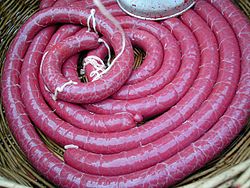
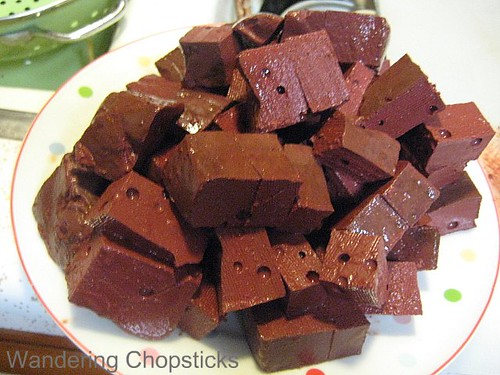
I’m not knocking Portland for this, necessarily. If you want to make the most money, you obviously want to market to your biggest, well, market, and in Portland, maybe that’s the mainly white American culinary tourist. And maybe this kind of dabbling leads to more people being more open and experimental with food choices. I didn’t start out eating pork knuckles and beef tendons. First I needed to know that pork knuckles and beef tendons were food and were being served at restaurants. Others may need a larger shove than just awareness: first sausage, then blood sausage, then blood cubes, then raw goat blood pudding, for example?
Still, such extreme accessibility, no matter how convenient and at times even tasty, feels weird and a little icky. I’d rather pay a steeper price of admission into another culture’s universe.
My favorite thing about Portland was something that needed no marketing at all: the local berries! Vancouver (Washington)’s farmers market provided me with all the marionberries, tiny strawberries, and Rainier cherries that I could eat, and the flavors were so wholly different from anything available in California that they instantly made the whole trip worth it.
Showing posts with label Korean. Show all posts
Showing posts with label Korean. Show all posts
Thursday, July 13, 2017


Monday, January 13, 2014
Al Bap Addendum II: Twists of Korea and Japan
Since my love affair with al bap began in the summer of 2012, I have mostly been resigned to making it myself. After all, if the shortest route to al bap involves 40 minutes on the freeway, why shouldn't I raid the fish roe section of H-Mart and make my entire house smell like chopped kimchi and sesame oil a few times a month?
It took me a few months after I moved to Los Angeles to realize that the shortest route to al bap was no longer 40 minutes on the freeway. It was 10 minutes in a car (followed by circling insane parking lots full of jostling valets, but I digress) to Koreatown.
Desiring to start my descent into al bap madness in a controlled fashion, I carefully chose two restaurants who boasted wildly divergent approaches to the dish. (You have no idea how happy it makes me that my potential al bap selection is now so enormous that I can type the previous sentence.)
The first, Chunju Han-Il Kwan, was a bustling stew-ladling madhouse at lunch, the whole place smelling like Seoul distilled and echoing with enthusiastic Korean vowels. Four waitresses served the whole restaurant; there were no assigned 'areas' or 'sections'. They came by the tables in shifts while the others filled banchan dishes, refilled and shook the barley-water machine, and visited the kitchen. Each took care to warn us, in studied tones, to be careful of our hot stone bowls!
The second, A-Won Japanese restaurant, though Japanese in title, murmured quietly with the sounds of Korean just the same. I was politely shown to the sushi bar with all the other single diners. Everyone else except me was a Korean businessman silently and methodically scooping up chopstickfuls of rice, fish, and fish eggs. The sushi bar was staffed by a tall, thin chef who made al bap and hwe dup bap in rows like a single-man assembly line. He took a break to gaze at me with an unreadable expression as I started mixing the beautiful rainbow of fish eggs, seaweed, uni, and tamago he'd just carefully arranged. I couldn't read his gaze. Perhaps I should have taken more than five seconds to admire the swirl of color and its deliberate asymmetry.
Chunju Han-Il Kwan's version came with the normal dizzying array of banchan - some standouts like spicy zucchini and marinated fishcakes were terrific and gone in no time - but the main attraction itself was surprisingly low key on flavor. Of course, it came out angrily splattering hot oil everwhere, and when I nudged it with chopsticks it sizzled menacingly. Leaning my whole upper body away, I stirred the rice, dodging the explosive snaps, knowing that my reward would be a perfectly crunchy, yet not unrecognizably blackened, rice layer.
And so it was, and it was the best part of the dish, once I got to it. Until then, the little piles of tiny roe dissolved so thoroughly into the rice that they left little in their wake but a slight oceany tinge on the tongue. I ate it enthusiastically nonetheless - the upbeat atmosphere was contagious and the promise of the crispy rice on the bottom propelled me through.
If this al bap was understated, I expected the al bap at A-Won to be overstated. I'd cheated and looked at pictures of it online, and it was an absurd carnival of colors. Fully four different shades of roe provided a pointillist background to a big old yellow slash of uni, two different types of seaweed salad (the light green wakame and the earthy green hijiki), and the giant orange marbles of ikura (salmon roe). Even the rice was speckled under the roe with tiny chopped pieces of tamago. A few strands of surimi poked their stupid meddling heads up around the bowl. I scowled at them, but mixed them in with everything else. My chef was watching.
A-Won's al bap, though, was a whole lot of showmanship masking a similarly muted flavor. The presence of yellow pickled daikon helped, but the only major difference here was the ikura, which burst showily between my teeth, and the lucky few times I was able to get some uni goo in a bite with all the rest of it.
What have I learned? I've learned that al bap may only be transcendent when taken as a welcome break from a constant overdose of gochujang, but it's always going to be a comfort food, and whether it's due to bursting ikura or crackling rice, my teeth are going to enjoy the ride.
It took me a few months after I moved to Los Angeles to realize that the shortest route to al bap was no longer 40 minutes on the freeway. It was 10 minutes in a car (followed by circling insane parking lots full of jostling valets, but I digress) to Koreatown.
Desiring to start my descent into al bap madness in a controlled fashion, I carefully chose two restaurants who boasted wildly divergent approaches to the dish. (You have no idea how happy it makes me that my potential al bap selection is now so enormous that I can type the previous sentence.)
The first, Chunju Han-Il Kwan, was a bustling stew-ladling madhouse at lunch, the whole place smelling like Seoul distilled and echoing with enthusiastic Korean vowels. Four waitresses served the whole restaurant; there were no assigned 'areas' or 'sections'. They came by the tables in shifts while the others filled banchan dishes, refilled and shook the barley-water machine, and visited the kitchen. Each took care to warn us, in studied tones, to be careful of our hot stone bowls!
The second, A-Won Japanese restaurant, though Japanese in title, murmured quietly with the sounds of Korean just the same. I was politely shown to the sushi bar with all the other single diners. Everyone else except me was a Korean businessman silently and methodically scooping up chopstickfuls of rice, fish, and fish eggs. The sushi bar was staffed by a tall, thin chef who made al bap and hwe dup bap in rows like a single-man assembly line. He took a break to gaze at me with an unreadable expression as I started mixing the beautiful rainbow of fish eggs, seaweed, uni, and tamago he'd just carefully arranged. I couldn't read his gaze. Perhaps I should have taken more than five seconds to admire the swirl of color and its deliberate asymmetry.
Chunju Han-Il Kwan's version came with the normal dizzying array of banchan - some standouts like spicy zucchini and marinated fishcakes were terrific and gone in no time - but the main attraction itself was surprisingly low key on flavor. Of course, it came out angrily splattering hot oil everwhere, and when I nudged it with chopsticks it sizzled menacingly. Leaning my whole upper body away, I stirred the rice, dodging the explosive snaps, knowing that my reward would be a perfectly crunchy, yet not unrecognizably blackened, rice layer.
And so it was, and it was the best part of the dish, once I got to it. Until then, the little piles of tiny roe dissolved so thoroughly into the rice that they left little in their wake but a slight oceany tinge on the tongue. I ate it enthusiastically nonetheless - the upbeat atmosphere was contagious and the promise of the crispy rice on the bottom propelled me through.
If this al bap was understated, I expected the al bap at A-Won to be overstated. I'd cheated and looked at pictures of it online, and it was an absurd carnival of colors. Fully four different shades of roe provided a pointillist background to a big old yellow slash of uni, two different types of seaweed salad (the light green wakame and the earthy green hijiki), and the giant orange marbles of ikura (salmon roe). Even the rice was speckled under the roe with tiny chopped pieces of tamago. A few strands of surimi poked their stupid meddling heads up around the bowl. I scowled at them, but mixed them in with everything else. My chef was watching.
A-Won's al bap, though, was a whole lot of showmanship masking a similarly muted flavor. The presence of yellow pickled daikon helped, but the only major difference here was the ikura, which burst showily between my teeth, and the lucky few times I was able to get some uni goo in a bite with all the rest of it.
What have I learned? I've learned that al bap may only be transcendent when taken as a welcome break from a constant overdose of gochujang, but it's always going to be a comfort food, and whether it's due to bursting ikura or crackling rice, my teeth are going to enjoy the ride.
Monday, June 17, 2013
Chu uh tang, plus an octopus conundrum
Everyone in the tiny restaurant is bent intently over black steaming pots of brownish, gritty-looking stew festooned with bright green piles of green onions. They're folding in their purple rice and carefully adjusting their seasoning ratios, way too focused to notice me spying on their private lunch-times.
All except for the man next to us.
"Have you been here before? Have you had this before? It's an... acquired taste," he admits. Both he and his companion have been fairly silent until now, looking only into the depths of their stews.
Yelp reviews have already told me this. He tells me this. And now the waitress will come over and take her turn, albeit in extra-tactful waitress language. "This is Korean specialty..." she says, trailing off.
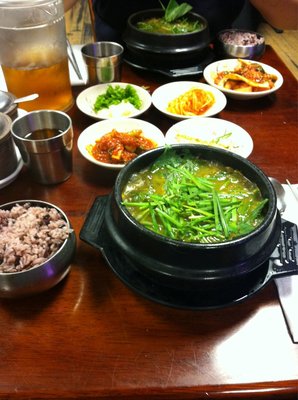
What is? Chu uh tang - mudfish stew.
Googling 'mudfish' brings up this rather eel-like, slithery-looking result...

... but the stew is fairly smooth, the kind of smooth you get with an old food processor, just a ghost of the original texture. The fish are ground up into a paste, mixed with soybean and red pepper (of course) paste, and the resulting mix is way past soup but not quite all the way to stew.
Actually, by the time the waitress finishes fussing with our seasonings, it's almost all the way to hummus.
Let me tell you something about Korean hospitality.
No matter the language barrier, you'll never feel lost. You'll never feel confused. You'll never look at your food and wonder 'how should I eat this? What should I season this with? What utensil should I use?' You won't have time to wonder anything before a guiding hand is doing it all for you, sometimes up to the point of tying your bib on and feeding you.
I've had my seafood pancake spiced, my cod stew sauced, and my purple rice mixed by the impossibly sweet proprietress of Western Doma Noodle in Los Angeles.
And more extremely, I had my street sushi dipped in soy sauce, dipped in red pepper paste, wrapped in a seaweed square, and put in my mouth for me by a lady manning a cart at KwangJang Market in Seoul.
So here, faced with mudfish stew, we don't have to lift a finger. The waitress sets the bowls down, adds the garlic, adds some onions, shakes three types of powder over it, and positions them just so with inviting spoons at the precise angle for grabbing, then departs.
Leaving us with our stew and our second dish, stir-fried octopus.
Here's where this story gets difficult and strange.
I want to love this restaurant. I love the way it looks and feels. The menu that is 80% mudfish variants (and neon backlit like a burger place). The twenty-gallon barrel of purple rice constantly being stirred next to the counter.
But the food confuses me. It's not that the mudfish is strong or distasteful - it's just bland, a slightly herbal-tasting oatmeal broken with green onion stalks. This is a surprise. What is the acquired taste, exactly? Do I have to wait to develop the tastebuds required to taste it? And the octopus, while coated in a wonderful spicy red paste, requires the chewing muscles of a canine tug-of-war champ.
The waitress comes back and sits down next to us. "Is it OK?" she asks cautiously, watching my mom try in vain to bite an octopus tentacle in half. "Hard to chew?"
We nod.
"In Korea we like it to be chewy," she says. "My daughter was born here. She likes soft food. Uh, tender food! She likes it tender. But this dish," - she gestures to the octopus - "is supposed to be chewy."
It had never occurred to me that people might prefer their food to be like gum, which is strange, because every other preference has occurred to me. I unblinkingly accepted the gamut of preferences from rare to charred meat, white to dark meat, raw to cooked fish, and every cut of meat from skin all the way inwards to intestines. I'd never thought of chewy and tender on the same continuum, though. I just assumed tenderer = better.
But when I hear it, I believe her: a memory springs forth.
When I was in Busan, in the formidable shadow of the Jagalchi Fish Market, I took a plunge and ordered stir-fried eel at one of the specialty restaurants on the side streets. The luckier eels writhed in the outdoor tanks as my specimens arrived at my table, sizzling, in a big aluminum foil-lined pot.

On my computer, this picture's filename is Bad Eel.jpg. No lie. The eel had such a strange, tough, rubber texture, almost like what you'd expect raw snake to feel like if you put it into your mouth. I had lots of trouble eating it because my teeth were screaming at me that it was raw meat, that it was a far cry from the pillowy anago and unagi of my childhood at sushi restaurants, that I should spit it out, that I should send it back.
Everyone in the restaurant looked at my cringing face like it, and therefore I, was crazy.
I think of this as I try to reassure the kind waitress at Nam Won Gol that we aren't angry at her or her octopus,* while at the same time trying to force my jaw to persevere when all it wants to do is lie down on the grass and take a nap.
Maybe there are some dishes that require the cooperation of muscle memory and its complex network of intuitive preferences to truly appreciate. My jaw's memories, unfortunately, mostly involve associating pleasure with being lazy.
----
* For what it's worth, the couple next to us whispers that if we want tenderness, we should go for the squid next time.
All except for the man next to us.
"Have you been here before? Have you had this before? It's an... acquired taste," he admits. Both he and his companion have been fairly silent until now, looking only into the depths of their stews.
Yelp reviews have already told me this. He tells me this. And now the waitress will come over and take her turn, albeit in extra-tactful waitress language. "This is Korean specialty..." she says, trailing off.
What is? Chu uh tang - mudfish stew.
 |
| Thanks, Yelper So H |

Actually, by the time the waitress finishes fussing with our seasonings, it's almost all the way to hummus.
Let me tell you something about Korean hospitality.
No matter the language barrier, you'll never feel lost. You'll never feel confused. You'll never look at your food and wonder 'how should I eat this? What should I season this with? What utensil should I use?' You won't have time to wonder anything before a guiding hand is doing it all for you, sometimes up to the point of tying your bib on and feeding you.
I've had my seafood pancake spiced, my cod stew sauced, and my purple rice mixed by the impossibly sweet proprietress of Western Doma Noodle in Los Angeles.
And more extremely, I had my street sushi dipped in soy sauce, dipped in red pepper paste, wrapped in a seaweed square, and put in my mouth for me by a lady manning a cart at KwangJang Market in Seoul.
 |
| Well, I was doing it wrong! |
Leaving us with our stew and our second dish, stir-fried octopus.
Here's where this story gets difficult and strange.
I want to love this restaurant. I love the way it looks and feels. The menu that is 80% mudfish variants (and neon backlit like a burger place). The twenty-gallon barrel of purple rice constantly being stirred next to the counter.
But the food confuses me. It's not that the mudfish is strong or distasteful - it's just bland, a slightly herbal-tasting oatmeal broken with green onion stalks. This is a surprise. What is the acquired taste, exactly? Do I have to wait to develop the tastebuds required to taste it? And the octopus, while coated in a wonderful spicy red paste, requires the chewing muscles of a canine tug-of-war champ.
The waitress comes back and sits down next to us. "Is it OK?" she asks cautiously, watching my mom try in vain to bite an octopus tentacle in half. "Hard to chew?"
We nod.
"In Korea we like it to be chewy," she says. "My daughter was born here. She likes soft food. Uh, tender food! She likes it tender. But this dish," - she gestures to the octopus - "is supposed to be chewy."
It had never occurred to me that people might prefer their food to be like gum, which is strange, because every other preference has occurred to me. I unblinkingly accepted the gamut of preferences from rare to charred meat, white to dark meat, raw to cooked fish, and every cut of meat from skin all the way inwards to intestines. I'd never thought of chewy and tender on the same continuum, though. I just assumed tenderer = better.
But when I hear it, I believe her: a memory springs forth.
When I was in Busan, in the formidable shadow of the Jagalchi Fish Market, I took a plunge and ordered stir-fried eel at one of the specialty restaurants on the side streets. The luckier eels writhed in the outdoor tanks as my specimens arrived at my table, sizzling, in a big aluminum foil-lined pot.

On my computer, this picture's filename is Bad Eel.jpg. No lie. The eel had such a strange, tough, rubber texture, almost like what you'd expect raw snake to feel like if you put it into your mouth. I had lots of trouble eating it because my teeth were screaming at me that it was raw meat, that it was a far cry from the pillowy anago and unagi of my childhood at sushi restaurants, that I should spit it out, that I should send it back.
Everyone in the restaurant looked at my cringing face like it, and therefore I, was crazy.
I think of this as I try to reassure the kind waitress at Nam Won Gol that we aren't angry at her or her octopus,* while at the same time trying to force my jaw to persevere when all it wants to do is lie down on the grass and take a nap.
Maybe there are some dishes that require the cooperation of muscle memory and its complex network of intuitive preferences to truly appreciate. My jaw's memories, unfortunately, mostly involve associating pleasure with being lazy.
----
* For what it's worth, the couple next to us whispers that if we want tenderness, we should go for the squid next time.
Monday, May 13, 2013
The Theory of the Dive
So, I eat almost exclusively at what most people might charitably call dives.
Why do I do this?
It's not because I'm a masochist. If I were I'd exclusively patronize eardrum-shattering bars or Pizza Hut or the deli food bar at health food stores. Or any place that uses lab-made capsaicin crystal hot sauce for the shock value.
It's not because I am a Guy Fieri disciple - I only know the guy's name because when I see it emblazoned on a formerly cheap, casual dive's wall, it's usually accompanied by jacked-up menu prices and hordes of camera-toting tourists.
And it's especially not, as one recent accusation implied, that I'm a huge foodie-hipster who only thinks restaurants are cool before they're 'discovered' (though I realize my last paragraph implies that there might be a grain of truth here).
Nope.
What follows is my Theory of the Dive. The Theory of the Dive is simple and (I think) intuitive:
If a restaurant is dirty, if it's small and the chairs grate, squeak, and wobble; if customers are crowded onto benches with strangers or forced to endure terrible music; if the waitstaff is rude, disinterested, or nonexistent; if there are cockroaches scurrying along the margins or the owner's baby runs around unsupervised; if the decor is neon green or 70's wood-paneled or otherwise garish; if some or all of these things are true, and the restaurant is still in business...
...there must be a damn good reason.
And that reason is usually that the food is phenomenal.
Think about it!
I don't expect everyone to be just like me and eat out solely for the food - I understand that people go out to eat for different reasons.
Some people like to feel taken care of. They cook for their family all the time and want to relax and have an experience where they are the ones waited on for a change.
Some people want to immerse themselves in some sort of crafted scene, an artistically constructed environment, and derive their pleasure from the aesthetics of their surroundings as they eat.
Some people treat dining as a social gathering and don't even notice what's going into their mouths as long as their friends are with them.
And some treat it as a stage. A see-and-be-seen catwalk of sorts.
The fact that I have different priorities than these people doesn't bother me.* I think it's obvious by the strained way I wrote those last four paragraphs that their preferences are hard for me to relate to, but their existence makes it easier for me to pinpoint a great restaurant just by looking at it.
All of the aforementioned eaters-for-other-reasons are eliminated.
All that's left is replicas of me. My food-obsessed, blinders-wearing brethren.
And if we're enough to keep the place open, it's almost guaranteed: there is something amazing hiding in there!
----
My favorite dives in the country (and though it should be clear by now, I emphasize that I say 'dives' with the utmost respect and affection):
Sahara Restaurant, Minneapolis. Hidden behind a fabric store, occasionally closed at prayer time, kids filing through with backpacks after school... all worth it for how well they cook their goat.
Ghareeb Nawaz, Chicago. Surly service, chaotic layout, excellent green chile chicken, 50 cent naan.
Good Mong Kok Bakery, San Francisco. Zero English from the cooks, zero lining-up prowess from the customers, best char siu bao in SF from a storefront the size of a closet.
Banh Mi My Tho, Alhambra. Half convenience store, half sandwich wizardry.
Sachi Sushi, Niwot. Shockingly good chirashi bowls in the back of a grocery store next to the dairy section.
Poke-Poke, Venice. Fresh raw fish sprinkled with all sorts of Hawaiian goodness surrounded by urine-soaked sidewalks, medical marijuana hawkers, and all-around kookiness.
----
*One exception to that rule is people who think it's appropriate to judge a place on the personalities of employees or fellow diners. This (perhaps irrationally) enrages me. The following are 100% real Yelp complaints posted for insanely delicious restaurants where I have had both amazing food and friendly service.
"...the restaurant is basically where fobby old asian guys who don't work go to talk shit and drink beer..." - a one-star review of Binh Dan Restaurant, home of excellent seven course goat.
(I'm sorry, how are these men eating food from their home country impacting your enjoyment of your own meal?)
"the lady could barely speak english...i hate when i go to restaurants where they can barely speak english, that's just not how you run a restaurant here." - a three-star review of Gae Sung, home of wondrous gamjatang.
(Come on, how hard is it to just point at a number on the menu?)
"food is ok, but be ready to learn about the owners political views and opinions about the world ..and they are not afraid to share it ha ha ha" - a one-star review of Zait&Zaatar, who makes the best chicken sandwich I've ever tasted.
(Oh no! Human contact!)
"I don't care that you can speak marathi, hindi, gujarati, and english. I mean congratulations that you know some many languages..but what does that have to do with my Sabudana vadas? So yeah, this place would get my 5 stars if the owner guy brought his yakkity yak down a notch." - a three-star review of Mumbai Ki Galliyon Se, whose owners constantly go out of their way to recommend the best combinations of their food.
(I have no words for this, other than I hope the guy never reads this review lest he erroneously think he needs to change his personality for this person.)
Why do I do this?
It's not because I'm a masochist. If I were I'd exclusively patronize eardrum-shattering bars or Pizza Hut or the deli food bar at health food stores. Or any place that uses lab-made capsaicin crystal hot sauce for the shock value.
It's not because I am a Guy Fieri disciple - I only know the guy's name because when I see it emblazoned on a formerly cheap, casual dive's wall, it's usually accompanied by jacked-up menu prices and hordes of camera-toting tourists.
And it's especially not, as one recent accusation implied, that I'm a huge foodie-hipster who only thinks restaurants are cool before they're 'discovered' (though I realize my last paragraph implies that there might be a grain of truth here).
Nope.
What follows is my Theory of the Dive. The Theory of the Dive is simple and (I think) intuitive:
If a restaurant is dirty, if it's small and the chairs grate, squeak, and wobble; if customers are crowded onto benches with strangers or forced to endure terrible music; if the waitstaff is rude, disinterested, or nonexistent; if there are cockroaches scurrying along the margins or the owner's baby runs around unsupervised; if the decor is neon green or 70's wood-paneled or otherwise garish; if some or all of these things are true, and the restaurant is still in business...
...there must be a damn good reason.
And that reason is usually that the food is phenomenal.
Think about it!
I don't expect everyone to be just like me and eat out solely for the food - I understand that people go out to eat for different reasons.
Some people like to feel taken care of. They cook for their family all the time and want to relax and have an experience where they are the ones waited on for a change.
Some people want to immerse themselves in some sort of crafted scene, an artistically constructed environment, and derive their pleasure from the aesthetics of their surroundings as they eat.
Some people treat dining as a social gathering and don't even notice what's going into their mouths as long as their friends are with them.
And some treat it as a stage. A see-and-be-seen catwalk of sorts.
The fact that I have different priorities than these people doesn't bother me.* I think it's obvious by the strained way I wrote those last four paragraphs that their preferences are hard for me to relate to, but their existence makes it easier for me to pinpoint a great restaurant just by looking at it.
All of the aforementioned eaters-for-other-reasons are eliminated.
All that's left is replicas of me. My food-obsessed, blinders-wearing brethren.
And if we're enough to keep the place open, it's almost guaranteed: there is something amazing hiding in there!
----
My favorite dives in the country (and though it should be clear by now, I emphasize that I say 'dives' with the utmost respect and affection):
Sahara Restaurant, Minneapolis. Hidden behind a fabric store, occasionally closed at prayer time, kids filing through with backpacks after school... all worth it for how well they cook their goat.
Ghareeb Nawaz, Chicago. Surly service, chaotic layout, excellent green chile chicken, 50 cent naan.
Good Mong Kok Bakery, San Francisco. Zero English from the cooks, zero lining-up prowess from the customers, best char siu bao in SF from a storefront the size of a closet.
Banh Mi My Tho, Alhambra. Half convenience store, half sandwich wizardry.
Sachi Sushi, Niwot. Shockingly good chirashi bowls in the back of a grocery store next to the dairy section.
Poke-Poke, Venice. Fresh raw fish sprinkled with all sorts of Hawaiian goodness surrounded by urine-soaked sidewalks, medical marijuana hawkers, and all-around kookiness.
----
*One exception to that rule is people who think it's appropriate to judge a place on the personalities of employees or fellow diners. This (perhaps irrationally) enrages me. The following are 100% real Yelp complaints posted for insanely delicious restaurants where I have had both amazing food and friendly service.
"...the restaurant is basically where fobby old asian guys who don't work go to talk shit and drink beer..." - a one-star review of Binh Dan Restaurant, home of excellent seven course goat.
(I'm sorry, how are these men eating food from their home country impacting your enjoyment of your own meal?)
"the lady could barely speak english...i hate when i go to restaurants where they can barely speak english, that's just not how you run a restaurant here." - a three-star review of Gae Sung, home of wondrous gamjatang.
(Come on, how hard is it to just point at a number on the menu?)
"food is ok, but be ready to learn about the owners political views and opinions about the world ..and they are not afraid to share it ha ha ha" - a one-star review of Zait&Zaatar, who makes the best chicken sandwich I've ever tasted.
(Oh no! Human contact!)
"I don't care that you can speak marathi, hindi, gujarati, and english. I mean congratulations that you know some many languages..but what does that have to do with my Sabudana vadas? So yeah, this place would get my 5 stars if the owner guy brought his yakkity yak down a notch." - a three-star review of Mumbai Ki Galliyon Se, whose owners constantly go out of their way to recommend the best combinations of their food.
(I have no words for this, other than I hope the guy never reads this review lest he erroneously think he needs to change his personality for this person.)
Saturday, May 4, 2013
Al bap: an addendum
Writing my recent post about al bap must have left me with a raging and untamable subconscious craving for it. While I'd managed the nine months between Korea and last week fairly well, yesterday morning I had scarcely woken up fully when I discovered that I was at the wheel of my car, speeding down the 5 freeway towards the apparent eden of al bap, Buena Park, CA.
As bossy subconscious cravings aren't known for their attention to details like when it is appropriate to eat lunch, I ended up being that creepy customer with her nose smushed against the front door glass trying to peek through when they rolled the shades up at Surah Korean Restaurant at 11AM.
The waiter recovered beautifully from the shock of seeing a hungry and inquisitive face at arm's length, and invited me to take a seat.
Now, I am not unfamiliar with the custom that Korean restaurants have of loading your table with everything but the kitchen sink, regardless of what you actually order. I love that banchan is pervasive and expected. However, when I ordered the al-bap lunch special with sides of sashimi and fried fish, I was not quite expecting this:
See the al bap? It's in the middle there: the little splotchy rainbow in a bowl.
And even flanked by fanciness such that it was, it was delicious. I suspect they might make a more simple version for the lunch special combo, as it was a basic, spare rendition: three kinds of roe, pickled red peppers, and rice. There weren't any turnips or seaweed or sesame seeds. I imagine that if the al bap is ordered alone, the fully adorned version comes out (also, I saw a picture on the menu).
So it is with pleasure (and relief) that I report that al bap can indeed be had stateside. Don't miss the cinnamon tea they serve at the end!
As bossy subconscious cravings aren't known for their attention to details like when it is appropriate to eat lunch, I ended up being that creepy customer with her nose smushed against the front door glass trying to peek through when they rolled the shades up at Surah Korean Restaurant at 11AM.
 |
| Precisely like this. |
The waiter recovered beautifully from the shock of seeing a hungry and inquisitive face at arm's length, and invited me to take a seat.
Now, I am not unfamiliar with the custom that Korean restaurants have of loading your table with everything but the kitchen sink, regardless of what you actually order. I love that banchan is pervasive and expected. However, when I ordered the al-bap lunch special with sides of sashimi and fried fish, I was not quite expecting this:
 |
| I literally couldn't fit all the food in the frame without standing up, knocking my knees on the BBQ well, and almost tripping. |
And even flanked by fanciness such that it was, it was delicious. I suspect they might make a more simple version for the lunch special combo, as it was a basic, spare rendition: three kinds of roe, pickled red peppers, and rice. There weren't any turnips or seaweed or sesame seeds. I imagine that if the al bap is ordered alone, the fully adorned version comes out (also, I saw a picture on the menu).
So it is with pleasure (and relief) that I report that al bap can indeed be had stateside. Don't miss the cinnamon tea they serve at the end!
Tuesday, April 23, 2013
Al bap
I visited Korea in the summer of 2012. Despite Korea's lightning-pace development, the communication barrier was absolute, and nowhere was this more apparent than when I wanted something quick to eat.
When I felt fresh and adventurous, ready to eat whatever came out of the kitchen, or when I felt flush, ready to jet off to some specialty restaurant chosen from the guidebook, I didn't care that I couldn't communicate. But when I was nearing the end of a long day, exhausted and in need of sustenance (that wasn't convenience store ramyun) before collapsing into bed, I didn't have the energy to risk inadvertently ordering some twelve-plate four-course monstrosity.
I couldn't speak Korean or read the script (all I retain now is the flourished underline of the ‘n’ sound) and I recall many a stomach-rumbling night where I peered through doorways into rooms austerely decorated with inscrutable text. Often, it was actually carved into wood like an art project. This was both beautiful and utterly irrelevant to my interests.
 |
| Ah.. I see. You serve food here. Thanks, Joshua Lurie |
I was occasionally thrown a bone in the form of hilarious, yet ultimately decipherable neon...
 |
or something that at least let me know there’d be an interesting selection to choose from...

... but when this didn’t happen, I felt utterly lost.
I would scour the guidebook for the characters for the dish I sought, and try to remember it, but it faded like the details of abstract art. A few days of this and I started writing the dish of the day on the back of my hand.
Unfortunately, I still had to peer through doorways like a myopic looky-loo and squint at long lists of menu options, and Koreans were too friendly to stand aside for my confusion. Up they would bound, cheerily pointing at their abstract menu art, and I would consider the implications of standing in the doorway comparing the back of my hand to the wall for ten minutes, then flee.
My unlikely savior turned out to be in the form of a fish roe rice bowl (al bap, 알밥).
 |
| My hero! |
Nearly every casual restaurant had a version. The characters were easy to spot. It tasted amazing, and I always felt healthy and fully nourished afterwards. They even laid off on the omnipresent red pepper paste (gochujang, 고추장) a tiny bit.
It would briefly occur to me as I was eating my fourth al-bap of the week that a stone pot full of crackly rice, fish eggs, seaweed, hot-sauce drenched cabbage and radish, and egg was a strange comfort food for someone raised in the Midwest, but I honestly felt like this dish was stroking my forehead (though sweaty from gochujang), murmuring soothing words, and tucking me into bed. It wiped the dancing Korean script from in front of my eyes.
And the taste! Pure ocean over rice, but unmistakably Korean in how strongly the vegetables were pickled. The individual tiny snaps of the eggs breaking, contained by the crackling seaweed strips and pot-blackened rice, gave my teeth reason to pay good attention, and set up a kind of hypnotic rhythm section in my jaw.
It formed a perfect beat for me to find a subway stop and stumble home.
-----
Where to get al-bap in Orange County:
According to Yelp, a smattering of restaurants in Buena Park, and of course, Koreatown in LA. However, I have so far been hesitant to ruin my amazing memories by trying it here.
Subscribe to:
Comments (Atom)