In foreign countries, there are lots of ways to fail at finding and eating the food you have so carefully researched ahead of time.
Vietnam specializes in the unauthorized duplication of famous stalls, presenting you with the quandary, for example, of three seemingly identical banh xeo stands facing each other across an alley. Korea likes to write its menus in a loopy, highly stylized script on wooden planks deep inside the dining room, where it would be exceedingly awkward to stand for minutes with face buried in Google Translate. China likes to run out of whatever the restaurant specializes in right as you arrive, even if you arrive at 6am. Malaysia goes a simpler route and just makes it impossible to walk anywhere.
Hokkaido, however, has taken all my memories of frustrated, fruitless city-wandering and shoves them aside. All restaurants are where they say they are, and if they don’t have lacquered replicas of their dishes in display cases outside, they have colorful posters, and if they don’t have colorful posters, they have a waiter willing to parse my halting hiragana-reading.
Unagi Kamogawa is wallpapered around the outer door with shiny but simple images of eel. Eel in round bowls and eel in square bowls – that’s it. I step into a den thick with eelsmoke, take off my shoes, and practically trip down into the space beneath the squatting table. A customer with one protruding bottom tooth and slow but confident English tells me he only eats eel once a month because it’s so expensive. It is – my round bowl is ¥2200 – but the two thick fillets are more smoky and tender than sweet and cloying, have only tiny flexible little bones that yield easily to my swallowing, and come with pickled vegetables and a clear soup featuring a mystery spring-onion-looking thing that tastes a little like a fish cake.
Sapporo’s Nijo market solves my ever-present problem at seafood markets: seeing all this delicious seafood but being unable to do anything with a giant horsehair crab or tank of abalone in my hostel/Airbnb. Next to the tanks of waving tentacles and claws and bubbling shells, there are restaurants, and the restaurants will put any combination of the market’s wares in a rice bowl for you. Again, it’s pricey, but ¥3800 gets me a sea urchin/salmon/salmon roe kaisen-don accompanied by a bowl of miso soup with, no exaggeration, half a crab tilted out of the side as if to mount a too-late escape attempt. The urchin is so soft and indistinct that it looks like scrambled eggs, usually bad news for a creature that gets runnier the longer it’s out of its shell, but it’s so mild and sweet that perhaps even avowed uni-haters would reconsider. It stains the rice under it sun-yellow, a welcome leftover after disappearing so quickly.
Oddly, the urchin here is better than in Otaru, the port where they actually capture them. Otaru’s kaisen-donlets me sample two different species of urchin, the northern variety and the short-spined variety, and while both are firm-edged, their flavor is tinged with iodine, and one’s color is somewhat greenish. Both would be laudable in a US sushi bar, but compared to Sapporo’s scrambled-eggy urchin, they pale. The winner in the Otaru bowl is the giant mound of crab meat next to it, taking up fully half the bowl and remaining sweet and stringily flavorful to the last mouthful. I always feel weirdly decadent eating chopstickfuls of crab meat, knowing the work it takes to extract just one strand from a shell, and as if to underline my uneasiness, they place a crab claw across the bowl with half the shell cleanly removed to reveal a perfect, untouched, still-claw-shaped wall of meat, ripe for the taking.
But one can’t always spend $30 on unagi or kaisen-don, and this is where Japan’s unsung heroes step in: train station restaurants. They always have English-speaking workers, and JR Sapporo Station is so much more than a train station, so it may be unfair to call its food train station food, but still: it’s a mall – actually three malls – two subway stations, and an underground tunnel to ensure continued commerce even during Hokkaido’s long winters. And it provides me with:
– legitimately excellent soba (studded with melt-in-your-mouth shrimp tempura and a tidy pile of tamago)
– airily-breaded tonkatsu surrounded by stuffed eggplant and shrimp, accompanied by mustard greens and silky chawanmushi
– a bowl filled with big chunks of soft tuna, bright green avocado, and that slimy white mass known as mountain yam that I usually hate, but that somehow ends up blended with rice to make a sticky-rice-like concoction, accompanied by gorgeously silky black sesame ice cream splashed with matcha ice.
Asahikawa Station, for its part, though only attached to a mere one mall, has a version of takoyaki that is perfectly cooked, incorporates greens into its batter and comes with a sour, zingy yuzu sauce. I pair it with a sugar-dusted green tea custard-filled taiyaki from a few stalls down.
While Japan may be lacking in the thrill of the chase, and therefore in providing me with the satisfaction that comes after having successfully chased a food item down, it’s kind of nice sometimes to just be able to decide what I want to eat, set off on an organized, efficient public transit system, and eat it!
Showing posts with label octopus. Show all posts
Showing posts with label octopus. Show all posts
Saturday, August 5, 2017

Thursday, August 3, 2017
The Octopus Dilemma
She comes out carrying a long, square, boat-shaped platter piled high with six different types of sashimi. This is exactly what I meant to order, which is a miracle considering I had to try to explain in Japanese that I wanted sashimi from Hokkaido only.
With the aid of a bilingual fish info sheet she procured from some hidden closet, we confirm that what is in front of me is, from left to right: hirame (flatfish), tako (octopus), hokkigai (surf clam), hotate (scallop), amaebi (raw shrimp), and iwashi (sardine). With a bow, she withdraws, though I can see her hovering in the corner in an area she might think is just out of my sightline. She is extremely anxious to please, which I find heartwarming considering I entered her establishment alone with terrible Japanese skills in a tank top and wide-leg pajama-esque pants to take up the only non-tatami four-top in the restaurant.
At first, there’s no problem with being attentively spied upon, since the iwashi are tiny maroon-striped fatty oily wonders coupled with ginger and green onions that make me wonder why we ever bother to cook, pickle, or jar them, and the amaebi, tiny tender little pink fingers, make me forget every negative word I’ve ever said about raw shrimp having the texture of dried glue.
I get nervous as I get closer to the octopus, though. Octopus served as sashimi is almost always inedible for me, and not because I don’t like it the taste. In fact, the soft white rubber banded fat around the tentacles of this version is plump, oceany, and delicious. What I mean is that I literally cannot eat it, because my front teeth are incapable of tearing off a piece, and my molars are incapable of crushing it.
Sadly, this turns out to be the case here. The only way I’m going to be able to eat this octopus, I know, is if I tear at it with my paws like a bear at salmon, suck the fatty tentacled area off with a big slurp and leave the rest, or choke to death trying to fit a whole piece in my mouth at once. So I know I’ve got to find some other way of getting rid of it.
I’ve been faced with this dilemma at sushi bars before. I have a vivid memory, for example, of sliding a piece of slimy, rank uni (sea urchin) nigiri slowly off the bar and into a napkin-lined jacket pocket, permanently imbuing the pocket with the smell of iodine, just so the chef wouldn’t know I didn’t eat it.
But there are no pockets in my pajama-like pants to slide the octopus into, and even if there were, I’m being watched closely enough that this isn’t an option. So I eat the rest of the platter with obvious appreciative gestures, which isn’t difficult given that everything else is excellent, and as I chopstick up various pieces of fish flesh, I nudge the pile of shredded daikon and onions ever closer to the pile of octopus. With each bite that travels to my mouth, the pile of vegetables overtakes the pile of octopus, until, at last, my tastebuds are vibrating with the last rich sardine (please make it a point to try sardine sashimi, everyone, really), and the octopus is very superficially covered.
I linger for awhile with my green tea, but realize that I’d better get up and pay at the counter so she doesn’t come over and look at my platter while asking how everything is, so I do that, and after I pay (a bit of a shock at ¥3200), she delivers a mouthful, a couple sentences maybe, of utterly incomprehensible Japanese, looks at me expectantly, and when it becomes clear I have no idea what she’s talking about, abruptly leans around me to gaze directly and at length upon the contents of my vacated table.
No ‘oiishi-des’s in the world can hide my abandoned tako now.
Is this a grave expression I see coming over her face as she places her hands on her thighs, bows more deeply than she yet has, and sends me on my way? Or is it just me projecting my shame?
With the aid of a bilingual fish info sheet she procured from some hidden closet, we confirm that what is in front of me is, from left to right: hirame (flatfish), tako (octopus), hokkigai (surf clam), hotate (scallop), amaebi (raw shrimp), and iwashi (sardine). With a bow, she withdraws, though I can see her hovering in the corner in an area she might think is just out of my sightline. She is extremely anxious to please, which I find heartwarming considering I entered her establishment alone with terrible Japanese skills in a tank top and wide-leg pajama-esque pants to take up the only non-tatami four-top in the restaurant.
At first, there’s no problem with being attentively spied upon, since the iwashi are tiny maroon-striped fatty oily wonders coupled with ginger and green onions that make me wonder why we ever bother to cook, pickle, or jar them, and the amaebi, tiny tender little pink fingers, make me forget every negative word I’ve ever said about raw shrimp having the texture of dried glue.
I get nervous as I get closer to the octopus, though. Octopus served as sashimi is almost always inedible for me, and not because I don’t like it the taste. In fact, the soft white rubber banded fat around the tentacles of this version is plump, oceany, and delicious. What I mean is that I literally cannot eat it, because my front teeth are incapable of tearing off a piece, and my molars are incapable of crushing it.
Sadly, this turns out to be the case here. The only way I’m going to be able to eat this octopus, I know, is if I tear at it with my paws like a bear at salmon, suck the fatty tentacled area off with a big slurp and leave the rest, or choke to death trying to fit a whole piece in my mouth at once. So I know I’ve got to find some other way of getting rid of it.
I’ve been faced with this dilemma at sushi bars before. I have a vivid memory, for example, of sliding a piece of slimy, rank uni (sea urchin) nigiri slowly off the bar and into a napkin-lined jacket pocket, permanently imbuing the pocket with the smell of iodine, just so the chef wouldn’t know I didn’t eat it.
But there are no pockets in my pajama-like pants to slide the octopus into, and even if there were, I’m being watched closely enough that this isn’t an option. So I eat the rest of the platter with obvious appreciative gestures, which isn’t difficult given that everything else is excellent, and as I chopstick up various pieces of fish flesh, I nudge the pile of shredded daikon and onions ever closer to the pile of octopus. With each bite that travels to my mouth, the pile of vegetables overtakes the pile of octopus, until, at last, my tastebuds are vibrating with the last rich sardine (please make it a point to try sardine sashimi, everyone, really), and the octopus is very superficially covered.
I linger for awhile with my green tea, but realize that I’d better get up and pay at the counter so she doesn’t come over and look at my platter while asking how everything is, so I do that, and after I pay (a bit of a shock at ¥3200), she delivers a mouthful, a couple sentences maybe, of utterly incomprehensible Japanese, looks at me expectantly, and when it becomes clear I have no idea what she’s talking about, abruptly leans around me to gaze directly and at length upon the contents of my vacated table.
No ‘oiishi-des’s in the world can hide my abandoned tako now.
Is this a grave expression I see coming over her face as she places her hands on her thighs, bows more deeply than she yet has, and sends me on my way? Or is it just me projecting my shame?
Monday, July 15, 2013
The mysteries of octopus brains
A skewered baby octopus from a street stall - whole, soy-browned, and roasted just past tenderness - presented me with a few questions I'd never contemplated asking, let alone having answered:

1. Do cooked octopus brains taste, feel, and look exactly like hardboiled quail egg yolk?

I used to eat baby octopus salad all the time as a kid; my mom would bring a small container of it home from the seafood market as a special treat for me to eat for lunch. But I never noticed that its brains tasted like egg yolk, so:
2. Alternatively, is it possible to somehow replace the brains of a seemingly intact baby octopus with the hardboiled yolk of a quail egg, fashioning the yolk as the brains and the white as the skull casing? And if this is possible, would the Japanese actually do such a thing?
I think we can all agree that the answer to part 2 of question 2 is 'yes', but the practicalities involved in part 1 boggle the mind and would involve magical syringes at the very least.
But people build collapsible models of ships they slide into bottles and proceed to maneuver their sails up with string, so I'll accept the magical syringes.
Regardless, while trying to find my foodie footing in a country seemingly starved of street food (at least compared with its neighbors) it was refreshing to be able to exchange a skewer of something for a few coins and go along my merry market-wandering way with something mysterious in my mouth.
Monday, June 17, 2013
Chu uh tang, plus an octopus conundrum
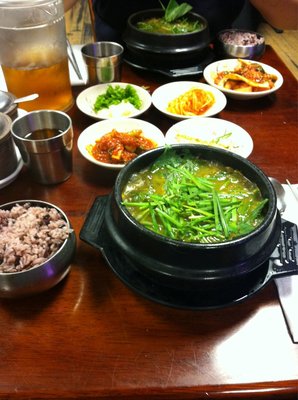
Everyone in the tiny restaurant is bent intently over black steaming pots of brownish, gritty-looking stew festooned with bright green piles of green onions. They're folding in their purple rice and carefully adjusting their seasoning ratios, way too focused to notice me spying on their private lunch-times.
All except for the man next to us.
"Have you been here before? Have you had this before? It's an... acquired taste," he admits. Both he and his companion have been fairly silent until now, looking only into the depths of their stews.
Yelp reviews have already told me this. He tells me this. And now the waitress will come over and take her turn, albeit in extra-tactful waitress language. "This is Korean specialty..." she says, trailing off.
What is? Chu uh tang - mudfish stew.
Googling 'mudfish' brings up this rather eel-like, slithery-looking result...

... but the stew is fairly smooth, the kind of smooth you get with an old food processor, just a ghost of the original texture. The fish are ground up into a paste, mixed with soybean and red pepper (of course) paste, and the resulting mix is way past soup but not quite all the way to stew.
Actually, by the time the waitress finishes fussing with our seasonings, it's almost all the way to hummus.
Let me tell you something about Korean hospitality.
No matter the language barrier, you'll never feel lost. You'll never feel confused. You'll never look at your food and wonder 'how should I eat this? What should I season this with? What utensil should I use?' You won't have time to wonder anything before a guiding hand is doing it all for you, sometimes up to the point of tying your bib on and feeding you.
I've had my seafood pancake spiced, my cod stew sauced, and my purple rice mixed by the impossibly sweet proprietress of Western Doma Noodle in Los Angeles.
And more extremely, I had my street sushi dipped in soy sauce, dipped in red pepper paste, wrapped in a seaweed square, and put in my mouth for me by a lady manning a cart at KwangJang Market in Seoul.
So here, faced with mudfish stew, we don't have to lift a finger. The waitress sets the bowls down, adds the garlic, adds some onions, shakes three types of powder over it, and positions them just so with inviting spoons at the precise angle for grabbing, then departs.
Leaving us with our stew and our second dish, stir-fried octopus.
Here's where this story gets difficult and strange.
I want to love this restaurant. I love the way it looks and feels. The menu that is 80% mudfish variants (and neon backlit like a burger place). The twenty-gallon barrel of purple rice constantly being stirred next to the counter.
But the food confuses me. It's not that the mudfish is strong or distasteful - it's just bland, a slightly herbal-tasting oatmeal broken with green onion stalks. This is a surprise. What is the acquired taste, exactly? Do I have to wait to develop the tastebuds required to taste it? And the octopus, while coated in a wonderful spicy red paste, requires the chewing muscles of a canine tug-of-war champ.
The waitress comes back and sits down next to us. "Is it OK?" she asks cautiously, watching my mom try in vain to bite an octopus tentacle in half. "Hard to chew?"
We nod.
"In Korea we like it to be chewy," she says. "My daughter was born here. She likes soft food. Uh, tender food! She likes it tender. But this dish," - she gestures to the octopus - "is supposed to be chewy."
It had never occurred to me that people might prefer their food to be like gum, which is strange, because every other preference has occurred to me. I unblinkingly accepted the gamut of preferences from rare to charred meat, white to dark meat, raw to cooked fish, and every cut of meat from skin all the way inwards to intestines. I'd never thought of chewy and tender on the same continuum, though. I just assumed tenderer = better.
But when I hear it, I believe her: a memory springs forth.
When I was in Busan, in the formidable shadow of the Jagalchi Fish Market, I took a plunge and ordered stir-fried eel at one of the specialty restaurants on the side streets. The luckier eels writhed in the outdoor tanks as my specimens arrived at my table, sizzling, in a big aluminum foil-lined pot.

On my computer, this picture's filename is Bad Eel.jpg. No lie. The eel had such a strange, tough, rubber texture, almost like what you'd expect raw snake to feel like if you put it into your mouth. I had lots of trouble eating it because my teeth were screaming at me that it was raw meat, that it was a far cry from the pillowy anago and unagi of my childhood at sushi restaurants, that I should spit it out, that I should send it back.
Everyone in the restaurant looked at my cringing face like it, and therefore I, was crazy.
I think of this as I try to reassure the kind waitress at Nam Won Gol that we aren't angry at her or her octopus,* while at the same time trying to force my jaw to persevere when all it wants to do is lie down on the grass and take a nap.
Maybe there are some dishes that require the cooperation of muscle memory and its complex network of intuitive preferences to truly appreciate. My jaw's memories, unfortunately, mostly involve associating pleasure with being lazy.
----
* For what it's worth, the couple next to us whispers that if we want tenderness, we should go for the squid next time.
All except for the man next to us.
"Have you been here before? Have you had this before? It's an... acquired taste," he admits. Both he and his companion have been fairly silent until now, looking only into the depths of their stews.
Yelp reviews have already told me this. He tells me this. And now the waitress will come over and take her turn, albeit in extra-tactful waitress language. "This is Korean specialty..." she says, trailing off.
What is? Chu uh tang - mudfish stew.
 |
| Thanks, Yelper So H |

Actually, by the time the waitress finishes fussing with our seasonings, it's almost all the way to hummus.
Let me tell you something about Korean hospitality.
No matter the language barrier, you'll never feel lost. You'll never feel confused. You'll never look at your food and wonder 'how should I eat this? What should I season this with? What utensil should I use?' You won't have time to wonder anything before a guiding hand is doing it all for you, sometimes up to the point of tying your bib on and feeding you.
I've had my seafood pancake spiced, my cod stew sauced, and my purple rice mixed by the impossibly sweet proprietress of Western Doma Noodle in Los Angeles.
And more extremely, I had my street sushi dipped in soy sauce, dipped in red pepper paste, wrapped in a seaweed square, and put in my mouth for me by a lady manning a cart at KwangJang Market in Seoul.
 |
| Well, I was doing it wrong! |
Leaving us with our stew and our second dish, stir-fried octopus.
Here's where this story gets difficult and strange.
I want to love this restaurant. I love the way it looks and feels. The menu that is 80% mudfish variants (and neon backlit like a burger place). The twenty-gallon barrel of purple rice constantly being stirred next to the counter.
But the food confuses me. It's not that the mudfish is strong or distasteful - it's just bland, a slightly herbal-tasting oatmeal broken with green onion stalks. This is a surprise. What is the acquired taste, exactly? Do I have to wait to develop the tastebuds required to taste it? And the octopus, while coated in a wonderful spicy red paste, requires the chewing muscles of a canine tug-of-war champ.
The waitress comes back and sits down next to us. "Is it OK?" she asks cautiously, watching my mom try in vain to bite an octopus tentacle in half. "Hard to chew?"
We nod.
"In Korea we like it to be chewy," she says. "My daughter was born here. She likes soft food. Uh, tender food! She likes it tender. But this dish," - she gestures to the octopus - "is supposed to be chewy."
It had never occurred to me that people might prefer their food to be like gum, which is strange, because every other preference has occurred to me. I unblinkingly accepted the gamut of preferences from rare to charred meat, white to dark meat, raw to cooked fish, and every cut of meat from skin all the way inwards to intestines. I'd never thought of chewy and tender on the same continuum, though. I just assumed tenderer = better.
But when I hear it, I believe her: a memory springs forth.
When I was in Busan, in the formidable shadow of the Jagalchi Fish Market, I took a plunge and ordered stir-fried eel at one of the specialty restaurants on the side streets. The luckier eels writhed in the outdoor tanks as my specimens arrived at my table, sizzling, in a big aluminum foil-lined pot.

On my computer, this picture's filename is Bad Eel.jpg. No lie. The eel had such a strange, tough, rubber texture, almost like what you'd expect raw snake to feel like if you put it into your mouth. I had lots of trouble eating it because my teeth were screaming at me that it was raw meat, that it was a far cry from the pillowy anago and unagi of my childhood at sushi restaurants, that I should spit it out, that I should send it back.
Everyone in the restaurant looked at my cringing face like it, and therefore I, was crazy.
I think of this as I try to reassure the kind waitress at Nam Won Gol that we aren't angry at her or her octopus,* while at the same time trying to force my jaw to persevere when all it wants to do is lie down on the grass and take a nap.
Maybe there are some dishes that require the cooperation of muscle memory and its complex network of intuitive preferences to truly appreciate. My jaw's memories, unfortunately, mostly involve associating pleasure with being lazy.
----
* For what it's worth, the couple next to us whispers that if we want tenderness, we should go for the squid next time.
Subscribe to:
Posts (Atom)