Showing posts with label travel. Show all posts

Wednesday, September 4, 2013

Sushi Dai, supermarket sushi, and the sushi in between: Part I

I love sushi.  I always have.

But it's not an easy thing to write about.

Most of its wonder comes from its simplicity; the closer you get to the living, breathing source, the better it is.

And the parts that aren't simple, the years and years of training, the ratio of fish to rice, the stickiness, warmth, and shape of the rice, the way the flesh is cut from the fish and carefully sliced, all take inside training to spot.  Either that or the budget to sample enough high-end sushi over enough years to be able to become a discerning gourmand.

I'm not an insider or a discerning gourmand, but I have been eating sushi since I was two years old.  Until I went to college, I hadn't so much as heard of spider rolls, caterpillar rolls, or the concept of putting mayo or sriracha on sushi.  My family went regularly to one sushi bar, where the owner, Kuni, plied us with extremely fresh versions of the familiar choices: maguro (tuna), toro (fatty tuna), shake (salmon), hamachi (yellowtail), tako (octopus), anago (sea eel), and the like, occasionally surprising us with fresh daily specials like white toro, hokkigai (surf clam), or aji (horse mackerel).

His fish was always excellent and he treated us like family.  He always cut my sashimi into little pieces because I was a little kid - and never stopped, even when I reached well into my twenties.  His restaurant had training chopsticks, held together with a rubber band.  I went there every year on my birthday.

Kuni's sushi was my whole world until I went to college, and it could have been my whole life.  I wouldn't have complained.

But the U.S.' palate was changing, and the same kids who cringed when I told them what I had for my 3rd grade birthday dinner were now hanging out at fusion sushi restaurants to spear themselves some dragon rolls or tempura bananas and drink sake out of wooden boxes while watching the chefs do karaoke behind the bar.  People who had already been enjoying simple sushi started to demand more variety and authenticity (whether those goals were compatible or not is an exploration for another entry).  Restaurants started springing up that served barracuda, Spanish mackerel, halibut, and sea bream.  Chefs started getting certified to prepare the deadly blowfish, fugu, without killing their patrons.

I was 1000 miles away from Kuni in college, and 2000 miles away afterwards, and so I started branching out.  I learned to respect the good fusion rolls (white tuna, avocado, and apples; mandarin oranges, salmon, and chives; and the good old Philly roll were the best flavor combinations I found) and disdain the bad ones (overuse of mayo and reliance on imitation crab meat were the most common offenders).  I tasted the aforementioned barracuda and sea bream at a place where novelty seemed to be the only consideration, and tasted them again at a few places which knew best how to season them to bring out their flavors.  They used ponzu and sea salt and tiny curled shisito peppers and green onions and blowtorches and strictly prohibited me from touching the soy and wasabi.  There was a world of difference.

An izakaya taught me to love the deep magenta skin at the edge of hamachi flesh, while a sushi maker in the back of a grocery store introduced me to battera, a pungent pickled blast of saba and kelp molded onto a square of rice.

So.

Last month, I went to Japan.

When a sushi lover goes to Japan, a sushi lover goes to Tsukiji Fish Market.  A sushi lover finds the restaurant with the longest line and joins it unhesitatingly, ready to sacrifice a half day standing in the rain.

In my case that restaurant was Sushi Dai.  Its line wound in a coiled snake shape in front of the restaurant, allowing the soaking wet queuers to press their noses against the glass and stare hungrily at the people inside.  The overflow from the snake coil was shifted across the street and around a corner, so it looked like there were just a bunch of people with umbrellas forming a queue to nowhere.


We waited.  One of us ran off to get some tamago.  We waited.  A guy ahead of us bailed in disgust after two hours (and he was so close!).  We waited.  No-nonsense workers barreled by with trucks full of crates full of boxes full of fish.

We waited.  We finally got in.  It was 1PM.

One of the chefs greeted the grinning crowd piling in with the loudest "IRASSHAIMASE!!!" and widest, toothiest grin I'd ever heard or seen before, which shocked everyone out of their queuing reverie and into the mood for sushi.

The pieces came out straight onto the bare, pristine, wooden counter.  I ate them with my hands, even though most used chopsticks.  It's strange to say, but I wanted to feel the fish as well.

I present the photos in the order that they came.  (All photo credit goes to the wonderful Eugene, who brought a fancy camera and consented to do the photo gruntwork as I flitted around excitedly from fish to fish like a sushi hummingbird.)

Toro
What Tsukiji is known for is its frenetic tuna auctions that take place at daybreak.  This tasted like the result of some seriously aggressive bartering.  I mean that in a good way.  I don't how else to adequately say that this was far and away the creamiest, fattiest, butteriest toro of my life, and I expect that it will never be topped.  This sounds depressing.  It isn't.  I'm just grateful to have gotten the chance to taste it once.

Hirame
Hirame, or fluke, is a fish I was taught to ignore my my whitefish-disdaining parents.  They did me a disservice if all of it tastes like this.  I doubt it does, since everywhere else isn't Tsukiji.  Snappy and sweet, it broke into thin squares in my mouth.

Kinmedai
I had never tasted this before.  The generous portion, trailing endlessly over the pat of rice, even over the edge of the counter, had a flavor like both hamachi and toro but also wholly unlike either.

Uni
I have eaten live uni from the shell in Redondo Beach, CA.  I've eaten it marinated in salad.  I've eaten it mixed into pasta as a buttery sauce.  I've eaten it countless times plain, straight from the sushi section at various Asian markets.  This, like the toro, was the best of its kind.  Pinker and browner than the bright orange I'm used to, I was wary at first.  It turned out to be the marinade.  How can marinade make something taste more unadulterated than it would have had it actually been unadulterated?

Live clam
This clam was still waving its 'limbs' as it was set in front of me.  Convincing myself it was just nerve twitchings and not death throes of agony, I placed it in my mouth and let it wiggle between my teeth.  While wriggly and new, I still prefer my clams wok-fried and served with peanuts and onions, Vietnamese style.  They don't have enough flavor, even alive, to make their chewing gum texture worth it.

Aji
Normally a hit-or-miss fish, this undeniable hit of a split slice poured citrus and ocean notes under my tongue like a waterfall as I chewed it.

Akami
Akami, the lean back of a tuna, looks like maguro, and I normally don't like maguro.  I don't know why this was so different.  Lean tuna's usually such a mealy, vaguely fish-counter flavored bland experience that I wonder how this silky, scentless wonder managed to overcome it.

Spanish Mackerel
 A rare find at sushi bars in the U.S., this seared, flaky, tender and strong tidbit made my top three along with the uni and toro.  Mackerel is unabashedly bold, and this piece combined it with a smoky aftertaste.

Anago
Perhaps sadly, perhaps not, this anago did not impress me.  The bones stuck me in the gums and the whole mouthful tasted vaguely like sardines. I found myself thinking of Kuni's sweet, slightly crispy, expertly rolled and patted anago and cucumber handrolls that he always stood ready to make for my mom, as they were her favorite.

I wish I could tell Kuni that even sitting at the epicenter of fresh fish, at a restaurant that had access and choices he could only dream of, and after a meal that easily ranked in the top three of my life, the memory of his handrolls in Chicago still had the power to make me wistful.

----

Next up, the other side of sushi: sushi from a Japanese supermarket!

Monday, August 26, 2013

Shanghai pooh-poohs my well-laid plans

I approached my Shanghai meal itinerary with all the precision of a Swiss watch-maker.  Shanghai's a huge city, I reasoned, and I couldn't just go wandering off into a random corner of the city and expect it to impress me (as my usual strategy goes).  I only had four days, and only the best would do!

I scoured food blogs and newspaper features, noting the dishes and restaurants that made me drool.  I wrote down their addresses and their hours.  I drew circles around sections of my printed out subway map and plotted out walking directions.  I showed the characters for each dish to my Mandarin speaking partner and had him confirm he could pronounce each one.

Visions of myself flitting freely from place to place, one hand filled with hairy crab dumplings, the other filled with pork mooncakes, with a baggie of tofu soup swinging from my arm and the city's best egg custard in my mouth filled my brain as I had the breath squished out of me on the subway.

China had other plans.

I skipped up to the hairy crab dumpling place, whose sign faithfully listed the characters I'd written down.  There was even a picture of the dumplings - orange roe brightly decorating the swirled noodly baskets.  But no: "We don't have any," barked the man behind the counter.

You don't have any of your flagship dish?  Well, OK.  No need to apologize or explain why, I guess!

Only slightly daunted, we set off for the egg custard place.  Yum yum, giant Portuguese style egg tarts, the likes of which Shanghainese bloggers can't stop raving about!  Brilliant yellow-orange custard with spots of brown where the sugar has caramelized!

Except the address was a clothes store.

Moving slightly more warily now, we approached the pork mooncake window, which wasn't too far.  In fact, we could see the line spiraling out into the street from a few blocks away.  Happy customers darted off holding baggies full of steaming, fresh pork mooncakes as the people who'd been in line right behind them...

...just kidding, there aren't any lines in China.  But the people who'd been elbowing and squirming and shouting and pressing their way up to the window managed to laboriously obtain their own baggies of gold.

I joined the thrum.  My height gave me an advantage; I watched the buns, hot and fresh on a silver try, get stuffed into bags and handed off.  I threw elbows with the best of them.  I slowly inched closer to the front.  And when I got there...

They had just sold the last bun of the day.  "No, no, no more," the lady behind the counter said brusquely, waving both her hands in front of her face like she was shooing away flies.  "Tomorrow," she added when pressed, like this was a viable solution, like we hadn't taken three subway lines and a two hour meandering walk to get there already.

It was a long, long way to the place that was meant to sell tofu flower soup, and it was something of a torturous walk.  Not having eaten anything all day, we were slogging along at a glacial pace - even more glacial than everyone else's normal 100 degree walking speed.  (I stubbornly insisted on eating only what was on my list, which turned out to be very stupid.)  

The tofu flower place, however, existed!  And it was open!  And it had tofu flower soup on the menu!  Finally - delicate dried shrimp sprinkled over curls of curdled soy, pickled radishes forming the flowers on the top!

Nope.  A nightmare of glass noodles, MSG, and sweet soy.

It's a good thing I learned these paired lessons on only my second day in China:

Never expect to find what you're looking for.  If you see something good in front of your face, seize it.

Friday, August 23, 2013

Assault by pepper: My first day on the Chinese-Burmese border

Rarely do I manage to escape a cluster of street stalls without fistfuls of mystery to-go bags, but Ruili’s local farmers’ market so overwhelmed me that I managed it.

People fanned spits of rotating ducks and chickens, the air heavy with dry spiced smoke. The woman at the first duck stall waved her cleaver menacingly as she told us how she’d cut and price the duck, but she good-naturedly offered me one of a bucket of tiny chili-soaked crabs as a taste when I expressed interest. The crab was a thumb-sized bomb of pure red spice, its meager flesh holding the oil of so many peppers that my nose, shocked, immediately started running so aggressively I had to use up my entire day’s supply of toilet paper.
Women sat surrounded by bowls of green salad-looking dishes, and after much deliberation, I chose two to sample as I wandered. Despite the vendor’s assurances that these were dishes and not spices, even though they came in plastic bags with no chopsticks, the first was a dense mass of cilantro and pepper seeds that would have been fiery even as a teaspoon in a pot of something much bigger, and the second was not much milder. Wishing I could magic the bags home to my mom, who would quickly figure out how to blend them into something, we kept walking. A beggar asked for my dishes/spices, and I gladly acquiesced, hoping he knew what he was getting into, and it started raining.

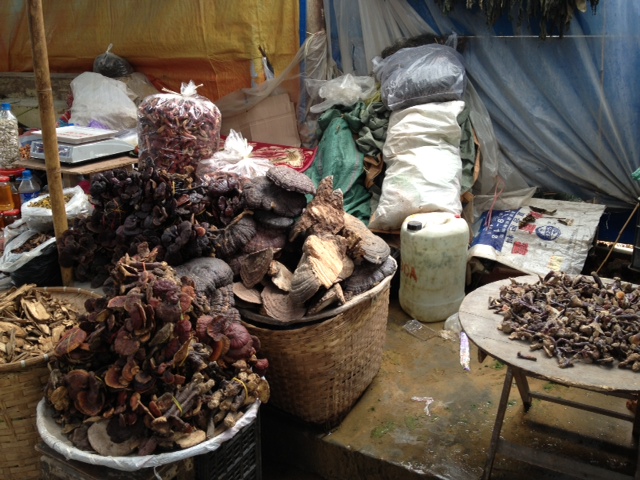
The covered section of the market was a muddy, sloshing gymnasium-sized gathering of butchers, vegetable vendors, breakfast stalls, and oddities (the most notable of which was a large, uneven-looking rock that its vendor explained was actually an anthill. One apparently hacks off a piece of anthill, boils it, and eats it. Next door to the anthills were mushrooms so large they appeared to have morphed into wooden tree trunks.


Indoor market
Tree trunk mushrooms
Unfortunately lacking in places or pots in which to boil an oversized anthill for lunch, we left the market (via boards laid across the flooding ground) and found a place that advertised Thai-style chicken on its sign, but actually drew us in with bowlfuls of fresh fruit on the counter, plus an extensive fruit juice menu. Buoyed by the sudden realization of my proximity to Burma - less than 6km away - I ordered tea leaf salad. It came out thick and a pastelike dark green, its leaves weighed down as though painted onto the plate. The dish was dotted with bright red circles of pepper, though the owner claimed they were merely decorative and the spice came from the green. Based on the care which I had to take to keep my lips from catching fire and falling to the ground, the green paste was likely distilled from ghost peppers. The only thing that saved me was the tall glass of passion fruit juice, which I saved from the inevitable Chinese Sugar Spoon of Overkill by claiming I wanted it ‘sour’.

Tea leaf salad in front, vegetarian rice embarrassment in back, smoothies standing guard.
I would not be granted a respite from spiciness for dinner.
Dai Dai Xiao Diao, a lushly decorated Dai minority restaurant next to a blind massage parlor (where I received my first gua sha of the trip), advertised Lao-style roast fish and though I knew what that would entail - dry red spice rubbed on the outside, gut cavity stuffed with wet green spice - I went for it.

As though the dry and wet spice weren’t enough, the fish came (along with lettuce leaves, fried garlic and mung beans, a mystery fish-mint cousin, and cilantro) with a mildly foamy orange sauce for dipping, a mere drop of which sent my nose into evacuation mode yet again.


Spying on my distress from a corner, our waiter very kindly dropped off a different dipping sauce which he claimed was not spicy. Though totally untrue objectively, when compared with the habanero lava lake, it indeed gave mostly the impression of lemongrass and garlic.

(I should reiterate here that I am the person who regularly gets into near-altercations with Thai and Chinese restaurants in the U.S. who are reluctant to make my food spicy enough.)

However, with the lemongrass dipping sauce, the fish made an extremely satisfying dinner. Dragon-backed and with almost no bones to speak of except for a robust rib cage, its flesh was easy to dig out, place in the lettuce leaf, and sprinkle with trimmings. The flesh alone was white and mild, but smeared in dry spice, soaked in wet spice, wrapped in leaves, and sprinkled with beans and garlic, it came alive in the kind of way that only really overwhelmingly flavorful meals can.

When what should by all rights be way too many axe-wielding ingredients somehow settles down, smooths out, and hits your throat as a unified whole, you know the chef really knows his stuff.

Thursday, August 22, 2013

Betraying Japanese river fish

In slippers, we padded eagerly down the stairs and into the dining room of our minshuku.  Each table was set with what looked from far away like dozens of hot plates, platters, stone pots, and side dishes.  I found it difficult to maintain Japanese composure, and would rather have leapt into the dining room yelling with excitement than what I did do, which was glide in as Japanese and refined a way as I could manage.

We seated ourselves, poker-faced.  A man came by to light the flames beneath our hot plate and our bowl of soup.  The candles burned steadily, setting the soup to bubbling and the hot plate to spattering.


And as I dodged hot oil from my exploding fatty beef slices and Shimeji mushrooms, I noticed something.

Those fish... the ones near the right, the whole ones with sea salt so artfully crusted on their fins and tails...

Younger versions of them had just been hanging out with me in the river that morning.

Kawayu Onsen, in Wakayama province, is a town built along a bend in a mountain river where boiling water comes bubbling up in tiny spurts through cracks in the riverbed.  The water is generally cold, but when the pebbly bottom is disturbed, either by a too-aggressive wiggling toe or by a hired hotel bulldozer come to forcibly create baths, boiling water comes shooting forth, either mixing with the cold to form a comfortable bath, or scalding whatever unfortunate skin unveiled it.

I had found a comfortably shallow, smooth-stoned lounging place with hot bubbles surrounding me and heating the water to body temperature.  I was leaning back against a rock, enjoying the tingling feeling of what I thought were bubbles bursting against my skin, only to find out that hundreds of little silvery fish were darting around my limbs, trying to eat up my freckles.

It was a guilty realization for sure that night when I realized my tiny massaging friends' parents were on my plate.  It was even worse when I realized the fish heads were bitter and inedible.  I sucked the salt off their fins and crunched their tails, hoping that savoring at least that much of them would make my betrayal worth it.

As for the rest?

Being a devotee of the wonderful, country-style Domo Restaurant in Denver, as well as an unabashed fan of most Japanese dishes, I was shocked to find that the country-style food in the actual Japanese countryside was not, generally, my cup of tea.  Not dinner that night, not breakfast the next morning, and not even the beautifully presented bento-style lunch pack they tucked into our hands as we left to take another dip in the river before our bus back to town.

While everything we ate looked like a whimsically wrapped present, it boiled down to two basic flavors: vinegar (pickles) and soy.  When food was not pickled or marinated in soy, it was left to fend for itself.  This, of course, works when ingredients are very fresh, but there was no evidence that these were.  (Though I will allow that the eggs were, as I didn't die after eating a big bowl of rice with a raw egg cracked in.) 

That's what you do when your bowl has a raw egg in it!
After my third meal in a row of vinegared something, usually rice, topped with soy-covered something else, usually some kind of fish, egg, or mountain vegetable, I was more than ready for southeast Asia to swoop out of the sky and rescue me with some lemongrass, or chili peppers, or fish sauce, or basil leaves, or something.

Lunch bento, layer 1.
Luckily (as you shall soon see), it did!

Sunday, July 21, 2013

A rampage of richness

After spending four nightmarish, tastebudless days sulkily eating onigiri and noodle soup like a zombie, actively cajoling my jaws into reluctant movement, my tastebuds finally exploded back onto the scene.

Strangely, enough, it was a carrot that did it.  A carrot, it should be said, that was surrounded by much flashier things: shoyu snails, fried chicken, shrimp tempura, battered pumpkin, that weird fish cake that's surrounded by a soaking wet edible sponge.

I'd never tasted a carrotier carrot.  I could taste the dirt that carrot was grown in, the vinegar it'd been lightly pickled in.  I could even taste its relatives.  Shades of parsnip, snippets of sweet potato.

Can you spot the magical carrot?  It's behind the okra and next to the pink fish cakes!
When my taste returned, I went on a raging bender of rich, fatty food.  I'd been eating to survive, but hadn't been able to force it enough to really subsist on what I was sulkily inhaling.  Now my body wanted to recharge, and I wanted oil, grease, fat, butter, and sugar.  I wanted every cut of meat I could name and some I couldn't.  I wanted to live on bar food.

I sat down at a yakitori bar and munched my way through reddish, charred, tender chicken livers and folded, sharp-edged, fatty chitterlings dipped in light soy sauce.  The tongue, deep burgundy slabs, I slathered in Chinese mustard so spicy I got a head rush every time I took a bite.  Green pepper and lotus root kushikatsu, ordered to erase my memory of the night kushikatsu was wasted on me, came out crisp and split cleanly and hotly at the faintest tooth touch, searing the roof of my mouth.  I didn't care.  I wanted every sensation it had to offer.


Then, the next day, there was yakisoba, a heaping plate of noodles fried with slices of pork, cabbage, ginger, and the omnipresent sauce that goes on everything 'yaki' around here: takoyaki, okonomiyaki, anything that could be called teppanyaki, and this, the yakisoba.  I tore through it like a madwoman, leaving Eugene with none of my leftovers, a first on this trip.


And the same night, as if those oiled- and sauced-up pork slices weren't enough, we stopped in at a ramen joint that advertised shortribs in their ramen: these ribs were better even than their 3 foot high backlit representation on the restaurant's outside wall.  Their texture was exactly like the best kind of toro, or a pat of mostly-cooled butter from the refrigerator.  I would poke a rib on my way to twirling some noodles and my chopstick would just fall through it as though it were made of clouds.  The broth was broth concentrate: more stew than broth.  I was positive they'd made a mistake and forgot to add water, but I didn't mind.  I was drowning in fat and loving it.


This was the first time I really felt like I was doing Osaka like it was meant to be done, living up to that famous term 'kuidaore'.  Eating until I dropped.  Flitting from restaurant to restaurant like a hummingbird to hibiscus.

Wednesday, July 17, 2013

The soba before the storm

About four days ago, I lost my sense of taste completely.*

I was in a kushikatsu bar in Osaka.  I had just ordered a bunch of skewers: lotus root, tuna cheek, eggplant, quail egg.  We'd made it through Shinsekai unmolested, found a bustling place without a ridiculous line, been irasshaimase-ed enthusiastically, and provided with a rough English menu.  I was virtually wriggling with excitement as I watched the cook casually flip my food in the big fryer with a few long metal chopsticks.


 When it got to my mouth, it tasted like fried paper.

All of it.

Hot, oily, crispy fried paper.  Even when I added a coating of shichimi togarashi (Japanese seven-spice) that normally would have turned me red and set me a-coughing.  Still hot, oily, crispy, now slightly gritty fried paper.

I tried some accompanying cabbage: wet paper.  Drank water: cold, icy paper.  With mounting desperation and dread, I unwrapped a red bean mochi ball I'd gotten earlier that day and shoved it in my mouth: lumpy, gummy paper.

Then I went home and cried.

I can say no more on this topic without becoming so despondent that I cease writing this entry.

But the day before all of that, there was this one bowl of hot soba.

When we asked the man who ran our Nara guesthouse for noodle recommendation, he prefaced his recommendations by saying he was from the 'udon prefecture' of Kagawa.  The way he said this was matter-of-fact.  It wasn't uppity or snobby.  He didn't say it like I would have if someone asked me, a native Chicagoan, for hot dog recommendations in Los Angeles: with a toss off the head, a flip of the hand, and utter derision for Los Angeles' inferior attempts at meat in intestine casing.

No, he just mentioned it, letting his credentials hang in the air, then moved on.  Looking carefully at our map, he pulled out a pen and started circling corners, appending them with his shaky English handwriting.

We went to the rough location of his first recommendation, but couldn't be sure whether we'd found it, since all signage was in Japanese.  We stood outside the door and did that thing we've learned to do: Eugene haltingly sounds out the hiragana, and if it's a food word, I'll recognize it.

"Za-ru-so-ba," Eugene said, and I nodded.  "Yeah, yeah, zaru soba, OK..."

"Sa-n-u-ki-u-don," he continued, and I nodded more vigorously.  "I think we found..."

"Ka-ki-a-ge-no..."

"All right!"

We entered.

A ponytailed man with a completely open kitchen greeted us warmly and gestured for us to sit at the bar.  From where we were seated, we could see his whole setup.


I ordered kakiage soba; Eugene ordered tanuki soba.  I thought I was so smart because I knew kaki meant 'oyster' and age meant 'tofu' so I figured I was probably going to end up with some crazy oyster-tofu concoction.

No.  That's not how Japanese works.  Kakiage turned out to actually be a big hockey puck full of tempura-ed vegetables and shrimp.

Made of, and surrounded by, amazingness.


The udon-making man was not content to simply let his (beautiful, savory, steaming hot) bowls speak for themselves.  He radiated food-enthusiasm.  His total lack of English and our near-total lack of Japanese did not stop him.

He pointed to Eugene's tanuki udon and started talking.  As he talked, he made his fingers into rings and covered his eyes.  Then he made frantic digging motions with his hands.  "Tanuki," he said, staring intently into each of our faces in turn.  "OK?"

We nodded.

Then, he pointed his finger vaguely in the air, and, chatting, he put his palms behind his ears and turned them this way and that.  "Kitsune," he said, catching our eyes.

"Tanuki soba.  Kitsune udon."

I am so glad that I knew what those two words meant (raccoon, fox), and what they signified (the same style of soup for soba and udon, respectively) before this tirade, or likelihood is I'd have gone away thinking I'd been drinking woodland creature broth.

(Not that this would have stopped me.)

His soup came out too hot even to slurp, the noodles glistening like grass snakes.  My tempura cake floated like a buoy on the broth, shining with oil and nearly audibly crackling, straight from the fryer.  It tasted like both the ocean and a good solid greasy spoon breakfast.  The shells on the shrimp got stuck in my teeth; I rinsed them out with swigs of strong roasted rice tea.

The whole time we were eating, the man talked.  He disappeared into a little closet and came out with his hands full of tomatoes.  For the first time, he spoke English.  "I am farmer," he proclaimed.

Then he ran the tomatoes under cold water and placed them onto two side dish-sized plates, handing them over the bar.  "Please," he said.

Shit, I thought.

See, I hate tomatoes.

People always ask me, before trips, what I will do if some foreign host offers me something really gross: a sheep's head, snake blood, fermented mare's milk, etc.

And I ask them, "...how is this a problem?  I'd eat it!"

But I never considered that somebody might offer me a tomato.

There are three things I strongly dislike eating.

Celery.
Natto.
And raw tomatoes.

But here the tomatoes were, dribbling water from the faucet, fresh from the farmer's hands, fresh from the farmer's farm.  He was smiling at me expectantly.

What could I do?  I took a bite.


It was the first tomato I've ever wanted to finish.

It had none of the sponge-soaked-in-stale-water texture I've come to expect from tomato slices; none of the skin-pulling-creepily-away-from-the-flesh, zombie-like outside.  Its seeds didn't hover in a solution of slime.  It didn't taste like fertilizer and poison.

In short, it transcended tomato-hood.

---

I'd like to tell you where you can find this charming noodle shop, magically learn to like fruit you've previously hated, and be regaled with woodland creature tales of your own, but I honestly cannot remember its name.  Instead, have a pin-festooned Google Map.  That's better than an address in Japan anyway.

---

*It was last in a long line of indignities committed against me by my body, which, suddenly noting that it hadn't really been sick in a good three or four years, decided to get ALL the illnesses, ALL at once.  First it hit me with a sore throat, the kind that feels like knives when you're swallowing something offensive, like warm broth.  Then, it gave me a raging fever, caused me to pass out a couple times, stuffed up only one side of my face, and ended with the kind of hacking cough that goes on forever but doesn't do any good.  Finally, it took my taste.  (And my sense of smell.  I stuck my nose right in a vat of Tiger Balm to check: nothing.)

Monday, July 15, 2013

The mysteries of octopus brains

A skewered baby octopus from a street stall - whole, soy-browned, and roasted just past tenderness - presented me with a few questions I'd never contemplated asking, let alone having answered:

1. Do cooked octopus brains taste, feel, and look exactly like hardboiled quail egg yolk?


I used to eat baby octopus salad all the time as a kid; my mom would bring a small container of it home from the seafood market as a special treat for me to eat for lunch.  But I never noticed that its brains tasted like egg yolk, so:

2. Alternatively, is it possible to somehow replace the brains of a seemingly intact baby octopus with the hardboiled yolk of a quail egg, fashioning the yolk as the brains and the white as the skull casing?  And if this is possible, would the Japanese actually do such a thing?

I think we can all agree that the answer to part 2 of question 2 is 'yes', but the practicalities involved in part 1 boggle the mind and would involve magical syringes at the very least.

But people build collapsible models of ships they slide into bottles and proceed to maneuver their sails up with string, so I'll accept the magical syringes.

Regardless, while trying to find my foodie footing in a country seemingly starved of street food (at least compared with its neighbors) it was refreshing to be able to exchange a skewer of something for a few coins and go along my merry market-wandering way with something mysterious in my mouth.

Sunday, July 7, 2013

Culinary decision paralysis and convenience store food

When I arrive in a new country, I always experience complete culinary decision paralysis for at least a few days.  Especially countries where there's no Yelp, or script that I can read, or clear menu prices, or anything else that would allow me to just make a restaurant choice at home, and then go out and singlemindedly seek it.

I'm not a good on-the-spot decision maker when faced with an overabundance of choice.  (Neither are most people, but I find I'm worse than most.)

Unfortunately, Korea and Japan are both shining examples of an overabundance of choice.  Restaurants are stacked five high, covered in undecipherable characters, but adorned with either laminated, multi-page, illustrated menus, or with cabinets of sculpted clay or plastic food models.

It's not that I don't know what the places serve.  It's that I'm suddenly faced with 500 different dishes and forced to stop and spend minutes rolling the prospect of each one around in my mouth.

And this leads to me choosing... nothing.

I get so hungry after hours of this that I have to buy something quick to sate my hunger until a decision can be made - and this, unexpectedly, is where Japan excels.

You can eat like a king at a 7-11: their shelves of onigiri, stuffed with salmon roe, or salmon, or green onions, or cod roe, or pickled plums, are all impeccably formed and cost under $1.50.  As my bus from Tokyo to Osaka made rest stops at the Japanese equivalent of Kum-n-Go's, I triumphantly sat back down in my seat with handfuls of them, ready to unwrap as we wound through misty mountains.

You can stop by the shabbiest-looking kaitenzushi place in the most abandoned-looking alley, where the chefs' irasshaimase's sound muted and the fish looks like it's been traveling around on its conveyor belt for hours, and it'll still beat out most American restaurants' sushi.  So, by the way, will supermarket sushi, its ridiculously low price tag ($4 for 8 pieces of hamachi, for example) belying how absolutely fresh it is.

The chain Choco-Cro, a kind of Panera bread-like nothing of a place with pastries limply lined up in front of the coffee counter, has excellent, flaky croissants topped with perfectly boiled potatoes, crispy bacon, and mild cheese that taste like they just emerged from the oven and wouldn't be out of place at a high-end French bakery.

Even drink vending machines, so omnipresent in Tokyo that we joked about the furthest distance from any point in the city to a drink machine being best measured in inches, have a dazzling array of legitimately delicious and intriguing drinks.  One, purportedly containing catnip, passionflower leaf, blueberry leaf, lemon verbena, and lemongrass, had such a relaxing effect that I nearly fell asleep in the Shinjuku Gyoen Gardens and was feasted on by mosquitoes who wanted a taste as well.

The 'kult' is part of the yogurt company "Yakult" - it's not referring to a beverage cult.
I feel fortunate every time I luck into one of these meals after freezing up at crucial moments, but also guilty, like I shouldn't keep being rewarded for my indecision.  But Japan seems to place a high value on food quality regardless of the prestige of the food involved, and treats it all with equal care.  While Japanese food has never quite synced up with my tastebuds the way, for example, southeast Asian flavors do, I respect the hell out of this attitude, and will feel extra sad to see boiled "hot dogs" rotating plastically on "spits" in the American 7-11's, and mere Cokes and Sprites in American vending machines, when I return.

Friday, July 5, 2013

Eating a statue's food

Item #1 on our Tokyo itinerary was a neighborhood, Sugamo, known to the locals as 'grandmother's Harajuku" (obasan no Harajuku) for its preponderance of old ladies and shops catering to old ladies.

It took us a little while, but eventually we got swept up in a tide of canes and walkers and found ourselves on a long, flat, bustling street adorned with tissue paper flags, shops selling lucky red granny panties and the latest in old lady fashion.  There were also tons of pastry bars.

We stopped at the busiest pastry bar, right on the corner across from a temple.  Having spent lots of time both at Good Mong Kok Bakery in San Francisco and at what is supposed to be the most popular egg custard spot in Beijing, I feel quite at ease in a crowd of old ladies speaking a different language, throwing elbows and jostling at counters.  This particular jostling crowd, though, turned out to be a very polite Japanese jostling crowd; I sidled in, dukes up, ready to fight, and the crowd just sort of organically melted away.  My turn came before I'd even checked out the goods!

Eugene eyed a skewer of 4 glutinous-looking balls covered in viscous-looking brown liquid, and as he did so, a lady behind the counter, through gestures, asked what seemed to be akin to 'What are you going to do with this?  Are you going to eat it?'

A strange implication, but one that didn't deter him.  He bought the skewer.  I bought an egg sesame bun.

We stepped back from the counter to try them out.  His skewer oozed mystery syrup onto the napkin it sat on and from there onto the pavement below, rolling and undulating at a glacial speed.

It looked incredibly unappetizing, and his face after he tried it confirmed this - but I still wanted a ball for the sake of holding to my eating-everything-itude.

He held the still-oozing napkin up to my mouth as I gingerly lifted the skewer and turned my head sideways to try and bite off a piece without smearing myself in goo.

It tasted like a lukewarm rice ball covered in a cross between maple syrup and teriyaki sauce.

My lips sticking confusedly to my tongue and teeth, I raised my eyes from the skewer and saw that there were two old ladies standing next to me and peering into my face.  They looked delighted - and very amused.  "Oiishi desu ka?!" they chirped, grinning widely at each other and at me.

I smiled back at them even though syrup was probably dripping grotesquely from my face.

We continued along our way to a statue with a roped queue leading to it: it was surrounded by older people, who were dipping saucers in a bubbling faucet at its feet, wetting one of a stack of washcloths that sat at the faucet's base, and vigorously and thoroughly scrubbing the statue clean before making quick bows and departing.

There were other statues around.

They had offerings at their feet.

Guess what their offering boxes were full of?


We accidentally ate statue food.

Wednesday, July 3, 2013

Japan Airlines sets the bar high

I'm squished into the butt-end of a 777, three seats from the far back lavatory.  In a bid for self-preservation, my feet are stretched out into the aisle.  An attendant approaches and I flinch, expecting a reprimand and a canned speech about keeping the aisles clear.  Instead, she presents me with a laminated sheet of paper.  On it are two pictures of airplane dinners.  I point at the Japanese-style picture and she nods.  "Thank you very much," she says.

This is perhaps the seventeenth time I have been thanked profusely: for having a boarding pass, for entering the plane, for entering the economy class cabin, for having my tray table up, for taking a customs form, for handing her back a used hot towel.

When she thanks me for taking the dinner platter she hands over a few minutes later, though, I want to jump up and out-thank her, bow deeper, turn the tables.

Because it's actually edible.  I'm on an 11 hour trip and for once I'll be able to eat something I'm fed.

Five bowls adorn the tray: a fruit cup, a Caesar salad, unagi (eel) slices over rice adorned with peas, a tangle of noodles tossed with egg, ginger, and clear sauce, and a pillowy fold of smoked salmon atop a bed of marinated beans and onions.

My uneasiness at eating close-to-raw fish on an airplane evaporates when I taste the lox.  With my eyes closed, my ears plugged, my sense of touch dulled, and my inner ear masked, I could easily be sitting in a frou-frou Scandinavian breakfast cafe.  The bean salad it sits on has a light vinaigrette; subtle, but not exactly mild.  The grapefruit in the fruit bowl bursts with juice.

As I start eating the the unagi bowl (sweet, but fresh, and better than half the donburi places in the states), my seatmate leans over to me.  "If there's one dish you have to try in Tokyo, it's this," he says.  "I know this sounds crazy, but you have to buy the eel rice bento at the bullet train station on your way to Osaka.  It's not just good for train food.  It's actually good.  You pull a lever and the food heats up like it's been freshly cooked - it's amazing."

"You're laughing now," he continues, noting my face, "but you're going to buy it and think, 'that random Asian kid on the plane was right!'"

Little does he know, I'm too cheap to take the bullet train.  We'll be taking the cut-rate highway bus.  But for now, the airplane eel more than gets the job done.

Tuesday, May 14, 2013

Stumbling on snails

Before last year, it never really occurred to me to eat snails.

It never occurred to me to NOT eat them either.  They were just creatures that surfaced in apocalyptic numbers after a rain, lining the sidewalks with suicidal determination.  Little molluscs whose intentions I anthropomorphized when they slowly waved their tiny feelers at me as I relocated them to the safety of the bushes.

"Hey asshole, I was halfway across that sidewalk!"

Despite their resemblance to delicious sea creatures like conches and oysters, and despite their fancy French pedigree as escargot, I just never looked at them as lunch.

And then Vietnam happened.

We'd arrived in Saigon at 5:30 that morning after a hellish overnight train ride in upright seats with a terribly dubbed Alvin and the Chipmunks playing on repeat on the train's TV.

This picture about sums it up.  An eye-mask and a neck-pillow were not sufficient pacifiers.

The hostel desk clerk was asleep on a couch by the front desk and no amount of shouting and knocking could rouse him.  So we were forced to sit in the park and watch impossibly early-rising and spry senior citizens make their morning exercise rounds until about 7:00, when we were finally let in to take a much deserved-nap.

When we woke up at 11:00, we were starving, and Bến Thành Market was right there to help.

Now, Bến Thành Market is an earsplitting hotbox of frenetic activity, stalls jammed wall to wall, signs stacked five high, shouting proprietors grabbing your arm and pointing wildly at their wares.

Thanks, Wikipedia - that looks about right.  I would have taken my own picture except moving my arm would have meant drawing attention to my existence and being given no other choice but to purchase 100 belts, áo dài, and bowls of rice noodles.

At the time, I could technically read and understand about half of the Vietnamese menus I saw.  In practice, though, this didn't matter.  I was unable to stop moving long enough to read the words, lest I be physically maneuvered into a chair and practically hand-fed (this literally happened in Korea - I wrote about it here).

So rather than try to read anything, I just decided to look for unfamiliar text and slide into whichever stall advertised it.  Thus, snails.

Also, this snail-cookin' lady didn't even try to get me to eat there.  Reverse psychology works, guys!
This was my first snail meal ever...

Garlic oil snails with pepper.
... and it was so good - simply, freshly, three-ingredient-ly good - that it spurred a mad dash around Saigon looking for more.  I actually came back to the same place the next day, while I obsessively Googled further possibilities.  And I NEVER eat at the same place twice when I travel.

Apple snails with lemongrass (+ bonus jackfruit smoothie).

My Googling eventually led me to a place called Quán ốc út Trang (which I briefly mentioned once before).  It was dead during the day, overflowing at night, and served a staggering array of sea creatures, beef tendon and intestines, duck tongue, random animal cartilage, and yes, snails.

Not that we could tell by the menu what kind of snails they were.


Nail screws, anyone?  How about some horse property?  Chem Copy?  No?  Really?  Well, trenches and EFA sure sound delicious.
Our first half hour consister of me trying to shrink into my plastic bench and disappear while Julian giggled, cackled, roared, and snapped pictures of the utterly unhelpful yet hilarious menu.

Google Translate actually comes up with 'junk' instead of 'interesting components', so you could argue they were going for positivity here.
This page was doing pretty well until the Building Ireland part.
Our next half hour, however, consisted of me threatening to leave Julian for a Vietnamese snail farmer so I could eat like this every day.

Snails are such perfect, mildly-shellfish-tinged bases for flavor, and they combine that with being really, really maddeningly hard to get out of their shells.

But we like food that makes us work for it, you know?  

We love smashing crab legs with little wooden hammers and digging the claw meat out with metal picks.  

We stand at our cutting boards spattering pomegranate juice all over the kitchen, making it (and our hands) look like a bloody murder scene, just for the privilege of a few arils of yummy juice.

We cry as we chop endless onions, cut ourselves shucking oysters, scrape ourselves picking blackberries, and ferment grapes for decades just to have a glass of wine with dinner.

So by extension, coconut snails we have to dig out with safety pins must be about the most coveted dish ever, right?

No, I'm not exaggerating - you do have to dig them out with safety pins.
I'm not going to say that snails are always delicious.  They depend on what they're cooked in.  What they are is a fantastic excuse for flavor experimentation, and particularly in Vietnam, showerings of herbs and oil.  The above-pictured dish - coconut snails - was a rich, silky, tropical indulgence.  The two above (apple and garlic snails) were more refreshing, just vehicles for fresh spices and herbs. 

-----

Where to find snails in Orange County:

I have had snails only twice since returning to the states, both at the same place.  The first time, I got a dish whose name I don't remember - but they were basically little garlic snails you pry out with a toothpick.  They were delicious, with a savory-light sauce.  The second time, I got ốc len xào dừa - snails in coconut sauce - hoping they'd be the same as the Saigon safety pin snails above.  They weren't - they were excessively slimy and almost cloying.

So attempt if you dare - but it's only a $5 gamble, so really, there's no reason not to.  Also, they serve hột vịt lộn* - I tried their version over the weekend and the baby I got was barely developed.  It would be a great place to start if you're squeamish.

-----

*When I ordered the snails, the lady behind the counter was all "UH, YOU KNOW SNAILS RIGHT?" but when I ordered the hột vịt lộn she didn't blink an eye.  I think this may say something interesting about what different cultures think other cultures are apt to find distasteful.

Saturday, April 27, 2013

Dragonfruit: fraternal twins

There are two varieties of dragonfruit (well, three, but the two varieties of purple-skinned dragonfruit are the only ones I've encountered in the wild): white-fleshed and purple-fleshed.

There might only be a psychosomatic difference in flavor, but I'm saying it anyway:

I love purple-fleshed dragonfruit.

Dinner on the Nanning-Hà Nội overnight train
I love it so much I have absolutely no problem posting an unflattering picture of me with purple smeared on my nose after chomping into this dragonfruit like an animal instead of walking three train cars down to the dining car and getting a fork.

It tastes like a raspberry, a kiwi, and a passion fruit had a very flamboyant baby!

The white kind is boring.  Not bad - it's certainly got the edge on lots of fruit - but surprisingly mild.  You've got to be kidding me, fruit: you look like an exotic butterfly or a tropical leaf or, well, a dragon, on the outside and then I cut you open and you're all pasty and taste like a muted kiwi?  Unacceptable.

Nope.
Dragonfruits like to play tricks.

WHAT IS THIS WIZARDRY?
(thanks, Ian Maguire)
I can ALMOST tell the difference from the outside, but not reliably enough.  You'll see me combing Asian fruit markets, holding dragonfruits up to the light, prodding them with my finger, examining their leaves, and peeking down their little dragonfruit navels.

Nanning, China: I am in the background, ready to pounce.
It's not bad enough that I am an abnormally tall white girl in Asia, of course; I also have to molest the poor vendors' wares.  When I come upon one of those stalls that slices one fruit open as an inviting display, I have to forcibly restrain myself from hugging its owner.  Luckily for the comfort zones of fruit vendors everywhere, it's not a great idea to slice open a display fruit in a hot, humid, buggy climate.

-----

Where to find dragonfruit in Orange County:

Many places.  Dragonfruit is getting more mainstream in the States.  They have it at H-Marts, 99 Ranches, Siêu Thị Thuận Pháts, and other big Asian grocery chains around the area.  Occasionally I'll even see a few sad specimens in the 'tropical' section at Ralph's.

Where to find purple dragonfruit in Orange County:

Like for good rambutan, you may have to go to the smaller Vietnamese fruit markets (again, anything whose sign says 'trái cây').  I have gotten lucky exactly once, when a close inspection of the leaves yielded me a goldmine of purple goodness.

How to tell the difference:

This is NOT foolproof, but here are some hints:

The leaves on the purple-fleshed ones tend to be a little shorter and more curled.  The give in the rind is a little softer: the difference between white-fleshed ones and purple-fleshed ones is like the difference between a ripe Clementine and a ripe satsuma.  Finally, the white-fleshed ones tend to be more oval and elongated, while the purple-fleshed ones are squatter.

How to eat:

If you want to be all fancy, you can cut them in half, scoop the flesh out with a spoon, cut it into cubes, and pour the cubes into the skin, which now serves as a bowl.  Personally, I just eat it in the messiest, least polite way possible - it gets it into my mouth faster.

Friday, April 26, 2013

Finding the real Sichuan pepper

The Sichuan pepper was banned from entering the United States from 1968-2005.  Not because it numbs one's face just as surely as a few good shots of novocaine.  Not even because it's terrifyingly spicy (it isn't: the fire in Sichuanese cuisine comes from elsewhere).

No.  (Anticlimax alert.)  We were just worried it would infect citrus trees with canker.

The end result for me is that for my whole life in the States I thought I was already eating Sichuan peppers.  For example, I'd had twice-cooked fish absolutely slathered with dry peppers, such that it appeared as though the cook had accidentally knocked a shelf full of them into my take-out container.

Dude... be more careful about swinging things around in the kitchen.
(Thanks, Yelper Chris Y)
These were not Sichuan peppers, however.  I learned this only when I tasted the real thing for the first time in Chengdu, the capital of Sichuan province.

My boyfriend's ex-host-brother, who was showing us around, had been briefed on the reason I was traveling around China, and tested me out almost within the first half hour of meeting me.

"You say you want to try everything?"

"Everything."

"I can buy you pig stomach sandwich?"

Delicious!
"You try rabbit dry pot?"

Gladly!
Having passed the pig stomach and rabbit dry pot midterms, I went on to take the final: real Sichuan hotpot.

It was almost 100 degrees outside and heat shimmers rolled off the sidewalk in bursts.  We ambled, sweating and rolling ice cubes around in our mouths, over to what our host assured us was the best hotpot restaurant in town  Like any hotpot restaurant worth its capsaicin, they informed us the wait would be an hour, then retrieved us from the teahouse next door within 15 minutes.

I surveyed the scene.  Guys were hunched over their steaming pots, shirts rolled up in the back all the way to their necks, sweat pouring down their backs and pooling in the notches of their belts.  Some of them just gave up decorum entirely and removed their shirts altogether, creating a strange and surreal atmosphere where ladies in cute summer dresses primly perched in their seats next to shirtless, butt-crack-revealing men in what was really a pretty fancy-looking establishment, especially for China: wood-paneling, stone detail, fake plants and all.

Not the greatest picture, but you get the idea.
Our host ordered practically the entire kitchen to be brought and cooked in our double-sided pot (broth for my boyfriend the spice-o-phobic, full red hot fire for himself and me).

I wonder how many pepper species went extinct to feed us that night?

I was pretty much expecting my tastebuds to burn to death upon mere contact with anything that had been dunked, let alone cooked, in that fire pit.  I took a breath, filled my bowl, mashed an ungodly amount of garlic and cilantro to it, as I observed my host do, and took a bite.

For one brief seething second I felt the spice start to rise, bubble, swell, arm itself, and drive its tiny needles into my lips and tongue.  Then, as I braced myself, it slowly began to transform.

My whole mouth started to feel like someone was holding a lightly charged battery to it, or a buzzing massager.  My lips started to tingle.  I felt like I was at the dentist's office and the first shot of Novocaine was just starting to kick in.

I looked at my bowl.

Squid, lotus, intestine, shortrib, sweet potato.
I took another bite.

By then, I could feel hardly any burning at all.  I tasted flowers, and wood, and something almost medicinal.  I felt sweat start beading around my hairline.  I was drooling like it was spicy, sweating like it was spicy, and my nose was running like it was spicy, but the spice had been dulled.  Somehow, the pepper had managed to block the pain, but leave in the part of capsaicin that enhances other flavors.

An hour later, I was absolutely drenched, exhausted, full to brimming, and understood fully why one would want to eat a scorching dish served in a scorching climate in a room full of sweaty, loud people drinking beer.  I can't explain it, but I understood it.

(I should mention that the pepper's properties were not always as blissful in other dishes.  When infused too strongly into oil, for example, the effect became so pervasive that it was unsettling.  Eating what looked like an innocuous plate of something translated only as 'empty-heart-vegetable', my throat slowly became so thoroughly numb that I no longer retained control over my swallowing muscles at all and had to wait, dousing my senseless throat with water, for half an hour before I could eat again.)

Sneaky death-greens!

But when it gets truly hot now, when my skin starts prickling and sweat beads start forming on my forehead, half of me still craves a passion fruit smoothie (sinh tố chanh dây, if I properly credit the little Vietnamese stands that instilled that craving in me).

But the other half longs for a clamoring, bubbling, burning, numbing, buzzing, woodsy, flowery hotpot full of Sichuan peppers.

-----

Where to find dishes made with Sichuan pepper in Orange County:

I have no idea.  If you find out, I'd love to hear about it.  Even exclusively Sichuan restaurants like Chong Qing Mei Wei in Irvine don't seem to use it in the same way (though I highly recommend eating there anyway).  Their Chongqing hotpot burns like lava without the relief of numbing.