Friday, October 18, 2013

Ốc Đào: Worth the hype

As long as I'm reviewing Hồ Chí Minh city restaurants that have expanded their fame to international levels (see: Bánh Xèo 46A), I may as well stay on that path and divulge that the place I will miss the most isn't a hidden gem, or an unassuming street stall, or totally inaccessible to tourists or anything.  It's even another Bourdain-vetted place.*

Ốc Đào.

Its address is a uniquely Saigonesque maze, including not only the implication that the place is in an unnamed alley off the main street, but is tucked away on one of four branches of the alley (A, B, C, and D) that are completely unlabeled.  Passing by about fourteen nail salons, a bunch of domestic doorways with curious old people peering out of them, and some too-interested dogs, I thought for sure we were going the wrong way.  But we weren't.

My waiter, the nephew of the owner, said he waits on foreigners all the time.  He's the designated foreigner-waiter because of his good English.  As I sat down for the first time, the fluttering of menus and giggling surrounding me dispersed in the same direction - to go get this guy, Linh, an enthusiastic twenty-year-old who immediately squired me to the cooks' area to look at all the snails.  Big coiled oblong snails, tiny flat snails, corkscrew-shaped snails, leopard-spotted snails, striped snails.  Not to mention the splayed salty flesh of oysters, mussels, scallops, and clams.

After I'd made my choice, we sat down together and I tried to help him learn the English names for the dishes on his menu.  It was nearly impossible.  The Vietnamese have a different name for every species of edible snail, whereas we... well, we hardly have a mental concept for an edible snail in the first place.  I was able to translate 'mussels', 'scallops', and 'lemongrass' and that was about it.  (As a bonus, I eventually ordered all the things I translated!)

---

The first night, chosen right from a living lineup:

Ốc bông me: snails in tamarind sauce
These snails were rich, slickly orange and sweet-sour, punctuated occasionally with candle-waxy stubs of pork fat.  The snail flesh resisted pulling with toothpicks, and it was a joy the few times one came out in one perfect piece, curled inner coil and all, whole and ready for swishing in fish sauce, spearing with rau răm, and dragging through chili-lime paste.

Sò điệp mỡ hành: scallops with peanuts and green onions
As many scallops as I've eaten in my life, I never knew they came in such a picturesque shell.  When I saw their scalloped edges, a lightbulb burned suddenly in my brain.  That's why they're called scallops!

Smaller than I'm used to, and tougher, with a texture more like a firm white-fish than the silky smoothness of raw scallops or the striped firm flan texture of scallops on a barbecue, these were a wholly new scallop experience to me.

---

The second night: ordered confidently from the menu after some internet research and translating:

Chem chép mỡ hành: mussels with peanuts and green onions
Though these mussels had the same preparation as the scallops the first night, they had a much stronger flavor.  Apart from a ring of snapping rubber, the flesh was yielding and full of ocean.

Note the appearance of green mango spears in the upper left-hand corner: I finally caught on that the roving bands of snack-toting women had things to offer other than baguettes and packets of 10 quail fetuses.  (3 or 4 quail fetuses would have been fine; 10 is pushing it.)

     Ốc hương xào sả : leopard-spotted snails steamed with lemongrass
Usually snail flesh itself doesn't taste like much: it just serves as a vehicle for flavor.  This type of snail has a distinct taste: fishy, kind of froggy even, with a bouncy texture.  Since steaming with lemongrass is not a hit-you-over-the-head kind of preparation, the dish needed the natural flavor of the snails to come through.

Also, rambutan had appeared by now (upper right).  It was placed without comment next to me by a smiling older waitress.  Grateful, I dug into them with my hopelessly greasy fingers.  Like little sponges, the rambutan skin soaked up the oil, cleaning my hands better than any towel.

---

Expensive by Hồ Chí Minh City standards, each meal cost me the stunning sum of US$5.

Had I had another month there, I would have returned six or seven times.  Enough to sweep their menu.  Enough to extract snails from their shells blindfolded and armed only with one dull safety pin.

-----

*I may generally shy away from famous places, but if I'm going to culinarily follow someone around Vietnam, it's Anthony Bourdain.  Anyone who has the kind of credentials he does, and the connections to eat with, and at, the sweethearts of the food world, and still calls Vietnam his favorite food place, choosing to move to Vietnam for a year... that person might just be my tastebud twin.


Tuesday, October 15, 2013

Too special for me: A mystery Yunnanese mountain vegetable

We trundled out of a city bus from Xiaguan to Weishan in the middle of what looked like nowhere.   With our suitcases rolling and clattering on the cobblestone streets, making a big racket, we promptly (and naively) wandered right into a construction site.

A woman, shoveling debris, put her hand out and yelled for us to stop.  We did, and right as we did, a wheelbarrow descended clunkily from the second floor of a building, hanging from the claw of a crane, coming to a crashing halt right where we'd have been standing if it hadn't been for her.

Weishan was the friendliest city I encountered in China.  Someone saving our lives was just the beginning.

The very first hotel we wandered into came complete with an effusive owner, who showed us his guest log to definitively prove he had given us the best deal of the week, narrated the local news channel's offerings in the evenings, got down on his hands and knees to try and fix our internet (despite being of the generation to which internet connectivity makes no sense), and whose wife offered to do all our laundry while we were at lunch.  (Contrast this to a more typical first hotel, whose front desk clerk brusquely informs us that they don't accept foreigners.)

Old ladies in juice shops were thrilled to see us and to share small talk over mango smoothies.  Nobody 'hello-ed' us like we were clowns in the circus, but rather waved as though we all shared a common humanity.

And, miracle of miracles, the waitress in the small country-style lunch place we went to was the helpful sort.  She didn't merely stand behind us, tapping her pen against her pad impatiently.  She hovered over Julian's shoulder, eagerly explaining what each dish was (in a country where dish names often bear no relation to their contents, this is invaluable).  She even dashed over to the cooler a few times to grab a sample of whatever it was she was talking about, so we could see it.  With her guidance, we ordered a stewed eggplant dish, tofu egg flower soup, cassava (not really cassava, but close) chips, and the omnipresent 'empty heart' stirfry.

She couldn't help herself, though:

"This dish is a mountain vegetable we grow here in this part of Yunnan.  I don't know if you would like it.  The flavor is maybe too... special for you."

Was this supposed to be a challenge?  (Or just a subtly well-played marketing ploy?)

I fear not its specialness - bring me the special mountain vegetable!!

Clockwise from top left: super strong Yunnanese tea, chips, soup, eggplant, pickles, empty heart, special mountain vegetable
This was one of those meals that was so complete, so filling from all directions, so obviously well-rounded, that I didn't notice it was vegetarian until hours later - until I looked at the picture, in fact.

The eggplant melted into its garlicky red sauce, its texture more like lentils than like vegetable stew.  (After we had finished, a fly dove into the liquid and slowly drowned as though it were sinking in quicksand.  It made no attempt to escape until the very last minute, when it was too late.  I was buoyed by the thought that it was probably experiencing the best taste sensation of its life, and so didn't think to save itself.)

The cassava-ish chips were clearly fried just that instant, and more hefty-tasting than potato.  They crunched briefly, then melted on our tongues.

And the 'maybe too special' mountain vegetables?  You know what that tasted like?

Pumpkin seeds.

Pumpkin seeds with the texture of a good oven-fried basil leaf, with a woody, gnawing sort of stem, but otherwise: 100% pumpkin seed flavor.  It was uncanny.  Why would a leaf growing in Yunnan taste exactly like pumpkin seeds?

---

Actually, this happened again later, in Ruili, when we ordered a dish of mysterious green leaves with okra.


The green leaves tasted exactly like ripe mango.  Julian dutifully asked the waiter if they were mango leaves, but the waiter said that they were not.  He did not, however, say what they were, and it's tickled at the back of my mind ever since.

Does anyone know what either of these leaves are?

Tuesday, October 1, 2013

Pole-vaulting over Vietnam's culinary bar

Vietnam's culinary bar is already set astronomically high, but it still manages to give me a meal that pole-vaults over it every so often.

Or, as it happens, an entire day full of such meals.  Enter August 31, 2013.

I. Cơm hến

When a business gets popular in Vietnam, it often spawns a menagerie of copycats.  Hotels featured in the Lonely Planet or the Rough Guide have twins popping up in the surrounding streets almost the instant the guides are published, hoping to draw patrons on name recognition.  In Quy Nhơn, a by no means touristy beach town between Đà Nẵng and Nha Trang, a hotel called Lan Anh had no less than 5 different 'locations' around town.  One even made sure to have a copycat Barbara's Backpackers next door, for maximum believability!

The reason I bring this up is that the restaurant I aimed for at lunch on August 31, a central Vietnamese specialty restaurant called Quán Nam Giao, was completely encircled by other Huế-style restaurants, touts-a-waving.  I disdained them, thinking it was another copycat phenomenon (this style of food isn't terribly common in HCMC) but apparently I was actually walking through HCMC's Little Huế.  Whoops!

I'd feel regretful about missing out on this great enclave but for the fact that I don't think any of them could have beaten what I had at Nam Giao.

Cơm hến is already one of my favorite dishes.  A well-delineated mix of baby clams, fresh taro stem and sour starfruit, various strong herbs, and crushed peanuts and sesame seeds over rice that looks a bit like Vietnamese chirashi might look.


 This doesn't mean it's easy to impress me merely by serving it to me.  I've had in its birthplace of Huế and I've had it at Quan Vy Da in Little Saigon, a restaurant that can do no wrong with any dish it tries.  It isn't easy to live up to either of these standards.

Nam Giao surpassed them.

I've never understood how certain flavor combinations were discovered.  Who first paired clams with mint, or taro with starfruit?  And then why would they have taken nuts, of all things, and crushed them on top?  Every ingredient is so different-tasting that you'd think your mouth wouldn't know what to do with the confluence, but this particular combination meshed so well and so smoothly that I wouldn't blink an eye if I were told it had just grown naturally on the Cơm Hến Tree.

II. Gỏi đu đủ

Nothing I've eaten out of a plastic bag in a park has ever been this good.


Those aren't noodles.  They're green papaya spears.  And those aren't leaves (well, not all of them - some of them are mint, I think), they're sweet beef jerky slices.  And that isn't mere orange oil, that is flaming-hot-pepper lava!  It'll soak the sesame crackers and turn them into fire-cakes.

Once I got used to maneuvering my chopsticks through the bag's narrow neck and getting bites with a little bit of everything, I was able to enjoy the sweet caramel char on the beef fighting with the papaya's sourness until it was all washed away in a wave of lingering spice.

(Thanks to Joe and Hai at eatingsaigon.com for directing me here - I never would have found these ladies on my own.  They stand at an unmarked stall on a busy corner not IN the park, but across the street from it.  Rough Google location here.)

III. Bánh xèo

Just around the corner from the gỏi đu đủ goddesses lies a much-lauded bánh xèo restaurant: Bánh Xèo 46A.  I'm pretty sure Anthony Bourdain popularized it, and as leery as I am of places famous food dudes have popularized (they almost always go rapidly downhill afterwards), well, it's bánh xèo, so...


I really wish I had included something for scale, but let's just make clear that if I stepped on this pancake, only about 3/4 of it would bear the footprint.  (And I wear size 11 shoes.)

A crackly outer skin, like seared paper, narrowed to impossibly thin widths at times, making it impossible to believe it held so much meat and so many vegetables together.  They leave their shrimps' skins on, so it gets even more crunchy when you ensnare shrimp in your lettuce scoop.  That's fine, because the pillowy pork fat leaves your teeth something rich to sink into afterwards.

Lots of people tell me they find bánh xèo too greasy, and I always wonder if they're eating it wrapped in, and stuffed with, vegetables and herbs, like you're supposed to.  Most Vietnamese herb 'accompaniment' places are bigger than my head, and Vietnamese people will finish them, right down to the last leaf.  If a dish isn't completely veg-i-fied with each and every bite, you're not doing it right.

I now proudly note that not one green speck of lettuce, mint, fish-mint, or basil remained on that plate after I was done cracking bites off this giant's-foot-sized pancake.

And not more than ten drops of nước mắm remained in the sauce bowl, either.

As we were leaving, I saw the kitchen.  It was like a mass bánh xèo production assembly line run by one sweating woman.  Stacks and stacks of these pancakes were balanced on a few aluminum platters, ready to be run out to the rapidly filling restaurant, while she flipped and filled at least 6 more in the three frying pans that surrounded her.  While the menu technically has about 20 items, nobody really looks at it.  It's a safe assumption that everyone will order the bánh xèo.

Monday, September 30, 2013

Moc Bai - Bavet border curry

Would you expect to be fed well in a restaurant - a shack, really - that caters only to border-crossing buses and has no competition for miles (if at all, given the tourist-herding)?

Of course not.  You expect boiled spam, waterlogged noodles, fridge-burned rice, and soggy boiled vegetables.  Whatever the lowest standard for restaurants is in whatever country you're in, you expect that.  Plus exorbitant price-gouging.  And gruff service.  And touts, if you're in Asia.  Lots and lots of touts.

Essentially, if you're smart, you bring sufficient snacks to avoid the process entirely.

On the Mekong Express from Ho Chi Minh City to Phnom Penh, I was not smart.  I had brought only a handful of mangosteens, which meant that I got to the border restaurant starving and with purplish-red stained hands that made me look like I had just murdered someone.

Expecting absolutely nothing in the way of edibility, I approached the carts and grudgingly ordered a red curry noodle dish.  Prices were carefully written in dollars ($0.75), dong (15000d), and riel (3000r).  The lady grabbed a clump of fresh vermicelli noodles with tongs, plunked them into an empty bowl, ladled out chicken and pumpkin from a big silver pot, and covered the whole thing in red sauce.  Then, to my delight (for the process up until then didn't necessarily bode excitingly) she opened a container of veggies and herbs and started sprinkling banana flowers, fried onions, fish-mint, cilantro, and basil all over the place.

Then, with a subtle flourish, she slid a spatula under the whole mess and flipped it like a big wet round noodly pancake!

Which is why no herbs are visible in this picture.
If I had ordered this in, say, a Thai place in the States, I would have raved about it and festooned it with lots of shiny Yelp stars.  Really!  It wasn't just the low expectations!

The pumpkin had the texture of a good Thanksgiving roast yam, but without the marshmallowy over-sweetness (obviously), while the chicken pieces split between my teeth to reveal miles of unsinewed white meat, a vanishingly rare experience in Asia, where they like their chicken, bony and full of cartilage.

The best part, though, was how heavy-handed the herbs turned out to be.  The fish-mint and the cilantro raced down the side of my tongue like Olympic sprinters, while the bitterness of the banana flowers sat comfortably in the back.

Somehow, the noodles managed to remain un-soggy despite being drenched in red curry, and I happily chopsticked the whole pile into my mouth well before the half hour deadline to get back on the bus!

Sunday, September 22, 2013

Lox and cream cheese saves Dali

The 'Old City' of Dali, Yunnan, China was tourist heaven and therefore (as far as I was concerned) food hell.

Throngs of Western and Chinese travelers pushed shoulder to shoulder down the narrow cobblestone streets.  Shoe-menders roamed the same streets pointing in mock horror at the travelers' feet.  Their faces were theatrically twisted into expressions like the tourists' shoes had murdered their parents by virtue of their shoddiness, and the only way to right the wrong was to stitch up the offending parts.

Tourists caused traffic jams watching street performers strum guitars, throat-sing, and do stand-up comedy.  They crouched at the sides of paths to finger the edges of fine silks and the soles of hand-stitched shoes.  They gathered in cafés to sip hippie-friendly vegan mushroom soup and, at best, eat strange fusion dishes like yak lasagna or or fried spiced goat cheese burgers.  At worst, they shrank away from any foreign influence whatsoever and had spaghetti with thin, watery marinara, or spammy ham and eggs on toast.

There were 'authentic' Chinese restaurants, but these, too, were catered to the tourist throngs.  With high hopes, I tried a few of the row of Bai restaurants that stood sandwiched in between puzzle shops, jewelry counters, and travel agencies.

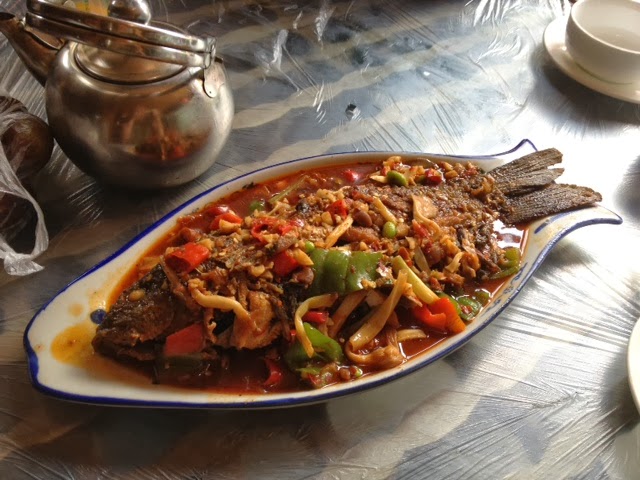
The first one served me a 'Bai Special Grilled Fish' on a metal platter that was burning hot in the chest, freezing cold in the tail, and soggy in the skin, lying in a pool of oniony, peppery soy sauce.  Its head was bitter, and some meat was too tough to chew while the rest mushed off the bone all water-laden like turkey stuffing.  When we inquired after this travesty, the waitress snapped that this was how they made it.


The second one had snails bubbling away in a tank on the sidewalk, so I took the opportunity to order large and small snails in bean sauce.  They came out so bitter that my tongue physically ejected them from my mouth as my lips shrank away.  Upon a second try, I noted that the snails were gritty with sand and the overall impression the sauce left my mouth was: totally numb.  Not Sichuan peppercorn numb - Novocaine numb.  Dead numb.  This waitress, too, claimed that this was how it was meant to be made.


Street vendors sold me rubbery, room-temperature quail egg skewers and burned, asphalt-textured fried cheese.  A smiling guy at a table outside a bookstore sold homemade custard that flopped around on my tongue like a dying guppy and tasted like glue.  Mango juice was made from syrup instead of fruit.

Of course, this all occurred at prices a good 2-3 times higher than the rest of China.

I was fed up and I was hungry, so I threw my policy of only eating local when traveling right out the window.

I'd heard tell of a German bakery that made delectable European-style rolls, loaves, and bagels, and better yet: I'd heard it had the elusive lox-and-cream-cheese topping!

When I'm traveling in Asia, a bagel with lox and cream cheese is always at the top of my homesick cravings list.  I can't explain why.  It has something to do, certainly, with much of Asia's reticence about cheese, but at this particular time I was in Yunnan, home of fried goat cheese.  Also, China doesn't shy away from yogurt.  So I'm not sure why I craved this so intensely, but I did.

"It's going to cost 100 kuai," I joked with Julian, not actually entirely sure I was joking.

At the bakery, timid, limited-English-speaking staff watched us as we perused the menu.  Sure enough, "bagel with cream cheese spread and smoked salmon" was written at the very bottom, nearly edged out by splashy chocolate mousse cakes and resplendent blueberry pies, next to the high but not totally insane price of 48 kuai.

"Bagel... ah... méiyǒu..." a staff member stammered.  He was right to be nervous.  I was on the edge of leaping across the counter and shaking the bagels right out of him.

A crisis was averted by ordering the lox and cream cheese on potato walnut bread.  While we waited for it to come out, we chatted with a couple of Californians snacking on blue cheese and bratwursts about the weather.  It was surreal.

I failed to take a picture of my quarry, because the second it was in my hands, it was between my teeth.  Here is a picture of it, three-quarters-eaten, next to the vegetable bāozi Julian insisted on having instead.


It may not have been the best idea to bite into the sandwich without looking, because it is apparently German-expat-in-China tradition to line one side of bread with whole lime slices, peel, seeds and all.  The first taste was therefore a combination of heavenly sighs and utter confusion, my tongue savoring the creamy spread at the same time as my teeth were crunching lime seeds.

Once the limes were removed (and retained for palate-cleansing between bites), the sandwich, while not quite akin enough to, say, delicatessen bagel creations to be in the same family, was certainly familiar enough to be utterly comforting.

Soft, pillowy potato walnut bread, with its mild flavor punctuated by pockets of nuttiness,  was almost a better base for the smoky fish than bagels.  The traditionalist in me (note: not a large part) hates to say it, but it's true.  They even used red onions and capers, the latter so alien in China that I have no idea where they possibly could have sourced them.

This fist-sized sandwich alone saved Dali from being a purely resentful slot in my culinary memory.

I suppose that's worth the shame of admitting I succumbed to my American-food cravings and paid $6 for Western breakfast in China.

Friday, September 20, 2013

Frogs in Vietnam, frogs in Cambodia

I. Frogs in Vietnam (Ho Chi Minh City)

In District 1, just to the northwest of the Phạm Ngũ Lão backpacker district, a sign shouted, "CHÁO ẾCH SINGAPORE!" at me from across the street.

"Singaporean frog porridge?" I said to Julian with a question mark in my voice, like he would know,  Frog porridge didn't sound familiar.  I thought it was more probable that I was getting my diacriticals mixed up, like always.  

But I was pretty sure, at least, that the sign didn't say "hello frog" (chào ếch), so we went in and sat down.

Yep, frog porridge!  Or rather, frog hot pot with a bowl of porridge on the side.


Beyond the cliché "it tastes like chicken!" I never heard much of a description of frog meat before I ate it on this trip.  I had no idea what to expect.

Allow me to elaborate: it does taste like chicken.  It tastes like chicken that's been crossed with eel.  And it's slippery and tender and encircled with tiny veins that look like tiny rubber bands holding the meat on the bone.

This particular frog was chopped up and marinated in a thick, syrupy sweet soy sauce that dripped tendrils into the porridge like honey into Cream of Wheat when I mixed the bowls together.

---

II. Frogs in Cambodia (Phnom Penh)

The frogs in Vietnam were relatively unadorned, and retained enough of their original shape, texture and flavor that they were unmistakably frogs.  The Cambodian dish, on the contrary, was so heavily stir-fried and coated in all sorts of spices that the meat serving as a vehicle for all that spice was practically irrelevant.  Tiny bones flexed and crunched, but that was the only clue.

In a raucous outdoor restaurant that had only beer and Fanta as refreshment options, I ordered something called 'Hot fried with frog', knowing it could be absolutely anything.


Like most of the mystery Cambodian stir fries I had, it came out liberally coated in lemongrass, an assortment of green leaves and herbs, and wildly spicy red chili specks.  This was the better frog dish by far.  It had a bar wings sort of feel, a carefree application of flavor, made to meld with alcohol.  I came very close to wishing I was a drinker.

Instead, we managed to flag down a wandering vendor who was studiously ignoring the table of foreigners and got him to sell me a baggie of hardboiled quail eggs.  Dragged through the tamarind sauce Julian had on his boring vegetarian noodles, they were the perfect accompaniment.

Saturday, September 7, 2013

Crabs in China, crabs in Cambodia

I. Crabs in China (Ruili, Yunnan)

Our first view of Ruili's night market came through waves of rain, crashing down from the sky like we were walking under the world's biggest waterfall.  The streets quickly flooded and became streams.  We crossed several in water up to mid-calf.

When we got to the market, it was ghostly.  Tarps rattled in the wind, covering deserted stalls.  The stalls were filled with coolers, which were empty and draped in cloth and cardboard.  Only a few places were open.  In one, one drenched diner sat, bedraggledly sipping a papaya smoothie.

We tried again a week later after a scorching day spent on the Burmese border, watching villagers traverse the tiny border river using unofficial makeshift bamboo bridges or merely wading with their pant legs rolled up.  I wanted to find crab to eat; we'd seen rows and rows of workers packing their little silvery blue bodies up into crates bound for the rest of Yunnan.

The night was clear and the market was hopping.  Vendors jostled for space at the edges of a massive inner dining area, their carts all identically piled with skewered meat, snails, crabs, crickets, worms, and baby bees.

View from inside the covered area, with a solid border of stalls
I wasn't that hungry, because, as I recall, I had had about 40 pork and green onion dumplings for lunch, but the night market vendors only sold their merchandise in one size: gigantic-Chinese-family-sharing-size, for 50 kuai (~$8.25).

Julian, of course, refused to eat any of the creatures on offer, so he was tasked with trying to convince the vendors to give me a smaller portion at a smaller price.  Some were mildly amused by the question (in a why-would-I-even-entertain-that sort of way), and some were offended by it (in a you-want-less-of-my-delicious-food?!?! kind of way).

One, though, didn't understand the question, or else didn't care.  "40 kuai," she said with a shrug and a take-it-or-leave it flip of her wok-stirring spatula.  As a normally utterly ineffective bargainer, I was shocked but pleased by this turn of events: an unintentional bargain!

Chopped crabs, passion fruit juice, mango shake
As the dish was set in front of me and I smelled the garlic and chilies wafting up into the air, all my hunger came rushing back somehow.  The dumplings, though still digesting, became a distant memory, as though I had eaten them in a dream.  It was a good thing I hadn't gotten a half-order.  I ate every last claw.

The crabs' sauce was so dark and thick it was tough to distinguish the basil leaves from the undercurrent of pounded chilies.  At first I tried to dig the meat out with chopsticks, but quickly came to realize it was a futile endeavor.  I pulled a rubber band from my pocket, tied my hair back, pushed wayward strands behind my ear, and dug into the bowl with both bare hands like the sauced-up and hot-oiled crab bodies and claws were nothing more than a bowl of jelly beans.

Before long, I couldn't pick up my drink without it slipping right out of my absolutely sauce-coated hands.  I dug my fingers under carapaces and wormed my way into tiny claw crevices.  I scraped claw adductors with my teeth and smeared my cheeks trying to get my tongue all the way into some of the spaces between organs.

The garlic had been stir-fried so thoroughly that it could be eaten in chunks right along with the crabmeat, which was good since they were indistinguishable in color.  The chilies' flavor had seeped into everything so thoroughly that eating them directly had no spicy effect beyond the effect of the rest of the dish, which was very hot.  At first, my tongue delightedly bounced from garlic to ocean to spicy to herby and back, but before long it started tingling and burning them all together.

On the way out, we told the crabs' cook that her work had been amazing.  She barely nodded as she kept stirring someone else's eventual dinner in her wok; she knew.

---

II. Crabs in Cambodia (Phnom Penh)

Khmer cuisine is one of those cuisines that hasn't been widely exported to the U.S.  Last year, I was persistent enough to ferret out a few places in Long Beach, but apart from those tastes, I had no idea what to expect when I found myself on a bus to Phnom Penh earlier this week.

Luckily, Cambodia and Vietnam share the custom of, at nightfall, dragging out hundreds of plastic chairs and tables along with countless tanks of fresh shellfish.  They do this in front of places that remained shuttered and gated all day.  A place that was fixing motorbikes at noon might be tossing sea snails with lemongrass at nine.  And language barriers can't stop me from recognizing those telltale shells.

There was one such place right down the street from our hostel.  It was called the Oyster House.  They had a simple one page menu largely consisting of English translations that left a lot to the imagination.  This wasn't unusual in Phnom Penh, a capital with a much higher general English level than Ho Chi Minh City - enough English to have translations, not enough English to have detailed translations.  One restaurant, for example, listed a particular soup as 'Khmer spice soup' and what came out was full of pumpkins, wintermelon, green beans, eggplant, and cucumbers.

My crab dish was an exception, though - it was called "Shake Sea Crab with Salt and Chili".


Which is exactly what it was.

It came out unadorned with any sort of silverware altogether, which confused me for a good minute.  My stomach was rumblings and I couldn't get any meat out!  Was I supposed to scrape the brain meat with my fingers and then stare at the legs wistfully?

No: I watched the locals.  They were cracking the legs with their teeth.

Despite knowing my dentist would wince if she saw me, and despite the fact that some of the legs were spiky, I did the same.  The crabs were small, about the same size as my palm.  Their open heads were full of potent pepper seeds and sea salt; the legs were grilled until they could almost be crunched like BBQ flavored potato chips.  To get the tiny wedges of meat out of their skinny limbs was like performing hand surgery, but ultimately worth it.  The seasoning was simple, but the crabs were effortlessly, lightly fresh, the kind of fresh you only get in the States by paying over $30 per head or by going out in a boat yourself.  Getting them for $1.50 was an experience I knew I shouldn't take for granted.

But they were tiny... so I couldn't help ordering some of the restaurant's namesake afterwards.

Grilled oysters!