At the beginning of this week, I moved to Los Angeles.
I have always loved L.A. unconditionally. Though I was born and raised in Chicago, attended college in Colorado, and went to graduate school in Orange County, my family took trips here two or three times a year and I always knew in the back of my mind that this is where I'd end up. Every cross-country move I made brought me closer.
I constantly find myself hotly defending L.A. against those who view it as an engorged, vapid, shallow extension of Hollywood and Beverly Hills, but I have only one firm rule. That is: if you consider yourself both a food lover and an L.A. hater, you might need to readjust one of those attitudes. You can't hold both.
L.A.'s dry sweeping winds, droughts, and brown desert cliffs only charm me and clear my skin; its sprawling vastness only makes for more expansive mountain views for me to enjoy, and its choked traffic and exorbitant valet parking just tempt me to walk or bus everywhere, discovering neighborhoods most people never see speeding (or crawling, as it were) by on the freeways.
One of those neighborhoods, Echo Park, is my home now. Today, I took a walk. And I was hungry.
Luckily, hungry is the best thing to be in L.A.!
There's apparently a cart where a lady makes terrific Oaxacan-style blue corn quesadillas on the corner of Sunset and Echo Park - but this cart remains the stuff of fables for me because I have never been able to find her. Today was no exception. The dusty and largely abandoned parking lot where she supposedly sets up was empty even of men selling chili-salted fruit bags, jangling and clattering ice cream/popsicle carts, and the heavy, greasy smoke of the bacon-wrapped hot dog lady's cooking. Unusual.
So I kept walking. I wandered into a Mexican grocery sandwiched in between two discount clothing stores. The first thing I saw? Papalo! 99 cents per bunch. The second thing? Manila mangoes: four for a dollar.
$1.50 poorer, baking in the sun, trying to peel a mango with one hand, and taking big juicy bites that dripped mango juice all over the concrete, I kept walking.
Sticky-faced, I passed an extraordinarily foofy-looking raw vegan café on the same block as a place that sells hot dogs, quesadillas, 'bibim noodle bowls' and licuados all for less than $8. Pozole from Costa Alegre, trout from Taix, and a machaca burrito from my childhood burrito-serving giant, Burrito King, also failed to beckon me, and my stomach growled ominously. It was too early for Tacos Arizas and its seductive lengua tacos, so I sadly bypassed the Walgreens parking lot.
But hark! What gleamed rainbow-colored from the Vons parking lot? Could it be... an earlier-rising taco truck?
Yes, it could!
The man inside the truck, friendly in an easygoing, chatty way, recommended the carnitas and the cabeza tacos, a recommendation I gladly took. Within two minutes, I had a sturdy plate of meat piled high, fresh, moist tortillas, and liberal sprinklings of cilantro and onions. The bar provided me with two types of green salsa, and I sampled one on each taco.
The darker, waterier tomatillo was deceptively spicy and heavily seeded, and filtered down through every pore of my carnitas, while the creamier cilantro-based sauce sat atop my cabeza like tzatziki. I pulled my bag of papalo from my purse and padded each taco with a few leaves. The taco truck proprietor tilted his head curiously: why is that girl adding secret purse ingredients to her taco?
Why are meals eaten perched on a curb so often the most satisfying meals? Is it the constant redirecting of ants from one's feet, or the telltale dusting of dirt on the backside? Is it the knowledge that there is nothing enhancing the quality of the meal, no wall paintings or ceiling hangings, no ingratiating service or padded back cushions, and yet it still makes you smile?
Sun-addled now, with remnants of mango juice, cow and pig parts, and grease likely speckling my face despite multiple wipes with a napkin, I stumbled towards home, but was arrested by the sight of a 300 square foot market featuring such attractions as $7 fig and olive crackers, artisanal olive oil in a giant jug, and prosciutto lined baguettes. Spotting some enormous cookies with the moniker 'Not Nutter Butter', I shrugged. Why not?
And thus did I stagger up the steep, winding incline towards home, letting the granola-like cookie flake away under my tongue as the fine, silky peanut butter melted on top of it.
This is the same hill where I, as a child, I stole loquats from the neighbor's laden trees in April, where I learned that nasturtiums were edible (and spicy), and where I looked out on the San Bernardino mountains while eating lox on bagels on Sunday mornings.
I finally feel, culinarily, very much at home, but it's almost time to be thrust into a completely foreign flavor environment: I leave for Japan in just under a week.
Wednesday, June 26, 2013

Tuesday, June 25, 2013
Papalo
If some people can't help but taste soap when cilantro touches their tongues...
... might the papalo leaf be the answer for those poor souls who have never been able to experience the zingy shiver of a good sprig of cilantro?
In summer 2013, one particular papalo leaf ('Bolivian coriander' or 'summer coriander' despite not actually being genetically related to coriander) tucked itself coyly away in a sandwich I was about to devour. I was expecting a torta: you know, meat, cheese, avocado, lettuce, some kind of spicy slathering, a bun, copious amounts of grease.
Instead, unbeknownst to me, I was actually holding a cemita.
The pounded, fried milanesa, monstrous as it was, amazingly faded into the background, providing only chicharrones-like crunch and a few pepper seeds as support for the teeth-squeakingly fresh cubes of queso fresco, the verdant fatty avocado, the zing of the papalo leaves, and the slow burn of the adobo sauce on top of it all.
But an unexpected guest at a party always earns an extra once-over, and I did a double take, peeking under the pillowy egg-bread to see what that surprise zing was. Cilantro? Fish-mint? Saw-leaf herb? My at-the-time-primarily-phở-based herb expertise was at a loss. I poked and prodded the clover-shaped herb, ripping off bits to taste and holding it up to the light, examining its plant-veins.
Giving up, I asked the cashier after I was done: "Papalo!" she exclaimed, smiling brightly. "It's seasonal!"
Seasonal? In today's frantic global scramble, with cargo airborne everywhere and instant culinary gratification?
What a treat! Something to look forward to every summer!
----
Where to get papalo in Orange/LA county:
The place that served it to me is called La Cemita Poblana and it's in Santa Ana. A cute little cottage with outdoor-only seating, cheerful service, and aguas frescas served in small-bucket and large-bucket sizes only, dinner for two won't run more than $20 (and probably much less).
Otherwise, if you're more of a kitchen-adventurer than a restaurant-adventurer, I hear it's available in the produce section of Mexican markets.
... might the papalo leaf be the answer for those poor souls who have never been able to experience the zingy shiver of a good sprig of cilantro?
In summer 2013, one particular papalo leaf ('Bolivian coriander' or 'summer coriander' despite not actually being genetically related to coriander) tucked itself coyly away in a sandwich I was about to devour. I was expecting a torta: you know, meat, cheese, avocado, lettuce, some kind of spicy slathering, a bun, copious amounts of grease.
Instead, unbeknownst to me, I was actually holding a cemita.
 |
| ...a MONSTER cemita. |
But an unexpected guest at a party always earns an extra once-over, and I did a double take, peeking under the pillowy egg-bread to see what that surprise zing was. Cilantro? Fish-mint? Saw-leaf herb? My at-the-time-primarily-phở-based herb expertise was at a loss. I poked and prodded the clover-shaped herb, ripping off bits to taste and holding it up to the light, examining its plant-veins.
Giving up, I asked the cashier after I was done: "Papalo!" she exclaimed, smiling brightly. "It's seasonal!"
Seasonal? In today's frantic global scramble, with cargo airborne everywhere and instant culinary gratification?
What a treat! Something to look forward to every summer!
----
Where to get papalo in Orange/LA county:
The place that served it to me is called La Cemita Poblana and it's in Santa Ana. A cute little cottage with outdoor-only seating, cheerful service, and aguas frescas served in small-bucket and large-bucket sizes only, dinner for two won't run more than $20 (and probably much less).
Otherwise, if you're more of a kitchen-adventurer than a restaurant-adventurer, I hear it's available in the produce section of Mexican markets.
Monday, June 24, 2013
Dê bảy món
Vietnamese restaurants are big on serving 7 courses of things. By far the most common '7 course' set is 'bò 7 món', or, literally, 'beef 7 ways'.
I decided to try it with a twist. 7 courses of goat: dê 7 món.
7 full courses of goat, or any type of meat, is risky business. Done wrong, it can easily be a heavy, plodding march of meat, a lunch that leaves you yearning for a fruit smoothie and a nap. It's a wonder churrascaria parking lots aren't littered with the wrecked cars of peacefully slumbering patrons.
Fortunately, undoubtedly owing to some chef-ly sleight of hand, the courses at Binh Dan Restaurant are neat, small, and sufficiently herb-garnished that you somehow never get the feeling like you're slipping away into a meat-coma.
"You want it with everything?" our waiter/owner/general helpful hoverer asked, slightly doubtfully, as I ordered the dê bảy món.
"Yes, everything," I said, nodding.
"All the dishes, too?" he continued. "Even the blood?"
"Yes, everything," I nodded more, exaggeratedly, like a broken puppet, hoping that my enthusiasm and openness would translate.
"Even the normal sauce?" he asked. "I can bring you different sauce if you don't like it."
"I'll like it," I said - and with true confidence this time, because every time someone in a Vietnamese restaurant suggests I'm not going to like a certain sauce, I know exactly what sauce it's going to be.
Well, one of two things - mắm nêm or mắm ruốc.
Both are unassuming little purplish brown piles that pack an extreme fermented-seafood punch to the face - even the amount that'll fit on the end of one chopstick will flavor a few bites to excess.
While I admit that the first time I had it I thought that they had accidentally left normal fish sauce out in the sun for a couple weeks and secretly feared I might die in the next few hours, I urge you to keep trying it: the appeal nuzzles its way into your tastebuds eventually.
Anyway, the waiter finally took my word for it that I wouldn't run screaming from his restaurant at the sight of blood or the smell of fermented seafood paste, and withdrew.
When he reappeared, it was time for the goat onslaught.
Course 1, goat sausages and barbecued goat made with goat fat, came smoking out to our table like a concentrated grill, releasing that summery greasy charcoal scent in clouds. The sausages lay sizzling in pools of their own fat, while the sesame seeds lining the curls of goat meat showed a slight tan, but no burn.
Just as we were starting to get the feel for grilled meat, imagining ourselves in a park or a night market or a dive bar, Course 2, a cold wobbly pudding of raw goat blood, liver slices, and peanut showed up, adorned with one sprig of cilantro. Our friendly waiter popped his head over the counter again: "You eat it with lime juice and mint... it's better that way!"
The pudding had the slightly shocking texture of cartilage-adorned Jell-O, and the refreshing, clean finish of the freshest sashimi. Paired with the sausages, it served as a citrusy, cool palate-cleanser.
Course 3, a boat-shaped curry of cumin-yellow goat pieces and onions, melted into my vermicelli bowl, leaving the noodles sunny and spicy, topped with so-tender-it-dissolved-under-my-tongue goat meat and springy intestine slices.
To trickle into the spaces in our now rapidly filling stomachs, the next four courses were stews: a spicy, curry-heavy soup laden with skin-on slices; an impossibly rich, silky broth with a layer of glistening oil on top; a slightly darker stew with a centerpiece of flower-shaped tripe; a nearly black potion rumored to contain Chinese herbs for comfortable digestion.
I was charmed by the innovative nature of the first three dishes and comforted by the hominess of the next three, but the herbal concoction sat strangely with me.
A woman from the next table had been eyeing me ever since the first spoonful of goat blood went into my mouth: she approached. "Where did you learn to eat this?" she exclaimed, then went on to explain that while this place was good, the meal was miles better in Vietnam.
Alas, the transition from stuffing-my-face-face to talking-with-strangers face took so long that she was gone before I had the chance to ask her where in Vietnam, I implore you, where?!
Damn.
I decided to try it with a twist. 7 courses of goat: dê 7 món.
7 full courses of goat, or any type of meat, is risky business. Done wrong, it can easily be a heavy, plodding march of meat, a lunch that leaves you yearning for a fruit smoothie and a nap. It's a wonder churrascaria parking lots aren't littered with the wrecked cars of peacefully slumbering patrons.
Fortunately, undoubtedly owing to some chef-ly sleight of hand, the courses at Binh Dan Restaurant are neat, small, and sufficiently herb-garnished that you somehow never get the feeling like you're slipping away into a meat-coma.
"You want it with everything?" our waiter/owner/general helpful hoverer asked, slightly doubtfully, as I ordered the dê bảy món.
"Yes, everything," I said, nodding.
"All the dishes, too?" he continued. "Even the blood?"
"Yes, everything," I nodded more, exaggeratedly, like a broken puppet, hoping that my enthusiasm and openness would translate.
"Even the normal sauce?" he asked. "I can bring you different sauce if you don't like it."
"I'll like it," I said - and with true confidence this time, because every time someone in a Vietnamese restaurant suggests I'm not going to like a certain sauce, I know exactly what sauce it's going to be.
Well, one of two things - mắm nêm or mắm ruốc.
 |
| No, not chocolate: don't make the same mistake I did. |
While I admit that the first time I had it I thought that they had accidentally left normal fish sauce out in the sun for a couple weeks and secretly feared I might die in the next few hours, I urge you to keep trying it: the appeal nuzzles its way into your tastebuds eventually.
Anyway, the waiter finally took my word for it that I wouldn't run screaming from his restaurant at the sight of blood or the smell of fermented seafood paste, and withdrew.
When he reappeared, it was time for the goat onslaught.
Course 1, goat sausages and barbecued goat made with goat fat, came smoking out to our table like a concentrated grill, releasing that summery greasy charcoal scent in clouds. The sausages lay sizzling in pools of their own fat, while the sesame seeds lining the curls of goat meat showed a slight tan, but no burn.
Just as we were starting to get the feel for grilled meat, imagining ourselves in a park or a night market or a dive bar, Course 2, a cold wobbly pudding of raw goat blood, liver slices, and peanut showed up, adorned with one sprig of cilantro. Our friendly waiter popped his head over the counter again: "You eat it with lime juice and mint... it's better that way!"
The pudding had the slightly shocking texture of cartilage-adorned Jell-O, and the refreshing, clean finish of the freshest sashimi. Paired with the sausages, it served as a citrusy, cool palate-cleanser.
 |
| Veggie plate, noodles, fish sauce, sesame crackers, sausage and grilled meat, blood pudding |
To trickle into the spaces in our now rapidly filling stomachs, the next four courses were stews: a spicy, curry-heavy soup laden with skin-on slices; an impossibly rich, silky broth with a layer of glistening oil on top; a slightly darker stew with a centerpiece of flower-shaped tripe; a nearly black potion rumored to contain Chinese herbs for comfortable digestion.
 |
| Courses 5 and 6: 3 and 4 disappeared before my camera made its way out of my bag |
A woman from the next table had been eyeing me ever since the first spoonful of goat blood went into my mouth: she approached. "Where did you learn to eat this?" she exclaimed, then went on to explain that while this place was good, the meal was miles better in Vietnam.
Alas, the transition from stuffing-my-face-face to talking-with-strangers face took so long that she was gone before I had the chance to ask her where in Vietnam, I implore you, where?!
Damn.
Monday, June 17, 2013
Chu uh tang, plus an octopus conundrum
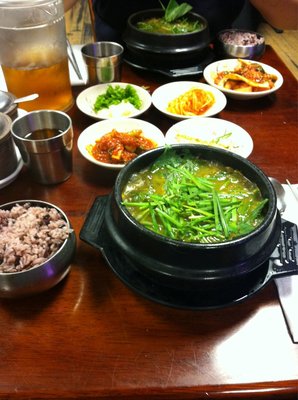
Everyone in the tiny restaurant is bent intently over black steaming pots of brownish, gritty-looking stew festooned with bright green piles of green onions. They're folding in their purple rice and carefully adjusting their seasoning ratios, way too focused to notice me spying on their private lunch-times.
All except for the man next to us.
"Have you been here before? Have you had this before? It's an... acquired taste," he admits. Both he and his companion have been fairly silent until now, looking only into the depths of their stews.
Yelp reviews have already told me this. He tells me this. And now the waitress will come over and take her turn, albeit in extra-tactful waitress language. "This is Korean specialty..." she says, trailing off.
What is? Chu uh tang - mudfish stew.
Googling 'mudfish' brings up this rather eel-like, slithery-looking result...

... but the stew is fairly smooth, the kind of smooth you get with an old food processor, just a ghost of the original texture. The fish are ground up into a paste, mixed with soybean and red pepper (of course) paste, and the resulting mix is way past soup but not quite all the way to stew.
Actually, by the time the waitress finishes fussing with our seasonings, it's almost all the way to hummus.
Let me tell you something about Korean hospitality.
No matter the language barrier, you'll never feel lost. You'll never feel confused. You'll never look at your food and wonder 'how should I eat this? What should I season this with? What utensil should I use?' You won't have time to wonder anything before a guiding hand is doing it all for you, sometimes up to the point of tying your bib on and feeding you.
I've had my seafood pancake spiced, my cod stew sauced, and my purple rice mixed by the impossibly sweet proprietress of Western Doma Noodle in Los Angeles.
And more extremely, I had my street sushi dipped in soy sauce, dipped in red pepper paste, wrapped in a seaweed square, and put in my mouth for me by a lady manning a cart at KwangJang Market in Seoul.
So here, faced with mudfish stew, we don't have to lift a finger. The waitress sets the bowls down, adds the garlic, adds some onions, shakes three types of powder over it, and positions them just so with inviting spoons at the precise angle for grabbing, then departs.
Leaving us with our stew and our second dish, stir-fried octopus.
Here's where this story gets difficult and strange.
I want to love this restaurant. I love the way it looks and feels. The menu that is 80% mudfish variants (and neon backlit like a burger place). The twenty-gallon barrel of purple rice constantly being stirred next to the counter.
But the food confuses me. It's not that the mudfish is strong or distasteful - it's just bland, a slightly herbal-tasting oatmeal broken with green onion stalks. This is a surprise. What is the acquired taste, exactly? Do I have to wait to develop the tastebuds required to taste it? And the octopus, while coated in a wonderful spicy red paste, requires the chewing muscles of a canine tug-of-war champ.
The waitress comes back and sits down next to us. "Is it OK?" she asks cautiously, watching my mom try in vain to bite an octopus tentacle in half. "Hard to chew?"
We nod.
"In Korea we like it to be chewy," she says. "My daughter was born here. She likes soft food. Uh, tender food! She likes it tender. But this dish," - she gestures to the octopus - "is supposed to be chewy."
It had never occurred to me that people might prefer their food to be like gum, which is strange, because every other preference has occurred to me. I unblinkingly accepted the gamut of preferences from rare to charred meat, white to dark meat, raw to cooked fish, and every cut of meat from skin all the way inwards to intestines. I'd never thought of chewy and tender on the same continuum, though. I just assumed tenderer = better.
But when I hear it, I believe her: a memory springs forth.
When I was in Busan, in the formidable shadow of the Jagalchi Fish Market, I took a plunge and ordered stir-fried eel at one of the specialty restaurants on the side streets. The luckier eels writhed in the outdoor tanks as my specimens arrived at my table, sizzling, in a big aluminum foil-lined pot.

On my computer, this picture's filename is Bad Eel.jpg. No lie. The eel had such a strange, tough, rubber texture, almost like what you'd expect raw snake to feel like if you put it into your mouth. I had lots of trouble eating it because my teeth were screaming at me that it was raw meat, that it was a far cry from the pillowy anago and unagi of my childhood at sushi restaurants, that I should spit it out, that I should send it back.
Everyone in the restaurant looked at my cringing face like it, and therefore I, was crazy.
I think of this as I try to reassure the kind waitress at Nam Won Gol that we aren't angry at her or her octopus,* while at the same time trying to force my jaw to persevere when all it wants to do is lie down on the grass and take a nap.
Maybe there are some dishes that require the cooperation of muscle memory and its complex network of intuitive preferences to truly appreciate. My jaw's memories, unfortunately, mostly involve associating pleasure with being lazy.
----
* For what it's worth, the couple next to us whispers that if we want tenderness, we should go for the squid next time.
All except for the man next to us.
"Have you been here before? Have you had this before? It's an... acquired taste," he admits. Both he and his companion have been fairly silent until now, looking only into the depths of their stews.
Yelp reviews have already told me this. He tells me this. And now the waitress will come over and take her turn, albeit in extra-tactful waitress language. "This is Korean specialty..." she says, trailing off.
What is? Chu uh tang - mudfish stew.
 |
| Thanks, Yelper So H |

Actually, by the time the waitress finishes fussing with our seasonings, it's almost all the way to hummus.
Let me tell you something about Korean hospitality.
No matter the language barrier, you'll never feel lost. You'll never feel confused. You'll never look at your food and wonder 'how should I eat this? What should I season this with? What utensil should I use?' You won't have time to wonder anything before a guiding hand is doing it all for you, sometimes up to the point of tying your bib on and feeding you.
I've had my seafood pancake spiced, my cod stew sauced, and my purple rice mixed by the impossibly sweet proprietress of Western Doma Noodle in Los Angeles.
And more extremely, I had my street sushi dipped in soy sauce, dipped in red pepper paste, wrapped in a seaweed square, and put in my mouth for me by a lady manning a cart at KwangJang Market in Seoul.
 |
| Well, I was doing it wrong! |
Leaving us with our stew and our second dish, stir-fried octopus.
Here's where this story gets difficult and strange.
I want to love this restaurant. I love the way it looks and feels. The menu that is 80% mudfish variants (and neon backlit like a burger place). The twenty-gallon barrel of purple rice constantly being stirred next to the counter.
But the food confuses me. It's not that the mudfish is strong or distasteful - it's just bland, a slightly herbal-tasting oatmeal broken with green onion stalks. This is a surprise. What is the acquired taste, exactly? Do I have to wait to develop the tastebuds required to taste it? And the octopus, while coated in a wonderful spicy red paste, requires the chewing muscles of a canine tug-of-war champ.
The waitress comes back and sits down next to us. "Is it OK?" she asks cautiously, watching my mom try in vain to bite an octopus tentacle in half. "Hard to chew?"
We nod.
"In Korea we like it to be chewy," she says. "My daughter was born here. She likes soft food. Uh, tender food! She likes it tender. But this dish," - she gestures to the octopus - "is supposed to be chewy."
It had never occurred to me that people might prefer their food to be like gum, which is strange, because every other preference has occurred to me. I unblinkingly accepted the gamut of preferences from rare to charred meat, white to dark meat, raw to cooked fish, and every cut of meat from skin all the way inwards to intestines. I'd never thought of chewy and tender on the same continuum, though. I just assumed tenderer = better.
But when I hear it, I believe her: a memory springs forth.
When I was in Busan, in the formidable shadow of the Jagalchi Fish Market, I took a plunge and ordered stir-fried eel at one of the specialty restaurants on the side streets. The luckier eels writhed in the outdoor tanks as my specimens arrived at my table, sizzling, in a big aluminum foil-lined pot.

On my computer, this picture's filename is Bad Eel.jpg. No lie. The eel had such a strange, tough, rubber texture, almost like what you'd expect raw snake to feel like if you put it into your mouth. I had lots of trouble eating it because my teeth were screaming at me that it was raw meat, that it was a far cry from the pillowy anago and unagi of my childhood at sushi restaurants, that I should spit it out, that I should send it back.
Everyone in the restaurant looked at my cringing face like it, and therefore I, was crazy.
I think of this as I try to reassure the kind waitress at Nam Won Gol that we aren't angry at her or her octopus,* while at the same time trying to force my jaw to persevere when all it wants to do is lie down on the grass and take a nap.
Maybe there are some dishes that require the cooperation of muscle memory and its complex network of intuitive preferences to truly appreciate. My jaw's memories, unfortunately, mostly involve associating pleasure with being lazy.
----
* For what it's worth, the couple next to us whispers that if we want tenderness, we should go for the squid next time.
Thursday, May 30, 2013
No, I’m crying because I’m happy
So I’m sitting at Thai Nakorn, hundreds of napkins stacked at the ready.
“How spicy do you want it?” asks the waiter. “On a scale of 1 through 5?”
Do not say ‘5’.
Don’t do it.
You’ll be sorry.
The waiters will come by later, concerned, and innocently ask, “Too spicy for you?”
And you’ll have to say no, no, of course not, as tears run down your face and water runs from your
nose and into your napkin as you try to surreptitiously spit out pepper seeds and simultaneously cool the fire with Thai iced tea.
Because, let’s face it, you said 5. And now you have to suffer the consequences. Here’s a secret: the only thing that will help your poor tongue now is not Thai iced tea. It’s sticky rice. Not regular rice. Sticky rice.
I always say '4'. '4' is tongue-swellingly, forehead-sweatingly spicy enough.
But Thai Nakorn doesn’t rest on its fiery pepper laurels. Its flavors come through, mingled, quite well enough on their own. The crispy catfish green mango salad is a particularly arresting dish texturally, with the peanuts and crispy fried catfish skins giving a satisfying crunch to the sour and juicy spears of green mango. The tiny orange half-circles are not some sort of exotic orange Thai pepper; they’re shrimp. Their microscopic legs and eyes are visible if you peer closely at your plate, but you don’t need to see them to be able to taste them: a savory ocean dash at the edges of your tongue.
Thai, Laotian, and Cambodian food has always thrilled my taste buds at the same time as it pushes my tear ducts' boundaries to the limit. It's not afraid to offend me, and I LOVE unapologetically pushy food.
Take Vientiane Thai Laos' larb goong (shrimp larb). There are shrimp chopped tiny and just barely seared, like ceviche, from the lime juice. There are impossibly crisp vegetables and shredded strips of mint leaves that aren't afraid to take over. But they don't have to worry about having to do that, because everything is thickly coated in finely chopped red pepper.
Or the gang thy pa from the same place, a soup that looks like it's going to be a neutral, perhaps coconutty or fishy cross between tom yum and tom yum kai, but then turns out to be a seething bowl of fermented fish sauce, tamarind, and pepper, pepper, pepper.
Sometimes you think you're safe ordering fruit. Wrong! Wat Dong Moon Lek Noodle's rambutan salad - rambutan salad, come on! - comes out so shockingly hot that you have to practically mainline your basil-pineapple smoothie just to keep breathing. Its base, spicy lime cream, is dotted with fiery orange chilies, and the juice from the rambutan spreads over the cream like oil over water, creating a swirled kind of tonguefeel.
Whenever I eat these dishes, and even though my nose is running and my mouth is aflame, I am able to taste straight through to the complex flowery tones beneath, I give thanks to one man.
I know him only as 'Kim'.
He runs Thai Avenue in Boulder and I used to order drunken noodles from his little food court stand weekly. I started going there in 2006, ordering my noodles emphatically mild. By 2010, when I left Boulder, I was well into the 'spicy' category and going strong.
I have no evidence of this, but I strongly suspect he upped the pepper content by microscopic amounts weekly to get me accustomed to it. I never noticed the difference in his plates - they were simply perfect and delicious every week - but I gradually started noticing I was able to hold my own with jalapeño pepper-infused Mexican dishes and Korean gochujang-soaked side dishes. And more than that, I was tasting them in new and wonderful ways.
Now, you'll find me vigorously entreating Thai waitresses to please believe me, yes I want it spicy, yes I know what that means, yes, I promise I won't run out of here cursing you. Yes. Spicy. Please.
Thank you, Kim.
Tuesday, May 28, 2013
Lengua and other 'secret' meats
I'd never been too fond of the idea of beef tongue before this past Saturday. Or any kind of tongue, for that matter.
Maybe this sounds weird, but the thought of another tongue in my mouth next to my own tongue made me cringe a little. I mean, what if I forgot which tongue I was supposed to be chewing? What if my teeth couldn't tell the difference? It's hard enough not to bite my tongue when it's numb from Novocaine - how would my jaw manage differentiating between multiple tongues?
So, there's been a taco truck that sets up shop next to the Echo Park Walgreens for as long as I can remember. It's called Tacos Arizas. Now, I've always been curious about it, but whenever I was in Echo Park it meant I was visiting my extended family, and that meant one thing: meat. Grandmas and aunts and mothers and cousins all cooking ridiculous amounts of meat. Chopped liver. Borscht (yes, this has beef all over the place according to their recipe). Enchiladas verdes con pollo. Essic-fleish. Spareribs - Korean or European style.
The last thing I ever wanted on top of all of that was a meaty meat-taco.
But Saturday, I had my chance. I had fifteen minutes left on the parking meter from shopping and I was starving. I ran over to the truck and ordered three tacos: buche, carnitas, and yes, lengua.
I didn't take a picture because: a) I was too busy spilling salsa all over my car as it was, and b) it was in my stomach before I knew it.
Tongue is like a cross between tender muscle meat and liver! It's juicy, not chewy at all, and much, much more forgiving to chew on than, say, many steaks. Why did no one inform me of its wonders earlier?
I feel like being raised in the States - for most of us, anyway - is like being raised in a parallel universe where animals just magically lack certain body parts. They have flanks, they have breasts, they have ribs and muscles and bellies, but their heads have disappeared into the air. And their hearts, and their organs, and their intestines, and their feet, and their spines too - when the animal is killed, these parts just shrivel up and disintegrate in little puffs of smoke.
And that makes me feel like for most of my life I have been complicit in a supreme conspiracy of waste, of toddler-like pickiness. What is inherently wrong or gross about eating these invisible parts of the animal? If you don't like the flavor or texture of a certain part after you've tried it, that's just fine. But I doubt nearly an entire country would spit out a sashimi-like smooth chunk of tendon or a chewy, fatty intestine if its source were hidden, or sugar-coated.
It sounds like I'm frustrated, and admittedly there is a bit of that, but the overwhelming feeling is that the world of unexplored meat cuts is like an endless platter of potential favorites laid out before me.
What cut next?
Maybe this sounds weird, but the thought of another tongue in my mouth next to my own tongue made me cringe a little. I mean, what if I forgot which tongue I was supposed to be chewing? What if my teeth couldn't tell the difference? It's hard enough not to bite my tongue when it's numb from Novocaine - how would my jaw manage differentiating between multiple tongues?
So, there's been a taco truck that sets up shop next to the Echo Park Walgreens for as long as I can remember. It's called Tacos Arizas. Now, I've always been curious about it, but whenever I was in Echo Park it meant I was visiting my extended family, and that meant one thing: meat. Grandmas and aunts and mothers and cousins all cooking ridiculous amounts of meat. Chopped liver. Borscht (yes, this has beef all over the place according to their recipe). Enchiladas verdes con pollo. Essic-fleish. Spareribs - Korean or European style.
The last thing I ever wanted on top of all of that was a meaty meat-taco.
But Saturday, I had my chance. I had fifteen minutes left on the parking meter from shopping and I was starving. I ran over to the truck and ordered three tacos: buche, carnitas, and yes, lengua.
I didn't take a picture because: a) I was too busy spilling salsa all over my car as it was, and b) it was in my stomach before I knew it.
Tongue is like a cross between tender muscle meat and liver! It's juicy, not chewy at all, and much, much more forgiving to chew on than, say, many steaks. Why did no one inform me of its wonders earlier?
I feel like being raised in the States - for most of us, anyway - is like being raised in a parallel universe where animals just magically lack certain body parts. They have flanks, they have breasts, they have ribs and muscles and bellies, but their heads have disappeared into the air. And their hearts, and their organs, and their intestines, and their feet, and their spines too - when the animal is killed, these parts just shrivel up and disintegrate in little puffs of smoke.
And that makes me feel like for most of my life I have been complicit in a supreme conspiracy of waste, of toddler-like pickiness. What is inherently wrong or gross about eating these invisible parts of the animal? If you don't like the flavor or texture of a certain part after you've tried it, that's just fine. But I doubt nearly an entire country would spit out a sashimi-like smooth chunk of tendon or a chewy, fatty intestine if its source were hidden, or sugar-coated.
It sounds like I'm frustrated, and admittedly there is a bit of that, but the overwhelming feeling is that the world of unexplored meat cuts is like an endless platter of potential favorites laid out before me.
What cut next?
Thursday, May 23, 2013
Ashure: Turkish Bakery Wheel of Fortune
One of my favorite dishes at Passover is charoset, which is made incredibly simply, using only apples, walnuts, wine, and sugar. It tastes like someone deconstructed the world's most perfect granola bar, then turned back time so all the ingredients just fell from the tree (or were squeezed from the cane, or fermented from the grapes, depending on the ingredient in question).
I can't really discern whether it's my favorite because it's delicious (which it is) or because it's the only Passover-related thing that my kitchen-challenged self can reliably prepare for a tableful of generally discerning Jewish people (which it also is - I mean, for example, have you seen how you make gefilte fish?!).
Conversely, one of my least favorite things to eat is oatmeal. This makes pretty much no sense, because I enjoy Cream of Wheat, Asian porridges (Chinese zhou, Vietnamese cháo; even that Japanese grated yam dish that has the consistency of snot...it's called tororo, I believe) yogurt with granola, and other oatmeal-like things. There's just something about oatmeal, its watery slight sweetness, that tastes and feels like someone left Cheerios and skim milk out on the porch in the sun.
So when I peeled the lid off a mystery dessert I got at a Turkish bakery that looked like an exact cross between charoset and oatmeal, I honestly had no idea what would happen with the communication between my tastebuds and my brain.
It was called ashure, and was more oatmeal-like than charoset-like - but really it departed quickly from both.
I can see how it might be better with fresh peaches rather than canned, because every time I got a surprising crunch and burst of juice from a pomegranate seed, I got a little electric shiver of delight. The chickpeas lent an almost Asian-dessert-like quality (with its always confounding emphasis on sweet legumes) and the cinnamon sauce all runny in the middle brought to mind a warm, gooey cinnamon roll.
Not bad for something I chose by pointing at random into a display case!
 |
| Thanks, Cooking With My Kid - that's much prettier than mine! |
Conversely, one of my least favorite things to eat is oatmeal. This makes pretty much no sense, because I enjoy Cream of Wheat, Asian porridges (Chinese zhou, Vietnamese cháo; even that Japanese grated yam dish that has the consistency of snot...it's called tororo, I believe) yogurt with granola, and other oatmeal-like things. There's just something about oatmeal, its watery slight sweetness, that tastes and feels like someone left Cheerios and skim milk out on the porch in the sun.
So when I peeled the lid off a mystery dessert I got at a Turkish bakery that looked like an exact cross between charoset and oatmeal, I honestly had no idea what would happen with the communication between my tastebuds and my brain.
 |
| I ate it on my windowsill to give it more of an 'I'm picnicking in the forest' feel. |
I can see how it might be better with fresh peaches rather than canned, because every time I got a surprising crunch and burst of juice from a pomegranate seed, I got a little electric shiver of delight. The chickpeas lent an almost Asian-dessert-like quality (with its always confounding emphasis on sweet legumes) and the cinnamon sauce all runny in the middle brought to mind a warm, gooey cinnamon roll.
Not bad for something I chose by pointing at random into a display case!
Subscribe to:
Posts (Atom)