Friday, September 6, 2013

Sushi Dai, supermarket sushi, and the sushi in between: Part II

(Continued from Part 1.)

I have a confession to make: I regularly eat sushi from American supermarkets.

I know it's a sorry excuse for what can be a true art form.  I know that if you put rice in the refrigerator, it totally ruins it, and that everything keeping the not-so-fresh raw fish from killing me is a preservative and preservatives are bad.  I know.

But sometimes I get a craving and it absolutely does not matter if I can only fulfill it by eating something that's only as akin to restaurant-quality sushi as a McDonald's burger is to one made with Kobe beef (actual Kobe beef, not fake American Kobe beef).

Last year, every week before my graduate seminar in social psychology, I would go to 'The Cage', which is an on-campus convenience store that sells things like Pringles, wrinkled day-old donuts, powerbars, and slimy old tuna sandwiches.  And, inexplicably, raw salmon handrolls.

They were always terrible.  There was spicy orange sauce everywhere, the cucumbers were often so bitter I had to remove them, and the fish was occasionally edible alone but more often required a full slathering of soy and wasabi.

Basically, everything I am telling you should disqualify me from any pretense of judging Japanese supermarket sushi, but I'm going to anyway:

IT.  IS.  UNBELIEVABLE.

And cheap!
($3.98 for 8 pieces)
When I was in Osaka, it was hot.  Smotheringly so.  There was one day when I had had just about enough of darting from covered mall to covered mall, looking at stacks of platform shoes because going in the sun would make me pass out, so I went to the supermarket, picked up the first package of to-go sashimi I saw, and booked it home before the heat brought the fish back to life.

I kicked my shoes off at the door, hauled open all the windows, sprawled on the bed, and lifted each piece of hamachi by two fingers, dropping them into my mouth like gummy worms, expecting them to satisfy my only slightly more than hamachi-flavored gummy worms would.

Instead, I found myself with a mouthful of fish fit to be served festooned on a platter at any sushi bar.

Seriously, I would not have been surprised or disappointed had I encountered it in a swanky izakaya or a spare, traditional establishment for $4 per piece.  I would have welcomed it, savored it, reviewed it highly.

And here I was with it between my fingers on a lazy weekday afternoon in a hotel room for $0.50.

The sushi at every big supermarket was this good.  Hamachi, sake, saba, and maguro.  I'm ashamed to admit it, but some days I didn't really want to go out searching for restaurants because I knew that if I wanted to and with almost no effort, I could lounge around popping sashimi like potato chips for a pittance.

----

Sushi Dai blew me away, and supermarket sushi blew me away.  But the mid-range eateries I tried were surprisingly average.

A hakozushi place in Shinsaibashi recommended by my (otherwise excellent) hostel, was full of old people.  This can mean one of two things, possibly both:

1. It's a long-running establishment with a great reputation
2. It's boring (old people have fewer taste buds - yes, really!)

This one was boring.
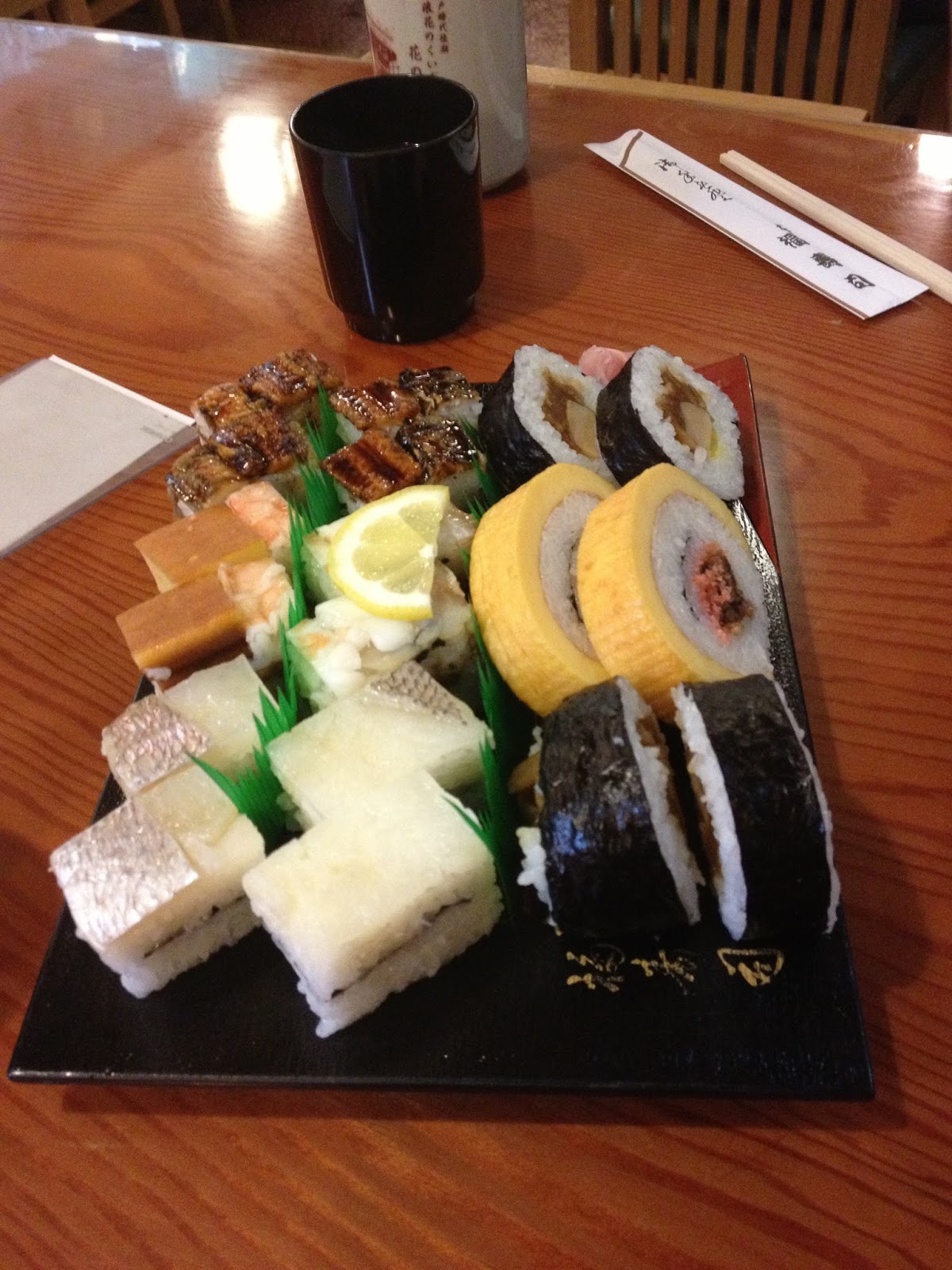
Yes, despite its beauty.  Every dish is beautiful in Japan.
The slices of fish were paper-thin and were overwhelmed by the dry, starchy rice.  The eggs were sickeningly sweet and there was that pink-sugar floss in half the rolls.

At another place in Namba, my chirashi bowl consisted mainly of fish that was so tough to chew that it felt like sinew had taken over my jaw and the spaces in between my teeth.

Admittedly, though, the salmon was fantastic.
The moral of the story, or at least the story I'm telling based on my own limited experience (and very shady expertise that has been thrown into question by my enjoyment of American convenience store sushi) is:

Go big - to the famous players that hold clout in the Tsujiki market, to places that emphasize freshness above all else, to places that have a great local reputation - or else just walk down the street to the supermarket!

Wednesday, September 4, 2013

Sushi Dai, supermarket sushi, and the sushi in between: Part I

I love sushi.  I always have.

But it's not an easy thing to write about.

Most of its wonder comes from its simplicity; the closer you get to the living, breathing source, the better it is.

And the parts that aren't simple, the years and years of training, the ratio of fish to rice, the stickiness, warmth, and shape of the rice, the way the flesh is cut from the fish and carefully sliced, all take inside training to spot.  Either that or the budget to sample enough high-end sushi over enough years to be able to become a discerning gourmand.

I'm not an insider or a discerning gourmand, but I have been eating sushi since I was two years old.  Until I went to college, I hadn't so much as heard of spider rolls, caterpillar rolls, or the concept of putting mayo or sriracha on sushi.  My family went regularly to one sushi bar, where the owner, Kuni, plied us with extremely fresh versions of the familiar choices: maguro (tuna), toro (fatty tuna), shake (salmon), hamachi (yellowtail), tako (octopus), anago (sea eel), and the like, occasionally surprising us with fresh daily specials like white toro, hokkigai (surf clam), or aji (horse mackerel).

His fish was always excellent and he treated us like family.  He always cut my sashimi into little pieces because I was a little kid - and never stopped, even when I reached well into my twenties.  His restaurant had training chopsticks, held together with a rubber band.  I went there every year on my birthday.

Kuni's sushi was my whole world until I went to college, and it could have been my whole life.  I wouldn't have complained.

But the U.S.' palate was changing, and the same kids who cringed when I told them what I had for my 3rd grade birthday dinner were now hanging out at fusion sushi restaurants to spear themselves some dragon rolls or tempura bananas and drink sake out of wooden boxes while watching the chefs do karaoke behind the bar.  People who had already been enjoying simple sushi started to demand more variety and authenticity (whether those goals were compatible or not is an exploration for another entry).  Restaurants started springing up that served barracuda, Spanish mackerel, halibut, and sea bream.  Chefs started getting certified to prepare the deadly blowfish, fugu, without killing their patrons.

I was 1000 miles away from Kuni in college, and 2000 miles away afterwards, and so I started branching out.  I learned to respect the good fusion rolls (white tuna, avocado, and apples; mandarin oranges, salmon, and chives; and the good old Philly roll were the best flavor combinations I found) and disdain the bad ones (overuse of mayo and reliance on imitation crab meat were the most common offenders).  I tasted the aforementioned barracuda and sea bream at a place where novelty seemed to be the only consideration, and tasted them again at a few places which knew best how to season them to bring out their flavors.  They used ponzu and sea salt and tiny curled shisito peppers and green onions and blowtorches and strictly prohibited me from touching the soy and wasabi.  There was a world of difference.

An izakaya taught me to love the deep magenta skin at the edge of hamachi flesh, while a sushi maker in the back of a grocery store introduced me to battera, a pungent pickled blast of saba and kelp molded onto a square of rice.

So.

Last month, I went to Japan.

When a sushi lover goes to Japan, a sushi lover goes to Tsukiji Fish Market.  A sushi lover finds the restaurant with the longest line and joins it unhesitatingly, ready to sacrifice a half day standing in the rain.

In my case that restaurant was Sushi Dai.  Its line wound in a coiled snake shape in front of the restaurant, allowing the soaking wet queuers to press their noses against the glass and stare hungrily at the people inside.  The overflow from the snake coil was shifted across the street and around a corner, so it looked like there were just a bunch of people with umbrellas forming a queue to nowhere.


We waited.  One of us ran off to get some tamago.  We waited.  A guy ahead of us bailed in disgust after two hours (and he was so close!).  We waited.  No-nonsense workers barreled by with trucks full of crates full of boxes full of fish.

We waited.  We finally got in.  It was 1PM.

One of the chefs greeted the grinning crowd piling in with the loudest "IRASSHAIMASE!!!" and widest, toothiest grin I'd ever heard or seen before, which shocked everyone out of their queuing reverie and into the mood for sushi.

The pieces came out straight onto the bare, pristine, wooden counter.  I ate them with my hands, even though most used chopsticks.  It's strange to say, but I wanted to feel the fish as well.

I present the photos in the order that they came.  (All photo credit goes to the wonderful Eugene, who brought a fancy camera and consented to do the photo gruntwork as I flitted around excitedly from fish to fish like a sushi hummingbird.)

Toro
What Tsukiji is known for is its frenetic tuna auctions that take place at daybreak.  This tasted like the result of some seriously aggressive bartering.  I mean that in a good way.  I don't how else to adequately say that this was far and away the creamiest, fattiest, butteriest toro of my life, and I expect that it will never be topped.  This sounds depressing.  It isn't.  I'm just grateful to have gotten the chance to taste it once.

Hirame
Hirame, or fluke, is a fish I was taught to ignore my my whitefish-disdaining parents.  They did me a disservice if all of it tastes like this.  I doubt it does, since everywhere else isn't Tsukiji.  Snappy and sweet, it broke into thin squares in my mouth.

Kinmedai
I had never tasted this before.  The generous portion, trailing endlessly over the pat of rice, even over the edge of the counter, had a flavor like both hamachi and toro but also wholly unlike either.

Uni
I have eaten live uni from the shell in Redondo Beach, CA.  I've eaten it marinated in salad.  I've eaten it mixed into pasta as a buttery sauce.  I've eaten it countless times plain, straight from the sushi section at various Asian markets.  This, like the toro, was the best of its kind.  Pinker and browner than the bright orange I'm used to, I was wary at first.  It turned out to be the marinade.  How can marinade make something taste more unadulterated than it would have had it actually been unadulterated?

Live clam
This clam was still waving its 'limbs' as it was set in front of me.  Convincing myself it was just nerve twitchings and not death throes of agony, I placed it in my mouth and let it wiggle between my teeth.  While wriggly and new, I still prefer my clams wok-fried and served with peanuts and onions, Vietnamese style.  They don't have enough flavor, even alive, to make their chewing gum texture worth it.

Aji
Normally a hit-or-miss fish, this undeniable hit of a split slice poured citrus and ocean notes under my tongue like a waterfall as I chewed it.

Akami
Akami, the lean back of a tuna, looks like maguro, and I normally don't like maguro.  I don't know why this was so different.  Lean tuna's usually such a mealy, vaguely fish-counter flavored bland experience that I wonder how this silky, scentless wonder managed to overcome it.

Spanish Mackerel
 A rare find at sushi bars in the U.S., this seared, flaky, tender and strong tidbit made my top three along with the uni and toro.  Mackerel is unabashedly bold, and this piece combined it with a smoky aftertaste.

Anago
Perhaps sadly, perhaps not, this anago did not impress me.  The bones stuck me in the gums and the whole mouthful tasted vaguely like sardines. I found myself thinking of Kuni's sweet, slightly crispy, expertly rolled and patted anago and cucumber handrolls that he always stood ready to make for my mom, as they were her favorite.

I wish I could tell Kuni that even sitting at the epicenter of fresh fish, at a restaurant that had access and choices he could only dream of, and after a meal that easily ranked in the top three of my life, the memory of his handrolls in Chicago still had the power to make me wistful.

----

Next up, the other side of sushi: sushi from a Japanese supermarket!

Monday, September 2, 2013

Quận Bình Dân, Part 2

...continued from Part 1.

One of the best things about Bình Dân district was how friendly, open, patient, and just plain kind everyone was.  There was a fairly significant language barrier even after my four month crash course in Vietnamese, as the audiobooks I used featured a Hanoi accent, and everyone in HCMC (obviously) has a southern accent.  I could talk to people, but as soon as they delightedly exclaimed that I knew Vietnamese and started chattering back to me, it became clear that I couldn't understand a word out of their mouths.

This didn't deter the people in the neighborhood.  Every morning and evening when we came walking down our small side street, everyone waved and said hello.  And the day we left, unsteadily toting our suitcases down the uneven gravel, people spilled out their doors to say goodbye.

A group of ladies a few storefronts down from us had a sinh tố (fruit smoothie) operation running early morning to late evening, and they always stopped what they were doing (gnawing corn on the cob and gossiping, usually) to fix us strawberry, durian, avocado, mango, sapoche, or passionfruit drinks for $0.60.

Another thing that would happen regularly is that a random English-speaker would show up at the most opportune times and lend their services.

In the local market, chợ An Lạc, I wanted to buy some candied ginger, but didn't know how to convey the concept of 'half-a-kilo'.  No worries, a college student showed up behind me from out of nowhere and negotiated the transaction!

Down the street by the park badminton courts, I wanted to buy a cheese bánh mì to fortify myself for a bracing game of hot and humid badminton.  But I had forgotten how to say 'cheese' (it's not a common ingredient in Vietnamese cooking).  Not a problem!  A worker selling New Year mooncakes came running across the street to translate.

At a restaurant advertising cơm gà Hải Nam in giant yellow letters, the English menu had 50 items, none of which were Hainan chicken.  A waiter rushed over to point out that this was actually a category of dishes, and that I could choose from duck, pork, chicken, intestines, or any combination thereof and order it Hainan style.  Then he apologized for his poor English.  I couldn't tell him he was being ridiculous because my mouth was full of melting pork fat and wonderful ginger sauce.

(Bottom dish) $2.75
There was only one exception to the 'exceptionally friendly' rule.

In a surprisingly spacious area for a place that served only one dish, bánh xeo, I sat down one table away from a group of boisterous men who were getting unabashedly sloshed at 4:30 in the afternoon.  Accustomed to respectful curiosity from everyone that I'd met, I remained open to the possibility of civil conversation when one approached me.

This was not to be the case.  He sat with his face three inches from mine as he slurred Vietnamese questions at me.  When I didn't understand them (I could understand most questions spoken at a clear, slow pace, but Drunken Slurring is not a dialect my course had covered) he would smack my arm or leg with his hand and repeat them in exactly the same way, but louder and more spitty.  The owner of the restaurant looked on with detached amusement as his friends roared with laughter and pointed fingers.

I put up with this for exactly three minutes before I grabbed my food and took it to a faraway table. 

Since I ate at lightning speed to escape this situation, and I didn't take photos lest Drunken Man grab my phone and use it to slap my arm, I have little to say about the food other than that it sustained me long enough to walk to the bò lá lốt I wrote about in my last entry.  It only cost $1, though.

Friday, August 30, 2013

Quận Bình Dân, Part 1

I spent my first 12 days in Hồ Chí Minh City in one of the the outer districts: a far cry from downtown and the backpacker areas.  Bình Dân has the highest population of any district (as well as the highest migrant population) but aside from a few nods to its west bus station, it's not mentioned in any tourist guidebooks.  It's skirted over even on websites dedicated to mentioning things about HCMC districts, meriting two entire sentences.

I wasn't so naive as to expect quaint, undiscovered gems to burst from every picturesque corner, or to return singing the praises of the 'real, unspoiled' HCMC.

What I expected was open friendliness mixed with curiosity, neighborliness, and merely decent but extremely cheap grub, and for the most part, this is exactly what I got.

(Links on dish names below lead to an approximate Google map location of where I ate them.)

The first day, snakehead fish porridge (cháo cá lóc) eased me gently into what I remembered best about Vietnam: its ability to stuff more flavor into things than has any right to be there.  The porridge's deceptively oatmeal-like exterior yielded to waves of pepper and caramelized onion as well as seemingly more fish than could physically fit in such a tiny bowl.  In case my tastebuds were bored, sliced limes, three kinds of chili sauce, salt, sweet soy, and hoisin were of course provided.

$1.25
That night, after watching groups of shirtless, sweating men play đá cầu in the park, I approached a man with a cart whose tiny sign said "Bún riêu cua, 12000".  What he brought out about 8 seconds after I ordered it had marinated tofu, fish cakes, a glistening blood cube, plenty of crab cake shreds, a plump tomato, and a biting tomato-seafood flavor, almost like cioppino.


$0.60
Good broken rice (cơm tấm) is a tough find in Vietnam, because the name is applied to every stale-riced, soggy-porked buffet languishing on the street.  My rule is if there is no one cooking any meat at the stall, I don't stop.  This particular stand had no less than twenty grilling porkchops on a knee-high grill by the gutter, plus a bonus line full of old ladies.  Old ladies know exactly what they are doing, so I joined it.

One old lady's grandson graciously helped me order, and I joined the throngs pressed knee to knee at the metal tables behind the cart.  The egg cake relied heavily on noodles and mushrooms rather than Little Saigon's pervasive pork, while the bi was as powdery, savory, and wriggly as I could have hoped.  The fat, candy-red lạp xưởng sausage tasted like strawberry sugared meat candy, which I wasn't feeling, but the highlight was absolutely the fresh-grilled pork chop, whose salty crust broke to veritably ooze meat juice wherever it was bitten.


$2.00
Last year's HCMC highlight was snails.  I hadn't realized, though, that snail/seafood restaurants popped into existence every night on nearly every corner of the city, downtown or not.  Addresses which at lunchtime were barred, deserted, and dusty transformed upon the setting of the sun into sprawling lots of tables and fish-tanks.

The first snail place I saw in my neighborhood was modest: just a woman throwing molluscs in a wok and a little table set up with about a platter's worth of each species. I stopped to check it out; an eager old man hobbled up and took my arm. "Ốc Hương," he barked, waiting for me to repeat after him. When I did, he moved my hand, and his, to the next bowl. "Sò Điệp," he asserted. "Nghêu. Chem chép. Ốc mỡ."  And so on.

When he had named all the varieties, he seemed satisfied that I was now well-schooled in the art of shellfish.  He shook my hand, said 'Bye!' and was gone, which surprised me, because I had thought that he worked there!

Feeling nostalgic for last year, I got the blood cockles, which she threw in the wok almost as soon as I uttered their name.  They came to the table coated in rau răm leaves, which stuck to the firmly closed shells.  Blood cockles are one of the only varieties of shellfish that don't open when cooked.  You need some serious fingernails to dig their stubborn shells open.  Here, their color wasn't so shockingly red and the texture was slightly more raw oyster than clam.  I also had to discreetly drop a few bad ones on the floor.  Overall, though, it was a happy reunion.

$2.50
My second snail restaurant was fancier, a lot covered in corrugated iron.  It had chairs with actual backs.  A skinny cat sharpened its claws on a stack of Heineken boxes and the waitresses giggled at my side, occasionally saying things like "Rice!" or "Chicken!" when I got to the relevant page of the menu.  No thanks, ladies - I am here for snails.  Bring me a big plate of ốc mỡ with garlic and onions!

And they did, but they also brought out a plate of seafood fried rice that I definitely did not order.  No matter.  The snails were mealy at certain ends and rubbery at others, but I swear you can put that lime-salt-pepper mixture on anything and cover it with garlic, cilantro, and rau răm and it'll be delicious.  Also, a platter of trứng cút lộn?  There's no better feeling than having waitresses watch you expectantly, waiting for you to gag on an unexpected baby duck beak, and instead ending up watching you pop three in a row.

$3.50 for the snails alone, $6 for the lot
To be continued...

Tuesday, August 27, 2013

Saigon's first surprises: Lảu đầu cá hồi and bò lá lốt

Even before I started studying Vietnamese seriously (even before I could say any more than 'hello' and 'thank you'!) I could read Vietnamese menus.  I had no alternative if I wanted to travel deep into Saigon - or even many of the U.S.'s Little Saigons.  

Vietnamese restaurants don't make splashy plastic molds of their dishes and stack them in display cases outside, like they do in Korea or Japan.  They also don't generally like to translate their menu items like they do (with often hilarious results) in China (cephalomappa belly burst, anyone?).

So I learned to distinguish my gà from my cá, my rau from my trái , my bún from my mì, and more.  I recognized the shape of the words even when I couldn't get my mouth around them, and used my pointing finger to the best of its ability.

I've been doing that for over two years.

Imagine my surprise, then, yesterday, when I came up short against a restaurant whose menu was like French to me.

I rocked on my heels outside, squinting at the board that listed its specials.  Nothing was familiar.  Diacriticals danced around collections of vowels.  Patrons clustered around steaming hotpots glanced curiously at me, while waiters enthusiastically motioned me to come inside and have a seat, but I balked.

As my blog indicates, I eat everything.  But I don't generally make complete shots in the dark.  Doing so has historically resulted in (for example):

- globs of fish paste and lettuce
- a pile of raw beef
- noodles with a pat of butter-cheese on the side

So my translation app and I suffered through some permutations of definitely-not-at-all-what-they-meant (metal oil slab chicken, crib wheel noodles, property of horn fish) before I finally remembered that I knew how to say 'head', and ordered something with the word 'fish head' in it:

Lảu đầu cá hồi.

It came out a deceptively small bowl of mostly green, the okra and bamboo hiding in a forest of morning glory.

But underneath, in the depths?


Salmon head galore!

The broth was almost tom yum, with a decidedly sour undertone to its sweet-and-citrus light broth.  The okra had nearly all its slime coaxed out, and its seeds wafted under the cheekbones of the salmon, whose flesh wedges dislodged with one mere poke of a chopstick.

Healthy hotpot for one!

---

That night, I set off in search of a dish recommended my by a Vietnamese penpal (Hi, Thủy!): bò lá lốt (beef grilled in betel leaves).  My frankly pathological geographical memory served me well in this search: I'd briefly glanced at a stall selling this three days before while taking a random walk, and for some reason remembered the exact intersection I'd seen it at.

The stand was nothing more than a 3X1 foot counter with a hot grill wobbling alongside.  But the smell... it filled the block.  Duck porridge, broken rice, and phở stands had their scents summarily overwhelmed by the aroma of fatty beef melting and sizzling inside their leaf wrappers.

I ordered one order, thinking I would get a five-leaf skewer of wraps, but what was carried to my table was this:

Just out of frame on the right is a MASSIVE plate of herbs - almost bigger than all the rest of it put together
 Ten crackling sausages of beef.  Ten cigarette-shaped green-black betel leaves filled with beef.  Sweet soy with chilies.  Crab paste softened with peanut sauce.  A bowl of noodles tossed with chunks of pork skin and fat.  And of course, enough herbs, lettuce, sour starfruit, and cucumbers to feed a whole army of discerning rabbits.

As helpful onlookers crowded around, trying to make Julian the vegetarian understand that he needed to dip his beef into his crab paste, rather than pick fastidiously at the bowl of noodles, trying to rustle them free of the pork pieces, I grabbed my rice wrappers and dug in.

Vietnam loves its leaves.  It occurred to me as I was masticating like a gorilla lounging around beneath banana trees that I was essentially eating beef wrapped in a leaf (betel), covered in three more leaves (basil, mint, and saw-leaf), all placed in another leaf (lettuce), and stuffed in rice paper.

I guess that's how I always manage to feel so healthy and vibrant after eating platefuls of the fattiest, oiliest, most flavorful meat while squatting precariously on plastic stools!

Monday, August 26, 2013

Shanghai pooh-poohs my well-laid plans

I approached my Shanghai meal itinerary with all the precision of a Swiss watch-maker.  Shanghai's a huge city, I reasoned, and I couldn't just go wandering off into a random corner of the city and expect it to impress me (as my usual strategy goes).  I only had four days, and only the best would do!

I scoured food blogs and newspaper features, noting the dishes and restaurants that made me drool.  I wrote down their addresses and their hours.  I drew circles around sections of my printed out subway map and plotted out walking directions.  I showed the characters for each dish to my Mandarin speaking partner and had him confirm he could pronounce each one.

Visions of myself flitting freely from place to place, one hand filled with hairy crab dumplings, the other filled with pork mooncakes, with a baggie of tofu soup swinging from my arm and the city's best egg custard in my mouth filled my brain as I had the breath squished out of me on the subway.

China had other plans.

I skipped up to the hairy crab dumpling place, whose sign faithfully listed the characters I'd written down.  There was even a picture of the dumplings - orange roe brightly decorating the swirled noodly baskets.  But no: "We don't have any," barked the man behind the counter.

You don't have any of your flagship dish?  Well, OK.  No need to apologize or explain why, I guess!

Only slightly daunted, we set off for the egg custard place.  Yum yum, giant Portuguese style egg tarts, the likes of which Shanghainese bloggers can't stop raving about!  Brilliant yellow-orange custard with spots of brown where the sugar has caramelized!

Except the address was a clothes store.

Moving slightly more warily now, we approached the pork mooncake window, which wasn't too far.  In fact, we could see the line spiraling out into the street from a few blocks away.  Happy customers darted off holding baggies full of steaming, fresh pork mooncakes as the people who'd been in line right behind them...

...just kidding, there aren't any lines in China.  But the people who'd been elbowing and squirming and shouting and pressing their way up to the window managed to laboriously obtain their own baggies of gold.

I joined the thrum.  My height gave me an advantage; I watched the buns, hot and fresh on a silver try, get stuffed into bags and handed off.  I threw elbows with the best of them.  I slowly inched closer to the front.  And when I got there...

They had just sold the last bun of the day.  "No, no, no more," the lady behind the counter said brusquely, waving both her hands in front of her face like she was shooing away flies.  "Tomorrow," she added when pressed, like this was a viable solution, like we hadn't taken three subway lines and a two hour meandering walk to get there already.

It was a long, long way to the place that was meant to sell tofu flower soup, and it was something of a torturous walk.  Not having eaten anything all day, we were slogging along at a glacial pace - even more glacial than everyone else's normal 100 degree walking speed.  (I stubbornly insisted on eating only what was on my list, which turned out to be very stupid.)  

The tofu flower place, however, existed!  And it was open!  And it had tofu flower soup on the menu!  Finally - delicate dried shrimp sprinkled over curls of curdled soy, pickled radishes forming the flowers on the top!

Nope.  A nightmare of glass noodles, MSG, and sweet soy.

It's a good thing I learned these paired lessons on only my second day in China:

Never expect to find what you're looking for.  If you see something good in front of your face, seize it.

Friday, August 23, 2013

Assault by pepper: My first day on the Chinese-Burmese border

Rarely do I manage to escape a cluster of street stalls without fistfuls of mystery to-go bags, but Ruili’s local farmers’ market so overwhelmed me that I managed it.

People fanned spits of rotating ducks and chickens, the air heavy with dry spiced smoke. The woman at the first duck stall waved her cleaver menacingly as she told us how she’d cut and price the duck, but she good-naturedly offered me one of a bucket of tiny chili-soaked crabs as a taste when I expressed interest. The crab was a thumb-sized bomb of pure red spice, its meager flesh holding the oil of so many peppers that my nose, shocked, immediately started running so aggressively I had to use up my entire day’s supply of toilet paper.
Women sat surrounded by bowls of green salad-looking dishes, and after much deliberation, I chose two to sample as I wandered. Despite the vendor’s assurances that these were dishes and not spices, even though they came in plastic bags with no chopsticks, the first was a dense mass of cilantro and pepper seeds that would have been fiery even as a teaspoon in a pot of something much bigger, and the second was not much milder. Wishing I could magic the bags home to my mom, who would quickly figure out how to blend them into something, we kept walking. A beggar asked for my dishes/spices, and I gladly acquiesced, hoping he knew what he was getting into, and it started raining.

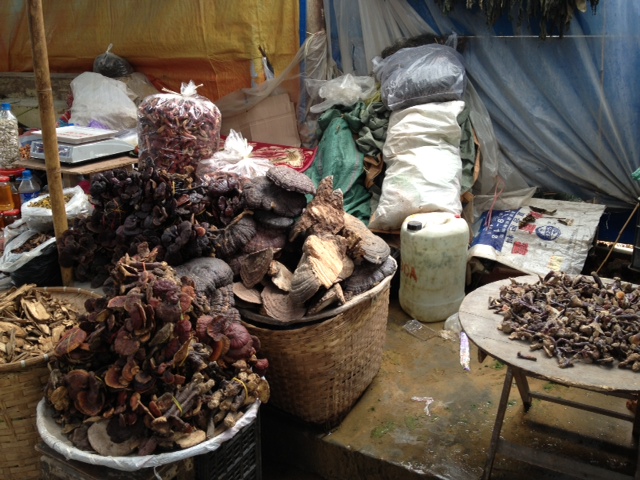
The covered section of the market was a muddy, sloshing gymnasium-sized gathering of butchers, vegetable vendors, breakfast stalls, and oddities (the most notable of which was a large, uneven-looking rock that its vendor explained was actually an anthill. One apparently hacks off a piece of anthill, boils it, and eats it. Next door to the anthills were mushrooms so large they appeared to have morphed into wooden tree trunks.


Indoor market
Tree trunk mushrooms
Unfortunately lacking in places or pots in which to boil an oversized anthill for lunch, we left the market (via boards laid across the flooding ground) and found a place that advertised Thai-style chicken on its sign, but actually drew us in with bowlfuls of fresh fruit on the counter, plus an extensive fruit juice menu. Buoyed by the sudden realization of my proximity to Burma - less than 6km away - I ordered tea leaf salad. It came out thick and a pastelike dark green, its leaves weighed down as though painted onto the plate. The dish was dotted with bright red circles of pepper, though the owner claimed they were merely decorative and the spice came from the green. Based on the care which I had to take to keep my lips from catching fire and falling to the ground, the green paste was likely distilled from ghost peppers. The only thing that saved me was the tall glass of passion fruit juice, which I saved from the inevitable Chinese Sugar Spoon of Overkill by claiming I wanted it ‘sour’.

Tea leaf salad in front, vegetarian rice embarrassment in back, smoothies standing guard.
I would not be granted a respite from spiciness for dinner.
Dai Dai Xiao Diao, a lushly decorated Dai minority restaurant next to a blind massage parlor (where I received my first gua sha of the trip), advertised Lao-style roast fish and though I knew what that would entail - dry red spice rubbed on the outside, gut cavity stuffed with wet green spice - I went for it.

As though the dry and wet spice weren’t enough, the fish came (along with lettuce leaves, fried garlic and mung beans, a mystery fish-mint cousin, and cilantro) with a mildly foamy orange sauce for dipping, a mere drop of which sent my nose into evacuation mode yet again.


Spying on my distress from a corner, our waiter very kindly dropped off a different dipping sauce which he claimed was not spicy. Though totally untrue objectively, when compared with the habanero lava lake, it indeed gave mostly the impression of lemongrass and garlic.

(I should reiterate here that I am the person who regularly gets into near-altercations with Thai and Chinese restaurants in the U.S. who are reluctant to make my food spicy enough.)

However, with the lemongrass dipping sauce, the fish made an extremely satisfying dinner. Dragon-backed and with almost no bones to speak of except for a robust rib cage, its flesh was easy to dig out, place in the lettuce leaf, and sprinkle with trimmings. The flesh alone was white and mild, but smeared in dry spice, soaked in wet spice, wrapped in leaves, and sprinkled with beans and garlic, it came alive in the kind of way that only really overwhelmingly flavorful meals can.

When what should by all rights be way too many axe-wielding ingredients somehow settles down, smooths out, and hits your throat as a unified whole, you know the chef really knows his stuff.